Showing posts with label classic. Show all posts

Friday, December 24, 2010

Nicholas Ray Triple Feature: Bigger than Life (1956) / Johnny Guitar (1954) / Wind Across the Everglades (1958)

Nicholas Ray never won an Oscar or a lifetime achievement award, worked in Hollywood for little more than a decade, and directed only a few canonized classics. His most famous film, Rebel Without A Cause, is remembered for James Dean's iconic performance rather than Ray's direction. Surprising, then, that this was the man whose career launched the auteur theory. François Truffaut, Claude Chabrol, and Jean-Luc Godard sang his praises in the pages of Cahiers du Cinéma, seeing in his work the possibilities of a newly personal cinema, in which the director was the true author of the movie. When these same critics became filmmakers themselves, and the leaders of the French New Wave, they continually cited Ray as a formative influence. Godard even dedicated his film Made in U.S.A. to Ray, and once declared, in typically hyperbolic fashion, "The cinema is Nicholas Ray!" All this while Ray was ignored in his native land.

What, exactly, makes Nicholas Ray an "auteur?" Upon first glance, he might seem merely a workmanlike, efficient Hollywood director. Unlike his French admirers, Ray was never really an independent filmmaker, rather working under the confines of the studio system. Neither did he specialize in a particular genre, but rather dabbled in film noir, Westerns, Biblical epics, socially conscious dramas, adventure films, and more. But Ray's triumph was to make deeply personal films with popular appeal. Each of his films, no matter the genre, is graced with the same qualities: a dynamic and expressionistic visual style, and a thematic concern for the lonely and isolated. Ray's films also address societal issues like suburbanization, the Communist witch hunts, and environmentalism - themes that were overlooked at the time but which only make his movies more fascinating as time goes by.

Bigger than Life (1956) is perhaps Ray's masterpiece. The story could almost be an after school special: a suburban father begins taking an experimental drug, which dramatically transforms his personality and nearly destroys his family. In the end, though, he recovers, repents, and the happy family is reconciled. Under another director, Bigger than Life could have been an insufferable message movie. Instead, though, Ray uses this plot to launch a freewheeling critique of American society in the 50s. We begin to understand that Ed Avery, the main character played by James Mason, is not fundamentally changed by the drug - it merely unleashes his suppressed feelings about his life, his family, and his culture. The failings of American education, the obsession of consumerism, the banality of suburban life, the superficial distinctions of class, the realities of a loveless marriage - all are targeted in Bigger than Life.

Part of what makes Ray a great director is his ability to dramatize his themes visually, and Bigger than Life is perhaps the best example. The film is shot in the aspect ratio of 2.55:1, an extremely wide format that allows Ray to fill the frame with revealing details. Consider the way Ray films Avery's house. The house is a typical specimen of suburbia, and would not be out of place in Leave it to Beaver or Father Knows Best. As the film progresses, though, the house becomes a visual representation of Avery's character, an extension of his psyche. The walls of the house are plastered with posters of European cities that Avery will never visit. A deflated football on the mantelpiece is a sad reminder of his fading college football days. The spacious interiors and separation of rooms suggest the estrangement that Avery feels from his family.

Ray, who made some of the great film noirs, is certainly no stranger to shadows. In Bigger than Life, they are everywhere. Initially, most of the interiors are shot with muted colors and low light, but Ray ups the contrast later in the film, setting bright colors against dark shadows. Consider the shot below, in which Avery looms over his son, pressuring him to finish a math problem. So many themes of the movie are present in that one shot: the impossible expectations Avery sets for his son, the God complex that the use of cortisone has given him, the ugly demons that overtake his personality. And perhaps above all, Richie, the son, isolated in the foreground, overwhelmed and silently crying.
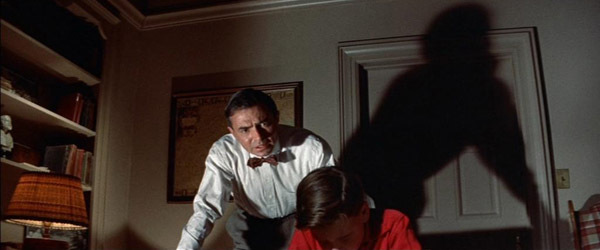
Richie, in fact, may be the key to the film. Upon a second viewing, it struck me that the viewer's sympathies - and certainly Ray's - lie almost entirely with this little boy. Richie is the wisest character in the film - the first to notice the effect of the drug on his father, the first to question his father's newfound obsession with spending money, and ultimately the one to call the doctor and make his father stop taking the pills. But Richie's mother dismisses his concerns, and his father considers him a failure. "Childhood is a congenital disease, and the purpose of education is to cure it," Avery says at one point. In the end, Avery gives up on even this cynical mantra, deciding to sacrifice his son in an imitation of Abraham slaughtering Isaac. Until a deus ex machina appears, of course, saving Richie and delivering a happy Hollywood ending.

Despite this obvious compromise, Bigger than Life remains perhaps Ray's greatest film: a social satire posing as a domestic melodrama that becomes something of a horror film. It is a movie of ideas, but these ideas never overtake the film's emotional center - Richie. He stands for his entire generation, I think, and he shares some affinities with the hero of Ray's previous film - James Dean's Jimmy Stark. It is easy to see how Richie, too, could become a rebel without a cause.

How to describe Johnny Guitar (1954)? François Truffaut put it this way: "It is dreamed, a fairy tale, a hallucinatory Western...Johnny Guitar is the Beauty and the Beast of Westerns, a Western dream. The cowboys vanish and die with the grace of ballerinas." That oft-quoted description comes close to capturing the film's wonderful strangeness, its bizarre remove from its own genre. Here is a Western where the gunslinger is a mopey, laid-back guitar player who hardly influences the action at all. The real drama, and indeed the final shootout, is between two women: Joan Crawford's Vienna, a saloon owner who is being run out of town, and Mercedes McCambridge's Emma, a Puritanical cattle rancher who wants her gone. The ostensible cause of the women's enmity is the love of a man, but the film is rife with barely concealed lesbian tension. "I never met a woman that was more man," a bartender says of Vienna, and Emma seems oblivious of all men in her quest to bring down Vienna.

The plot is patently ridiculous, the colors are outlandish, and the film has few of the traditional pleasures of the Western. It's easy to see, then, how Johnny Guitar has become something of a cult classic; it's also easy to see how it could be dismissed as little more than an eccentric example of genre revisionism. But the movie is better than that. Despite all of its ludicrous trappings, the true story of Johnny Guitar is a sincere, affecting one. It reiterates Ray's perpetual themes of loners and outsiders. Vienna is a woman hardened by life and unrequited love, who builds her saloon as a kind of haven. Johnny is a wanderer who returns to his ex-lover, Vienna, for a few days of happiness before Emma's posse descends on the saloon and ruins their paradise.

Johnny Guitar is also an unapologetic commentary on McCarthyism and the Hollywood blacklist. About halfway through the film, Sheriff McIvers (Ward Bond) is desperate to frame someone for the robbery of a stagecoach, and his gang try to make townspeople testify against each other - a clear parallel to the House Un-American Activities Committee and their attempts to root out suspected Communists. The issue would certainly have had personal significance to Ray. His political views leaned towards the left, and many of his closest collaborators - among them Johnny Guitar's screenwriter Ben Maddow, and Humphrey Bogart - had been targeted by HUAC. Ray dresses the sheriff's gang in matching black, and arranges them in diagonal formations that suggest their gang mentality.

What emerges from Johnny Guitar most clearly, though, apart from these political overtones, is a sense of doomed romanticism. Ray's vivid use of color and space, the melancholic score, and the script's surprisingly moving romantic exchanges do indeed create a dreamlike quality, as suggested by Truffaut. This is not a hard-hitting Western, but a sensitive, passionate one, in which the characters all seem to be wounded and yearning for love.

Wind Across the Everglades (1958) is obscure even by Ray's standards. It was never released on VHS, let alone DVD, and its two main stars were hardly A-listers: Burl Ives and Christopher Plummer. What's more, it has to be asked if it is a Nicholas Ray film at all. The movie was the brainchild of screenwriter Budd Schulberg, and was produced by his brother Stuart; when they were unhappy with Ray's style, they fired him and Budd directed the rest of the film. The critic Jonathan Rosenbaum has described it as "a kind of litmus test for auteurists," and from that perspective it is a fascinating case study.

Unfortunately, and perhaps inevitably, the movie itself is somewhat choppy. Schulberg so resented Ray that he threw away much of his footage, and the narrative is not easy to follow. The story is set in early 19th century Florida, and concerns a game warden (Christopher Plummer) who comes to enforce conservation laws and goes up against a violent bird poacher (Burl Ives). There is also a romantic subplot that goes nowhere.

Wind Across the Everglades
plays like a rough draft of a film that, if polished, could have become something much greater. Nonetheless, the movie is not without interest. For a 1958 film, it is curiously modern in its depiction of the environment. The opening scene depicts, in a documentarylike fashion, how the whims of women's fashion nearly decimated the population of birds in Florida. The main character, moreover, is a strident conservationist who pits himself against a ruthless hunter. The relationship between these two men is the core of the film. Both men are, in their own way, outcasts from society. Despite their professional differences, the two men unite over a drinking game, in an extended scene that seems spontaneous and improvised. Alas, such improvisational techniques are what got Ray fired from the film.

Wind Across the Everglades is less than the sum of its parts, but in some scenes Ray's brilliance is clearly evident. Ray's visual gifts are on full display, though this time he largely trains his camera on beautiful wildife exteriors, as opposed to the interiors of Bigger than Life and Johnny Guitar. A subplot involving a Native American is a classic example of Ray's outsider theme, and the performances he coaxes from the actors are uniformly strong. One only wishes that Ray had been allowed to see his vision through from beginning to end.

What makes a great director? For the famous critic Andrew Sarris, it was the presence of a theme. For Orson Welles and the New Wave critics, it was the extent to which the work represented the man who made it. Others might point to style, or influence. Whatever the criteria, Nicholas Ray seems to have it all.

Apologies for the delay with this post! When I saw these films in July at the Harvard Film Archive, I never expected that it would take 5 months to write the blog post on them. Hopefully, with my college apps almost done, I will have more time for blogging in the future.

Saturday, July 31, 2010

Sunrise (1927)

Quick trivia question: what was the first Academy Award winner for Best Picture? The official answer is 1927's Wings, directed by William A. Wellman. But in fact, there were two winners that year: Wings won for "Best Production" but F.W. Murnau's Sunrise won for "Unique and Artistic Production." Over time, the dichotomy between those two films has grown even sharper: Wings, a romantic, expensive World War I spectacle, has all but receded from memory - or to be more accurate, is more remembered in name than for its artistic merits. Sunrise, on the other hand, was largely ignored by audiences upon its initial release, but has since become a film school staple and is widely regarded as one of the greatest films ever made. Indeed, the greatness of Sunrise lies not only in its importance to film history - for combining the sensibilities of German and American filmmaking, and for its array of innovative visual and aural effects - but also in its sheer beauty. This is not a stuffy old silent film, but one of the most ravishing and lyrical films I know.

To summarize Sunrise is to trivialize it. The film involves three main characters: The Man (George O'Brien), The Wife (Janet Gaynor), and The Woman from the City (Margaret Livingston). The Man is a farmer who begins an affair with The Woman, who then convinces him to drown his wife. The Man brings his wife out on a boat to do the deed, but cannot go through with it. The rest of the film concerns The Man's attempt to repair and renew his relationship with The Wife.

Right down to the lack of character names, Sunrise has the potential for a simplistic, treacly allegory. That it is something more is above all a tribute to F.W. Murnau. Murnau was one of the most significant pioneers of German Expressionism - a bold, exaggerated style that utilized high contrast cinematography, oblique angles, and shadows to great effect. It was a style most famously used in horror (Nosferatu, The Cabinet of Dr. Caligari) and sci-fi (Metropolis); it also provided part of the inspiration for American film noir. Sunrise does not sound like it would need this kind of treatment. But Murnau uses it to explore the dark side of its protagonist's heart.
Murnau's visual style in the opening and closing scenes - looming shadows, canted angles, and dimly lit shots - reflect The Man's estrangement from his wife, and his tortured sense of guilt. At the beginning of the movie, this estrangement is out of choice; The Man chooses to abandon his wife to elope with another woman. By the end of the movie, the two have reconciled, but after a fateful storm, The Man believes he has lost his wife forever. In shots like the one below, Murnau seems to suggest that without his wife, The Man is quite literally a shadow of his former self.Murnau's visual mastery also extends to his use of superimpositions. Several times throughout the film, Murnau uses these layered images to explore the characters' dreams, hopes, feelings, fears, and nightmares. This kind of effect could be cooked up easily today, but in Murnau's time, it was a painstaking process. Whatever the limitations of the technology, though, the superimpositions still hold up today as evocative, sensuous, telling images.
I've barely scratched the surface of Murnau's innovations. I could also point to his roving camera, in an era when cameras were bulky and usually kept stationary. I could mention his use of Movietone, an early soundtrack system, to include not only a classical film score but also numerous sound effects. But the real genius of Murnau's film is how seamlessly these techniques are woven into the fabric of the story. His direction is never intrusive or distracting, and he knows when to simply pull back and observe. During the long reconciliation scene, Murnau leaves most of the heavy lifting to his wonderful, expressive actors.

I'm reluctant to call any film perfect, but Sunrise comes as close as any film I've seen. The movie was initially overshadowed by movies like Wings as well as The Jazz Singer, the first talkie, released the same year. Within a few years, silent films would be all but obsolete in Hollywood. Yet Sunrise reveals all the possibilities of that medium, and achieves a level of purity and simplicity that few films can claim. With silent films as great as this, who needs sound anyway?

Coming soon to the blog: a trio of Nicholas Ray films!

Monday, July 19, 2010

Make Way For Tomorrow (1937)

Upon first glance, Make Way For Tomorrow looks like an awfully treacly, didactic melodrama. The movie opens with a shot of the sky, a bombastic music cue, and a title card outlining the major themes of the movie - the "painful gap" between "the aged and the young." The whole thing caps off with "the ancient words of a very wise man - HONOR THY FATHER AND THY MOTHER." Thankfully, though, this well-meaning but rather overstated opening is hardly indicative of the film that follows. On the contrary - Make Way for Tomorrow is a remarkably subtle film, full of quiet observational grace. It regards its characters honestly, objectively, in all their faults and failings. And yet the movie balances this objectivity with deeply felt empathy. Though the film is 73 years old and tells a simple story of an elderly couple cast out of their home, it is universal in the way that it shows how we all live our lives.

As the film begins, the elderly Lucy (Beulah Bondi) and her husband Bark (Victor Moore) gather their children to make an announcement: they have lost their home to a bank, and need to move out in a few days. None of the children claim to have the resources to support both parents, so as a "temporary measure" Lucy stays with their son Robert (Thomas Mitchell), while Bark goes with their daughter Cora. The children assure their parents that everything will work out, but as Bark is quick to mention, "It never has worked for any one else."

The film picks up with the parallel stories of Lucy and Bark trying to cope with their new separate lives. Robert, ever the devoted son, looks kindly after his mother, but his wife Anita (Fay Bainter) and daughter Rhoda (Barbara Read) see her as little more than a nuisance. Bark, meanwhile, makes friends with a local Jewish storekeeper (Maurice Moscovitch), but otherwise feels neglected by his own family.

And so Make Way for Tomorrow proceeds - moment by moment, dealing in insightful observations rather than dramatic revelations. The story may sound slight, but the film's profundity lies in its details - in the embarrassed looks exchanged by the children in regards to their parents, in the way that Bark and Lucy withhold their emotions from their children, in the way actress Beulah Bondi delivers simple lines like "Don't worry about me" while suggesting so much more. Every scene of this film is full of such moments - details of family life that are so honest and observant that they can be painful.

The cast (largely unknown, but uniformly strong) and the writers certainly deserve praise, but at least equally important is the man behind the camera: Leo McCarey. McCarey is not remembered today; perhaps he worked in too many genres to be easily pinned down as an auteur. Moreover, McCarey follows the classical Hollywood tradition of invisible style: the camera shows only what needs to be shown, and the style never draws attention to itself. Still, this is surely one of the film's assets. Not a shot is wasted, and the whole movie unfolds with economy and precision. McCarey always knows where to place the camera. Consider an early scene, when Lucy loudly talks on the phone to Bark, interrupting the bridge game of Robert, Anita, and friends. For most of the scene, McCarey uses two camera set-ups, cutting back and forth between the two. The first shows Lucy in the foreground, with the scowling bridge players in the background. The second is a reverse-shot, isolating Lucy in the background while placing the others in the foreground.Those two shots are deceptively simple. McCarey is actually breaking one of the fundamental principles of continuity editing: the 18o degree rule. In doing so, McCarey creates a tone of awkward embarassment, revealing how oblivious Lucy is to her surroundings. But he also allows us, literally and emotionally, to see both sides of the scene. In the shot of Lucy in the foreground, we see Lucy's excited expressions, hear the happiness in her voice, and as a result empathize with her. In the second shot, we realize just how loud Lucy is, and how she is disrupting the game, and thus empathize with the bridge players. That seemingly simple camera setup is really a microcosm of what makes the film great: an ability to be objective about the story, to understand multiple sides of an issue.

As mentioned earlier, McCarey largely adheres to the invisible style of Hollywood filmmaking. But within the boundaries of that tradition, his shots are often rife with meaning. This ironic shot shows Lucy and Bark gazing at a window display with the advice, "Save While You Are Young" - exactly what they both failed to do.


That shot takes place near the end of the film, when Lucy and Bark are reunited in New York. They spend a few precious hours together - walking in parks, going to restaurants, visiting a hotel they both stayed at, talking about the past - before Bark must leave on a train for California. He is to move in with another son there; Lucy will be sent to a rest home in New York. It is in this final passage that all of the movie's themes become clear. "I figure that everyone is entitled to just so much happiness in life," Lucy tells Bark. "Some get in the beginning, and some in the middle, and others at the end. And there are those who have it spread thin all through the years." Lucy and Bark get one last day of happiness together, and then Bark leaves. In the final shot, Lucy gazes after the departing train, watches it go, and turns to leave the frame as it fades to black.

The studio tried to impose a happy ending, but McCarey refused. As it is, the ending is devastating but perfect. A happy ending would have been a betrayal of the movie's themes. It is a movie that contains great love and joyous moments, but more importantly it is about life's little disappointments, about how bad things can happen to good people for no reason. The title, I think, is ironic. This is not a cautionary tale about preparing for the future. In fact, the movie seems to say that we cannot prepare for what will happen. Tomorrow makes way for itself.

After years of being unavailable on video, Make Way for Tomorrow was released on DVD earlier this year as part of The Criterion Collection. It's certainly well worth your time to catch up with this neglected classic.

Tuesday, December 22, 2009

Nashville (1975)


A minor controversy arose in the online film scene this past October, when Richard Schickel, film historian and critic for Time magazine, launched a scathing critique of Robert Altman in the LA Times. The occasion was a new book, Robert Altman: The Oral Biography, but Schickel spent most of the article denouncing Altman's personal failings, in addition to spouting out pithy attacks on his films ("To make sure the audience never quite understood what was going on, he overlapped dialogue..."). Schickel concludes that Altman's films are hopelessly dated, and will not "survive as anything more than historical curiosities."

A film like Nashville is undoubtedly emblematic of its times - what with the long hair, the hippies, the drugs, and the music. But what Altman manages to do is create a sardonic commentary on the times posing as a celebration of them. For a director whose films supposedly resemble "someone else's not-very-interesting drug haze," as Schickel claims, Nashville is quite critical of the 70s generation, revealing the hypocrisies that lie beneath the world of politics and the entertainment industry.

In describing Nashville, I am reminded of Mark Twain's preface to The Adventures of Huckleberry Finn: "persons attempting to find a plot in it will be shot." Like many of Altman's films, Nashville is essentially a series of character sketches and vignettes loosely tied to a main idea. The film follows no fewer than 24 major characters - a motley crew of hippies, folk singers, housewives, country stars, reporters, and political campaigners - as they descend on Nashville for a benefit concert. The candidate is Hal Phillip Walker of the "Replacement Party" - never seen, though his voice can be heard delivering speeches from his seemingly omnipresent van.

Using the campaign as a springboard, Altman paints a huge, sprawling canvas of American life. Altman follows dozens of storylines and fills each of his widescreen compositions with detail. His camera is fluid, constantly shifting perspective and revealing new details, making us an active observer. Aside from its technical feats, though, Nashville has grand thematic ambitions. The film is essentially an ironic response to Watergate; Altman contrasts the patriotic American ideals celebrated in the upcoming bicentennial with their seeming irrelevance in a disillusioned America. The whole tone of the film is set by the first song, a patriotic anthem sung by country star Haven Hamilton (Henry Gibson) that includes the not-so-inspiring chorus "We must be doing something right to last 200 years."

That song is the first of many in the film; Altman has even classified Nashville as a musical. Certainly the songs are central to the film, helping to establish mood and develop character. (Almost all of the songs were written by the actors specifically for their roles). One of the most famous is Keith Carradine's "I'm Easy," sung in one of the film's greatest scenes. Carradine's character, a womanizing folk singer named Tom Frank, takes the stage at a local bar and dedicates the song to "someone special who just might be here tonight." Three women - Tom's habitual fling, Mary (Cristina Raines), Geraldine Chaplin's kooky BBC reporter, and a groupie played by Shelley Duvall - all think that the song is about them. But Tom is actually playing to Linnea Reese (Lily Tomlin), a housewife and gospel singer that caught his eye at a recording studio a few days ago. They go to bed, of course, but Linnea decides that the affair must go no further, and she returns to her family. Tom tries to incite jealousy by calling another woman, but Linnea remains strong and leaves with dignity. That scene alone, so rich with restrained emotion and subtle characterization, reveals what a terrific director of actors Altman was.

And it is moments like that which make Nashville so rewarding. For all of his cynical commentary on hypocrisy, Altman makes us genuinely care for his characters. So many of them seem adrift - the lonely old man with the dying wife; the waitress who wants to be a singer but can't sing; the country star's son, who manages his father's career but has no life of his own. In many ways, Nashville is about the ways that these characters envelop themselves in patriotic ideals, in country music - in anything - to make themselves feel better. That theme is there in the first song, and it's there in the last one. After an assassination occurs at the benefit concert, a wannabe country singer takes the stage to lead the crowd in a song called "It Don't Worry Me." "You might say that I ain't free, but it don't worry me," they all sing.

Is that song a stirring hymn of unity, or a feeble attempt to cover up a sad reality? Altman doesn't tell us what to think, and the film's ambiguity is what makes it so fascinating - and so frustrating to viewers like Schickel. Since seeing Nashville last month, I have read a number of reviews and essays concerning the film, but I am still far from penetrating its mystery. Altman once said that it depressed him when people told him they had seen one of his films, when what they meant was that they had seen it once. Coming from the man who made Nashville, you can see why.

****/****

Sunday, September 20, 2009

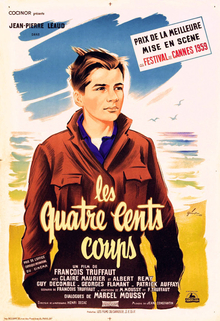
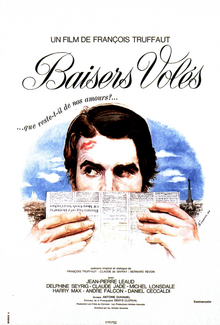
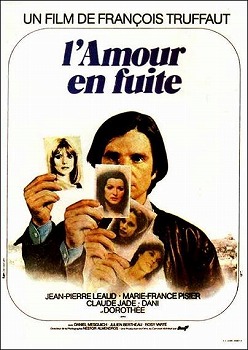
The Adventures of Antoine Doinel - The 400 Blows / Antoine and Colette / Stolen Kisses / Bed and Board / Love on the Run


In September 1958, an advertisement appeared in the French newspaper France-soir for a thirteen year-old boy to play the lead role in an upcoming feature film, The 400 Blows. The director was known in some circles for his controversial film criticism, but had never before directed a feature. The actor eventually chosen was also an amateur, and was initially deemed too old for the part. Yet these two men, Francois Truffaut and Jean-Pierre Léaud, forged a creative partnership and friendship that would last for decades. Incidentally, they also made one of the cornerstones of cinema, a film that kickstarted the French New Wave and ushered in a new era of personal filmmaking.

Looking back today, it hardly seems possible for it to have happened any other way. Rarely has there been such a perfect harmony between actor and director, with each man's personality equally informing the character of Antoine Doinel, who evolved in four sequels. The 400 Blows, rightly, is the most admired, but none of the later Doinel films is without value, and they all play off of motifs established in the first film.

In The 400 Blows, Antoine is a 13 year-old living in Paris with a stressed-out mother and distant stepfather. Neglected at home and vilified by his teacher at school, Antoine spends much of his time wandering through Paris with his friend René - going to movies, carnival rides and parks. Due to a series of poor decisions and misunderstandings at home and school, Antoine resorts to petty crime, and is sent to a seaside camp for juvenile delinquents.

Truffaut said his goal was "not to depict adolescene from the usual viewpoint of sentimental nostalgia, but....to show it as the painful experience it is." His visual style fits the mood - the films is shot in gritty black-and-white, set in cramped apartments, crowded prisons and dirty playgrounds. But the film also captures the excitement of living in the city, the simple pleasures of going to the movies and exploring the city with friends. In one sequence, Antoine goes on a centrifugal carnival ride, and ends up suspended in midair, back against the machine as it spins around. Adults watch from a distance, but Antoine can hardly make them out. It is a striking scene, and one that emphasizes Antoine's uncertain place in the world - stuck between childhood and the world of adults who don't seem to understand him.

Then there is the final scene, one of the most famous in cinema. It shows Antoine as he escapes from his juvenile holding camp. For a few minutes, Truffaut just shows us Antoine running, as he seems to do so often in the series. Then, an exhausted Antoine sees the sea for the first time, wades into the water, and turns to face the audience. The film ends with a zoomed-in freeze frame of Antoine's face. This shot, in some ways, is a miniature of the entire film - an honest, unflinching look at adolescence, freed from all sentimentality and false artifice.

Of all the sequels, Antoine and Colette looks most like The 400 Blows, but announces a departure in terms of tone and mood. This time, Antoine is not an angsty, misunderstood adolescent but a plucky 19 year-old working at a record store in Paris. Antoine is also a regular conertgoer, and it is at one such conert that he meets Colette (Marie-France Pisier), who soon becomes the object of his affections. Antoine tries to woo her, but only manages to charm her parents.

Antoine and Colette (a 30-minute short originally made for the omnibus Love at Twenty) seems downright lightweight compared to The 400 Blows. It maintains the previous film's black-and-white photography and Parisian settings, but the tone is more comic and romantic. That does not mean it is a bad film, for it is certainly an acute and bittersweet portrayal of young love. But it is an intermediary film more than anything, and perhaps too short to fully establish itself.

The romanticism of Antoine and Colette is taken even further in the next installment, Stolen Kisses. This time around, Antoine has been dishonorably discharged from the army, and finds himself on the streets of Paris looking for a job. He eventually finds one in a private detective agency. He also finds love, in the form of an older married woman (Delphine Seyrig) and a charming girl his own age, Christine (Claude Jade).

Stolen Kisses is light, funny, somewhat episodic and mostly irresistible. The success of the movie lies not so much in Truffaut's mise-en-scène but in the charms of the characters and script. It is also the film where Léaud, so arresting as the troubled boy of The 400 Blows, emerges as a full-fledged comedic actor. By this point in the series, you can see how the character evolved from a distillation of Truffaut's troubled childhood to a combination of Truffaut and Léaud's sensibilities. At its most basic level, though, Stolen Kisses is a skillful romantic comedy- whimsical, sentimental, slightly forgettable, but hard not to enjoy.

Bed and Board is my sentimental favorite of the Doinel series, though my perceptions of it are no dobut colored by the circumstances in which I first saw it. I saw both Bed and Board and Love on the Run as a double feature at the Brattle Theatre in Cambridge. As someone largely raised on VHS and DVD, seeing a real film print of a cinema classic is truly a thrill that cannot be replicated at home. In any case, though, there is something more about Bed and Board that makes it rise above the other Doinel sequels. The first half of the film is a domestic comedy that resembles Stolen Kisses in its episodic nature and comedic tone. Much of the film is set in a courtyard where Antoine works selling flowers; his wife Christine works as a violin tutor in their apartment a few floors above. Through a series of vigenttes, Truffaut establishes the supporting characters - a moocher who is constantly asking Antoine for money, a woman who is always hitting on him, a silent, shifty-eyed man deemed "The Strangler" by the apartment residents.

But about halfway into the movie, the tone changes as Antoine begins an affair with a Japanese woman. Up until this point in the series, the movies have relied on the natural likability of the main character. Now the empathy switches to Christine, and Truffaut portrays Antoine as a boy who refuses to grow up. In the centerpiece of the film, a separated Antoine and Christine have a passionate discussion which rapidly changes from a heated argument to a declaration of love. At one point, Christine lashes out against Antoine's desire to have everything his way. On the subject of Antoine's autobiographical novel, she says that "if you use art to settle accounts, it's no longer art." You can almost hear Truffaut's doubts in that statement; he seems to be questioning the artistic value of the entire series. At the very least, he seems fed up with playing the story for laughs, and Bed and Board briefly regains the melancholy tone that made The 400 Blows so powerful.

Consider the end of the scene. A cab arrives to take Christine into the city for a night of shopping. Before she leaves, she senses that Antoine is lonely and asks if he wants to go to a movie. After a few minutes of joking around, Christine gets in the cab and asks Antoine to kiss her, although they have already established that they will not be seeing each other. He does, and in typically melodramatic fashion declares, "You're my little sister, my daughter, my mother." Christine responds with an understated "I'd have liked to be your wife too."

This scene alone reveals what a terrific writer Truffaut was; it is an emotional rollercoaster ride in which the confused emotions of the main characters keep bubbling to the surface, threatening to obscure their best intentions to stay away from each other. It may be true, as it is frequently claimed, that by this point in his career Truffaut had abandoned the experimental, avant-garde nature of his early work for a more traditional style. But he never gave up the humanism that made his work so moving and so accessible to so many people. There are no flashy camera tricks or showy editing techniques in Bed and Board. It is purely minimalist, and extremely effective at that. All that needs to be said about Antoine's regret is shown in the shot where Christine's cab pulls away and Antoine walks down a lonely street into a brothel.

Bed and Board was originally intended to be the final Antoine Doinel film, and in retrospect it probably should have been. At times, Love on the Run seems like a clipshow; it features numerous flashbacks to all the previous films, which only makes it seems slight in comparison. It also seems altogether too tidy, with every aspect of Antoine's life coming together to create a happy ending. Finally, Love on the Run is a retreat from the serious reflection of Bed and Board, reverting back to the comedic situational comedy of Stolen Kisses.

The film is helped a great deal by the return of Colette's character; the actress Marie-France Pisier infuses the film with much-needed warmth. The style of the film is also noteworthy - the editing is quick and forceful, featuring swift cutaways and fast zooms. But the story is ultimately where the film falls apart. Antoine's love interest, Sabine, hardly establishes a personality of her own, and there is a genuine lack of new, interesting material.

Despite the final film's shortcomings, the Antoine Doinel series really is a remarkable piece of work. It is too easy to dismiss the sequels to The 400 Blows as sentimental fluff, but this is simply not the case. Watching the entire series, you can trace the evolution of Antoine Doinel not only in terms of plot, but in the sensibilities of his creators. You can also see the whole series as an examination of the fine line between adolescence and adulthood. Or you can simply get caught up in the story, in the acute feelings that Truffaut's films so effortlessly exude. No matter how you look at it, The Adventures of Antoine Doinel is a success.

Ratings (out of 4 stars)
The 400 Blows: ****
Antoine and Colette: ***
Stolen Kisses: ***
Bed and Board: ****
Love on the Run: **1/2

Wednesday, August 12, 2009

Network (1976)


Sidney Lumet's Network, like The Graduate, is a genre-bender of such generational importance and undeniable power that it is at first easy to overlook its flaws. Most of these trace back to Paddy Chayefsky's script, one of the most acclaimed in American film. It is an astute and prescient satire of American culture, yes, but it also has the unfortunate tendency to devolve into caricature and a lot of speechifying.

Network focuses on the fictional, lowly-rated television network UBS. When longtime, washed-up news anchor Howard Beale (Peter Finch) is fired, he announces on the air that he will kill himself. The controversy attracts much attention, so Beale is exploited and reinvented as "the mad prophet of the airwaves." Max Schumacher (William Holden), Beale's longtime friend and colleague, is fired and replaced by programmers Diana Christensen (Faye Dunaway) and Frank Hackett (Robert Duvall), who will stop at nothing to get high ratings.

What is admirable about Network is the prophetic nature of its satire. Many things about Network are unbelievable, but the trashy Howard Beale Show looks more and more familiar every year. Years ahead of his time, Chayefsky seems to have predicted today's profusion of tawdry talk shows and mindless reality TV. And yet he is not so naive as to assume that things were ever entirely different. The film's moral center is Max Schumacher, Holden's character, who fancies himself an emblem of respectable journalism. Yet even he goes along with the Beale hysteria at first, only protesting when he is fired. No one is let off the hook in Network - least of all the TV viewers themselves, who are portrayed as passive, complacent players in the whole machine. An extremely cynical view, yes, but one the film expresses quite cleverly. In the movie's most famous scene, young people from all across the country, prompted by Beale's mad ramblings, yell out the window that they're "mad as hell and not going to take it anymore," a line regurgitated by an eager audience before each taping of the show. It is a frightening scene, and one that perfectly expresses how the masses can get behind a mindless catchphrase while thinking they are saying something meaningful.*

That is a skillful device, but much of Chayefsky's script suffers from a lack of such invention. Rather, he resorts to characters dishing out carefully worded monologues. Mind you, they sound great - until you realize that no one speaks that way in person. Chayefsky's script also suffers from tonal inconsistency, bouncing somewhat incongruously from satire to farce to drama. And many of his supporting characters are goofy caricatures; actors like Peter Finch, Ned Beatty, and Robert Duvall have little to do but rant and rave. The only actors who manage to give fully rounded performances are Faye Dunaway, William Holden, and Beatrice Straight in a small role as Holden's wife. Holden, especially, is terrific, injecting his role with sarcastic bite while remaining a likable, flawed character who is fully aware of his faults and limitations.

If there is one person who elevates Network to something greater than the sum of its parts, I am convinced it is Sidney Lumet. The director lacks any obvious auteurist touches, but as with 12 Angry Men, he does a superb job of building dramatic tension. Network also reveals that Lumet has a talent for comedy, and he never lets the film become too self-important. Finally, Lumet and his cinematographer Owen Roizman create a series of memorable images, from the famous "mad as hell" scene to the final, indicting shot.

In the end, the overall effect of Network is so powerful that its many imperfections almost seem not to matter. In one of the film's most affecting scenes, Holden asks Dunaway to love him, "primal doubts and all." She cannot accept him that way, but I embrace Network, inherent flaws and all.

Verdict: B+

*I don't mean to get political, but I keep thinking of this video.

Monday, July 20, 2009

The Searchers (1956)


Of all the canonical classics of American cinema, few are as highly disputed as The Searchers. It has been called the "Great American Film," and a generation of filmmakers, critics, and moviegoers have imbued it with an almost mythic stature. Yet a new generation of moviegoers have questioned its reputation, focusing on its perceived racism and jarring variations in tone. I find the accusations of racism hard to fathom, though The Searchers is far from politically correct. However, The Searchers is flawed in several important ways, most of them tracing back to the script.

As the film begins, crusty Civil War veteran Ethan Edwards (John Wayne) arrives at his brother Aaron’s ranch in Texas. Shortly afterwards, a Comanche raid leaves all but Aaron’s two daughters killed. Ethan sets off with a search party to rescue the two girls, but soon all have abandoned the quest except for Ethan and Martin Pawley (Jeffrey Hunter), Aaron’s adopted son. As the years go by, the racist Ethan becomes intent upon killing the lone survivor, Debbie, believing that after years of living with Indians she is beyond saving.

This central arc of The Searchers is compelling, but unfortunately screenwriter Frank S. Nugent surrounds it with a meandering romantic subplot. In several scenes, Jeffrey Hunter and Vera Miles play out a contrived romance which only serves to distract from the main story. Nugent’s script is also flawed in its treatment of the supporting characters, most of whom are caricatures being played for laughs. The comedy often sinks quite low – in fact, a big joke is made out of a large Indian woman being kicked down a hill. The script is altogether too comic, a flaw which often undermines the film’s suspense and the film’s tone in general.

What cannot be argued with, though, is John Ford’s superb direction. Monument Valley, no doubt a stunning vista on its own, becomes even more breathtaking when filtered through Ford’s discerning camera. Few films capture so well the beauty and breadth of the natural world, along with the inherent dangers that go with it. Ford also displays his skill for choreographing exciting and suspenseful action sequences. It is no surprise to see how often the film’s shots are quoted, in films ranging from Star Wars to Lawrence of Arabia to Kill Bill.

Yet Ford’s skill does not lie only in the cinematography. He takes a rather conventional Western script and draws out universal themes like obsession and the nature of heroism. This is done completely without pretension, and Ford never seems to stretch to lofty artistic ambitions. The Searchers reveals what a master Ford is, as he simultaneously delivers an entertaining Western movie and elevates it to something far more lyrical.

Still, I cannot pretend that The Searchers is the masterpiece that so many claim. I think the film's supporters tend to ignore the buffoonery of the supporting characters and the many imperfections of the script. It is one of the landmark Westerns, no doubt (though I prefer both My Darling Clementine and The Man Who Shot Liberty Valance). But one of the greatest films ever made? That'll be the day.

Verdict: B

Tuesday, June 9, 2009

Persona (1966)


If there were ever a definitive answer to what Persona all meant, I would not want to hear it. Countless theories have tried to make sense of its enigmatic characters, of its surreal, seemingly random images, and of just what Ingmar Bergman was trying to say. Wisely, Bergman never commented on the film's meaning, preferring to let the film speak for itself. And so it does, 43 years after the fact. Persona is more disturbing than most horror films, more emotionally devastating than most dramas, and altogether more satisfying than almost any film I have seen.

The setup for this complex film is deceptively simple. Alma (Bibi Andersson) is a young nurse assigned to take care of Elisabet Vogler (Liv Ullmann), an actress who one day stopped talking after a performance. As Alma's superior informs her, there is nothing physically or mentally wrong with Elisabet - she just refuses to speak. Alma is ordered to look after Elisabet at an isolated seaside home for the summer. Alma at first enjoys their time together, but as she spills more and more of her private life, Alma begins to break down.

"The human face is the great subject of the cinema. Everything is there." Bergman himself said that, and Persona is perhaps the greatest expression of this belief. The startling cinematography, by Sven Nykvist, often lingers on the actresses' faces in long, revealing close-ups. At other times, he frames shots so that the two actresses seem to be mirror images of each other, on opposite sides of the frame. Nykvist and Bergamn also constantly experiment with light and shadow, background and foreground. As a result, every shot looks gorgeous - and not just superficially, either, for this is a film in which every shot reflects, on an aesthetic level, the film's themes. The most dramatic example comes at the film's climax, when Bergman fuses the two women's faces together in an expression of how the characters' personalities have merged.

None of this would matter, of course, if it weren't for the actresses, who play off each other in consistently fascinating ways. Ullman is a tranquil, ethereal presence as the silent Elisabet. Andersson is equally brilliant as Alma, who initially comes off as composed and controlled, but is in fact full of doubts and insecurities. In one of the film's most famous scenes, Alma tells Elisabet about a sexual encounter she had with two strange boys at a beach. Bergman pulls no punches with describing the graphic details, and Andersson is compelling as her character confronts her guilt over aborting the child that resulted. Indeed, the film is full of such darkly compelling monologues. One, spoken by Alma near the end of the film, is actually spoken twice - once, with the camera focused on Elisabeth, and once with the camera focused on Alma. This seems tedious at first, but it serves the useful purpose of showing how inseparable these two women's experiences are.

This may all sound like pretentious, pseudo-psychological nonsense, but I assure you that Persona is nothing of the sort. Bergman's film may be ambiguous, but it is not esoteric. Persona is a true joy to watch, enveloping us in its spell. From the very first frame, I was utterly captivated by the film - so much so that I watched it again two days later with the same fascination. I also recently watched Michelangelo Antonioni's Blowup, and was struck by how dated and stuffy it seemed in comparison - more of an intellecutal exercise than a fully formed film. Persona never lets its ideas stifle its emotions, and it is without a doubt one of the most beautiful films I have ever seen. Indeed, on every single front, Persona is that rare film that reminds you of everything that cinema can be.

Verdict: A+

Saturday, March 7, 2009

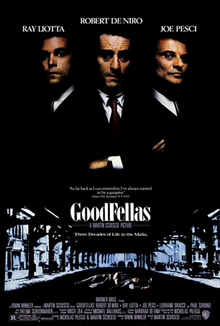
Triple Feature: Taxi Driver (1976) / Goodfellas (1990) / The Departed (2006)


Martin Scorsese is widely hailed as one of the great American directors, yet before I began this blog I had only seen three Scorsese films, and abnormal ones at that – The Last Waltz, No Direction Home, and The Aviator. I have never been particularly attracted by his films’ subject matter, which often tends toward the extremely and unpleasantly violent. But after seeing the astonishing work of filmmaking that is Raging Bull, I decided to catch up with three Scorsese classics. Taxi Driver, which has been called by some the best film of the 70s, is a psychological thriller from the point of view of a mentally unstable cab driver. Goodfellas is Scorsese’s widely praised drama about life in the mob over the course of three decades. And The Departed, the film for which Scorsese finally won an Oscar, is a crime drama about an Irish mob and corruption in the Boston police department.

Taxi Driver is the oldest of the three films, and certainly the most daring. Goodfellas and The Departed, for all their merits, are basically genre films, but Taxi Driver is a bold, unconventional portrait of a man losing his grip on reality. Robert DeNiro, in one of his most famous performances, plays Travis Bickle, a war veteran who is now a taxi driver in New York City. Suffering from insomnia, he spends his sleepless nights shuttling people across the city, always repulsed by what he sees. “All the animals come out at night,” Bickle declares, describing the whores, drug dealers, and addicts he sees every night. “Some day a real rain will come and wash all this scum off the streets. “ Bickle sees a glimpse of hope in his miserable life when he meets a beautiful young campaign worker (Cybil Shepherd), but their relationship soon backfires. He also gets involved in the life of a 12 year-old prostitute (Jodie Foster), whom he tries to save before it is too late. In the end, alienated by society, Bickle resorts to shocking violence.

When I sat down to watch Taxi Driver, I expected to see a violent revenge movie more than anything else. But the film is deeper than that. It is a contemplative, brooding film about loneliness and alienation. Everything is seen from Bickle’s perspective, and the driving scenes perfectly emphasize his isolation from the rest of society – separated by that little plastic window, mired in shadow, and ignored by his customers, we begin to understand Bickle’s frustration – although the film wisely never tries to explain Bickle’s actions. Rather, it relies on the strength of DeNiro’s performance, who makes the whole thing seem believable.

Yet for all its strengths, I cannot pretend that I walked away from Taxi Driver with any lasting impression, or real insight. There is nothing particularly wrong with the film – DeNiro’s performance is excellent, Bernard Herrmann’s eerie score is memorable, and the cinematography is remarkable. But for all of its efforts to delve into Bickle’s psyche, I never became invested in the character – I always remained emotionally aloof, like Bickle himself.

I was less impressed with Goodfellas, one of Scorsese’s most popular and critically acclaimed films. The film, as its tagline declares, depicts three decades of life in the Mafia. Henry Hill (Ray Liotta) grows up in the 50s in Brookyln, and as a teenager becomes attracted to the allure of Mafia life – the cars, the money, the privileges. Much to the concern of his parents, Henry begins working for the local family, led by Paulie Cicero (Paul Sorvino), and the notoriously violent Tommy DeVito (Joe Pesci) and Jimmy Conway (Robert DeNiro). Soon, Henry quits school and becomes part of the mob full time. Despite initial happiness, Henry’s lifestyle eventually leads him to a drug addiction, jail time, and an unhappy marriage, before he winds up in FBI Witness Protection limbo, where he still longs to return to the life of a “Goodfella.”

Goodfellas has often been compared to The Godfather, but for me there is no comparison. I will concede that Goodfellas is no doubt the more realistic mob movie – for all of its artistry, The Godfather is somewhat romanticized, the violence buried under slick montages and swelling music. Scorsese doesn’t fall for that – the violence is frequent, graphic, sudden, and often quite shocking. His movie is certainly an accurate portrait of the Mafia in America, and the performances all ring true. The dialogue always seems realistic and spontaneous, never rehearsed. Scorsese also does a suitable job of depicting the allure of Mafia life. The early scenes are at times playful and fun, reflecting Henry’s naïve perspective on the Mafia. “We were treated like movie stars with muscle,” Henry’s narration tells us, “we had it all just for the asking.” This at first glorious life is depicted with great flair in a long tracking shot where Henry and a date skip the line at an expensive restaurant, make their way through the kitchen, and find their seats while everyone else is standing outside in the cold. Of course, Henry’s lifestyle soon backfires into a hopelessly violent and amoral one.

But after a while, it seems like that is all Goodfellas has to offer – a series of violent, unpleasant incidents. The film lacks any basic sense of humanity, like The Godfather had. None of the characters are relatable. None of the characters are remorseful. And the film lacks any sense of elegance or grace. That may seem an odd complaint for a Mafia movie, but compare it to Taxi Driver. Both films deal with violent, disturbing material, but Taxi Driver uses violence sparingly, and does have a certain elegance about it. Goodfellas is just coarse, and in the end Scorsese relies too heavily on gratuitous violence to make his point – and there doesn’t seem to be much of a point anyway.

I will probably sound like a hypocrite for praising The Departed, because it suffers from many of the same flaws as Goodfellas – overlength, excessive violence, an over-reliance on four-letter words. But I found The Departed totally gripping from its first frame. The film begins with a narration by Irish mob boss Frank Costello (Jack Nicholson), who declares, “I don’t want to be a product of my environment. I want my environment to be a product of me.” In an opening prologue set to the Rolling Stones’ “Gimme Shelter,” Scorsese masterfully sets the scene, depicting Costello’s game – bribing kids off the streets of Boston, pulling them away from the Church and indoctrinating them into his mob. Flash forward many years later, and one such mobster, Colin Sullivan (Matt Damon) has become a mole in the Special Investigations Unit of the Massachusetts State Police. At the same time, the SIU sends its own mole, Billy Costigan (Leonardo DiCaprio) into Costello’s gang. Of course, both sides soon become aware of an intruder, and a bloody cat-and-mouse game ensues.

As I mentioned earlier, The Departed is essentially a genre film, a basic crime story– Scorsese isn’t really experimenting here, he’s playing it safe with familiar material. But what a crime movie it is! The whole film crackles along at a galloping pace, propelled by strong performances. Part of the joy of watching The Departed is to see the giants of 70s cinema – actors like Jack Nicholson and Martin Sheen – matched with some of the most talented actors of today, like DiCaprio, Damon, and Mark Wahlberg. The cast is uniformly solid, particularly Nicholson, who is a genuinely frightening presence. The film also has a tremendous sense of location, making full use of its Boston setting. I was skeptical about The Departed – despite its Best Picture win, I had heard criticisms that it was excessively violent, warmed-over Scorsese. Yet all of these criticisms were trampled by the film’s narrative drive, and the sheer talent of all the players involved.

Taxi Driver: B+
GoodFellas: B
The Departed: A-

Tuesday, February 17, 2009

Apocalypse Now Redux (2001)


Rarely have I been left so utterly speechless at the end of a film than after I finished watching Apocalypse Now Redux. After sitting through Francis Ford Coppola's 3 1/2 hour recut of his 1979 Vietnam epic, I was shocked, terrified, moved, entertained, intellectually stimulated, and speechless. I knew that I had witnessed something extraordinary, but I did not quite know what to make of it. Of course, it is easy to appreciate the technical mastery of the early scenes, with their splendidly choreographed helicopter fights, luscious cinematography, and startling use of sound; the sheer size of the production is incredible. But what to make of the final scenes, in which the protagonist Capt. Willard finally comes face-to-face with the apparently insane Col. Kurtz, who is worshipped like a god in the middle of the Cambodian jungle? This portion of the film is heady and strange, yet there was something undeniably fascinating about it. At the film's end, though not fully understanding the ending, I nonetheless remained convinced that Apocalypse Now was a staggering work of art by one of America's greatest directors.

Apocalypse Now Redux opens with a powerful montage in which Capt. Willard (Martin Sheen) lies in a drunken stupor in his Saigon hotel room, waiting for a new mission. Soon enough, Willard is ordered to sail up the Nung River to Cambodia to find Colonel Walter E. Kurtz (Marlon Brando), a once-promising soldier who has allegedly gone insane and betrayed the army. Willard's task is to terminate the Colonel's command - "with extreme prejudice." Willard is joined by four other men, and the film tracks their journey upriver to find Kurtz's compound.

Ambitious does not begin to describe Apocalypse Now. The production woes of the film are legendary - Sheen had a heart attack, Brando showed up unprepared and overweight, extreme weather destroyed sets, and principal production ended up taking 238 days to complete. To watch the film is to marvel that Coppola managed to pull it off. The air strike sequence, in which the maniacal Col. Kilgore (Robert Duvall) attacks a Vietnamese village to the tune of “Ride of the Valkyries,” is simply extraordinary. We see the point of view of the helicopters, as they swoop through schoolyards and blow up buildings with missiles, while the villagers scatter. The sheer logistics of directing such a scene, especially in the pre-digital age, are mind-boggling. It is simultaneously one of the most thrilling and disturbing battle sequences I have ever seen.

But the long river journey is the heart and center of Apocalypse Now. Willard’s team is filled with young and innocent soldiers, as Willard’s cynical narration tells us – “rock ‘n’ rollers with one foot in their graves.” There is the seventeen year old Clean (a young Lawrence Fishburne) from “some South Bronx shithole,” a Californian surfer named Lance (Sam Bottoms), the tightly wound “Chef” (Frederic Forrest), and the domineering Chief Phillips (Albert Hall). At first the journey seems almost pleasant – the men water ski, chat amicably, drink booze, and surf. But this feeling soon wears off as the journey continues. They are exposed to war atrocities, are attacked by a tiger, and in one tragic scene, accidentally kill a boatload of civilians. Several die along the way. The rest lose whatever faith in civilization they had.

When the survivors finally pull into Kurtz’s compound, they are greeted by a legion of native soldiers and a stoned American reporter (Dennis Hopper) who babbles on about how Kurtz is a “great man.” The camera passes over details like bloody staircases and decapitated heads without providing any explanation, thus leaving us to question who exactly this Kurtz is. The build-up here is effective, and it works on a parallel level, because of Brando’s reputation as a brilliant but difficult actor. When Kurtz finally appears, he is mired in shadow, a bald, cryptic old sage who cynically calls Willard “an errand boy, sent by grocery clerks, to collect the bill.” Brando is a frightening, mysterious, and powerful presence in his few scenes, and it is difficult to imagine any other actor playing the part so successfully.

It is in these final scenes that Apocalypse Now reveals its true ambitions. For all the impressive spectacle of its early scenes, Apocalypse Now remained a somewhat conventional war film. But in this final segment, Coppola dares to show us the darker side of human nature, and to reveal moral complexities. We begin to see Kurtz not as just a raving lunatic but as an ordinary man driven mad by the horrors of war. Yet Coppola offers no easy answers, particularly with an ambiguous ending that plays out like some ancient tribal ritual. This is a film that is meant to challenge, and so Coppola does, with the masterful spell that is Apocalypse Now.

Verdict: A+

Note: I have only seen the 2001 “Redux” version of Apocalypse Now, so all my views here are based on that version.

Wednesday, January 7, 2009

Double Feature: Grand Illusion (1937) / Paths of Glory (1957)


“Patriotism is the last refuge of the scoundrel.”
- Samuel Johnson

That line is quoted early on in Stanley Kubrick’s Paths of Glory, a brilliant World War I film about a risky mission gone wrong. But it might have just as well belonged in Jean Renoir’s Grand Illusion, an influential French film that deals with the relationships between a group of French officers in a German war camp. Although the films were made two decades apart and in different countries, the similarities are striking. Both are black-and-white World War I films about the French army, and both have strong anti-war messages. The two films tackle different realities of war, though – Paths of Glory deplores military corruption, while Grand Illusion laments the way war tears apart human relationships.

Grand Illusion is a war film without the war. There is never a single battle sequence in the film, nor should there be. The story focuses on a group of French officers who are taken as prisoners of war in a German prison camp. Among the captives are Captain de Boeldieu (Pierre Fresnay), a wealthy aristocrat, Lieutenant Maréchal (Jean Gabin), a middle-class soldier, and Rosenthal (Marcel Dalio), a Jewish banker. The men spend every night digging an underground tunnel to escape, but they are deported to another camp before they get the chance. At the new camp, the supposedly inescapable Wintersborn, they meet up with the German Captain von Rauffenstein (Erich von Stroheim), who first shot down Boeldieu’s plane. At Wintersborn, the men eventually pull off a somewhat successful escape, but not without the cost of one man’s life.

I spent much of the first half of Grand Illusion puzzled at its supposedly pacifist message. I suppose I was used to films like Saving Private Ryan, which depicts horrible conditions and sickeningly violent battles to push its message that war is hell. In contrast, the prison camp in Grand Illusion seems downright cheery. The prisoners are treated well, given large quarters, seem fairly happy, and even put on a musical show. But I began to understand that Renoir was not interested in depicting the physical horrors of war. Renoir wrote that the film was “a story about human relationships,” and it is exactly that.

The key relationship in the film is the one between Captain de Boeldieu and Captain von Rauffenstein. Von Rauffenstein is a hospitable captor – after he shoots down the plane, he invites Boeldieu to lunch before he is sent to the camp. The two captains immediately get on, discussing a mutual friend in Berlin. Later, when Boeldieu is reunited with von Rauffenstein at Wintersborg, they seem glad to see each other again, and have a conversation about what will come about after the war. It has been said that World War I was the most literary war; it was led by well-educated aristocrats. That idea runs throughout Grand Illusion, especially in the scenes with the two captains. They discuss how the age of the aristocrat is ending, and von Rauffenstein speaks of having to go on leading a “futile existence” after the war. The scenes between the two men have great poignancy, and the acting is tremendous. Apparently Erich von Stroheim spoke almost no German and struggled through his lines, but he conveys the essence of his character with facial expressions. Von Stroheim was himself a silent movie director, and no doubt realized the power of facial acting.

Another important relationship is introduced near the end of the film. Maréchal and Rosenthal have escaped, and stay with a German widow named Elsa (Dita Parlo) in the countryside. A romance blossoms between Maréchal and Elsa, even though neither can speak the other’s language. But the two soldiers have to leave for Switzerland, and Elsa breaks down crying, telling Maréchal how she has been alone for so long. These two relationships (von Rauffenstein and Boeldieu, Maréchal and Elsa) reveal the essential tragedy of Grand Illusion. Outside of war, these characters would be best friends, but war dictates that they cannot be.

If aristocratic French officers are the heroes of Grand Illusion, they are the villains in Paths of Glory. Kirk Douglas is Colonel Dax, just about the only sympathetic officer in the film. Dax’s corrupt superior officer, General Mireau (George Macready) is ordered by his superior, General George Broulard (Adolphe Menjou) to lead an attack on a well-fortified German hill. Dax insists that it is a suicide mission, but Mireau insists on the attack – mainly for the possibility of promotion. When the attack inevitably fails, Mireau blames it on cowardice, and orders 3 men to be tried under penalty of death. The trial is a sham, and despite Dax’s noblest efforts, the three innocent men are ordered to die.

Paths of Glory is a very cynical film, exposing the inherent corruption in the high ranks of the army. The battle scenes are grim, and probably more harrowing than most films of the time, but the most terrifying scenes occur “behind the scenes,” so to speak – in offices and courts. After the mission inevitably fails, Mireau calls a meeting with Colonel Dax and General Broulard. Mireau, who prides himself on being a principled patriot, initially calls for one hundred men to be killed. Broulard calms him down, eventually working the number down to three, much to Mireau’s disappointment.

The scene is disturbing because it becomes clear how cold and distant these generals are. They feel no guilt in sentencing three innocent men to death and then genially making lunch plans. Dax, meanwhile, is caught in the middle, working his best to defend the innocent men. Douglas may be more of a movie star than a great actor, but his performance in Paths of Glory is very effective. Dax is appalled at the situation, but must contain his anger during the trial. The whole film is a very quiet one. For the most part, there are no impassioned monologues, no tirades against injustice – until the penultimate scene in the film. After the execution, Broulard offers Dax Mireau’s job, implying that Dax has been aiming for promotion all along. Dax, who feels like he has been used, finally explodes, calling Broulard a “degenerate, sadistic old man” and refuses to apologize. The scene is cathartic for both Dax and the audience.

Kubrick adds an interesting tag to the end of the film. The soldiers are gathered in a bar, where a captured German woman is brought onstage to sing a folk song. The men cheer and whistle, but when she starts singing the whole place falls silent. Everyone is clearly affected, and several of the men visibly weep. It’s not clear why - maybe they are thinking of their sweethearts back home, or maybe they are just wondering how this poor woman found herself so far from home. But for a moment, the German woman and the French soldiers, so different superficially, are united in song. It is a very emotional scene, and would not have felt out of place in Grand Illusion. Indeed, I wonder if Kubrick was inspired by Renoir’s film.

Both Grand Illusion and Paths of Glory are incredibly accomplished films. Grand Illusion is by far more influential, and is widely praised as one of the greats of French cinema. But Paths of Glory is a wonderful example of studio filmmaking by a true auteur who would soon transcend it. Grand Illusion shows that a bond can exist between people who should have nothing to do with each other. In the same way, two directors from different backgrounds and countries here made two separate masterworks about the follies of war.

Grand Illusion: A
Paths of Glory: A

Sunday, December 28, 2008

My Darling Clementine (1946)


There is a certain old-fashioned sensibility about John Ford's My Darling Clementine that is charming in this day and age. The few modern Westerns that do exist tend to be grim and serious and violent, but My Darling Clementine is an entirely different beast. It is an almost genteel film, where the characters and comedic moments take precedence over the violence. I mean this only as a compliment; John Ford wrote the book on how to make Westerns, and by all accounts this is one of his finest. While not as serious or artful a work as The Searchers, the movie is a near-perfect example of studio film-making by one of the great American directors.

Henry Fonda plays Wyatt Earp, who along with his three brothers is hustling cattle to California. They decide to stop at a small town named Tombstone for the night, leaving behind the youngest brother, James, to watch the cattle. Upon their return, the Earp brothers find James dead and the cattle stolen. Wyatt decides to take the job of marshall in Tombstone, in an attempt to bring law to the untamed town and to avenge his brother's death. Soon enough, though, he runs into trouble with the local powers, like Doc Holliday (Victor Mature) and Old Man Clanton (Walter Brennan), both of whom Wyatt suspects might have been involved in James' death.

Intercut with all of this is the love story between Wyatt and Clementine Carter (Cathy Downs), a schoolteacher from Boston who arrives in Tombstone chasing her old flame Doc Holliday. Clementine, though, has deceptively little screen time in the film that is named after her. She arrives almost 40 minutes into the film, and shares very few scenes with Fonda. Still, her presence is key. Her shy, sweet character is contrasted with the saucy yet disloyal Chihuahua (Linda Darnell), a saloon singer and Holliday's current plaything. Clementine also gives the film its emotional center, and despite little screen time, provides the film with one of its most memorable scenes. At a community dance, Wyatt seems unsure whether to ask Clementine to dance, but eventually sums up the courage, tossing aside his hat in resolve and bringing her to the floor. What is at first a stiff and awkward dance turns into a dance of joy as the town's residents cheer on the marshall and his "lady fair." It is a simple and joyous scene, the kind that would never be found in today's Westerns.

My Darling Clementine tells an essentially violent story of revenge and corruption, though, and there are many of the typical Western conventions - bar fights, shootouts, riots, and wonderfully politically incorrect dialogue ("What kind of town is this anyway, selling liquor to Indians?"). But still, Ford is more interested in the characters than in any conventions or setpieces. The climatic gunfight at the OK Corral is over quickly, and rather forgettable. Rather, the most memorable moments in My Darling Clementine are the simplest ones - like the dance scene, or the scene where an actor drunkenly recites from Hamlet in a bar, or Wyatt's farewell to Clementine at the end of the film. The beautiful vistas of Monument Valley, as photographed by Joseph MacDonald, are also impressive.

The story of Wyatt Earp has been retold numerous times in various films. Ford's was not even the first one - that distinction goes to 1939's Frontier Marshall. Since then, films like Gunfight at the OK Corral, Tombstone, Doc, and Wyatt Earp have all been versions of the same tale. From what I gather, these films are more historically accurate than Ford's version. But I would be surprised if any is as effective and enjoyable a piece of cinema as My Darling Clementine. The movie is lush, gorgeously photographed, joyful, and entertaining from beginning to end. Is it a fictionalized, inaccurate, sentimental piece of romanticism? Absolutely. And I wouldn't have it any other way.

Verdict: A

Monday, December 22, 2008

L'avventura (1960)


L'avventura (English title: The Adventure) is a strange title for any film. It is certainly a nondescript title, and it implies a sort of light-hearted escapism. But Michelangelo Antonioni's 1960 film offers nothing of the sort. It is a film where the "adventure" - namely the disappearance of a wealthy socialite on an island - plays second fiddle to the characters and their relationships. This deception initially led to a vitriolic public reaction, and the film was booed by the audience when it premiered at the Cannes Film Festival in 1960. But two years later it was voted by Sight & Sound as the second greatest film of all time, and it is regarded as a milestone in foreign cinema today.

The story begins with two wealthy friends, Anna (Lea Massari) and Claudia (Monica Vitti) leaving to go on a yacht trip. Anna brings her boyfriend Sandro (Gabriele Ferzetti), whom she feels frustrated with and distant from. The three depart, along with two other couples, for their excursion. After making a stop at an island, the company soon discovers that Anna is missing. They search the island and call in the police, but to no avail. After a few days worrying, everyone goes on with their lives - including Sandro and Claudia, who are beginning to fall in love.

L'avventura never resolves the mystery of what happened to Anna. It doesn't need to, because that is not what the film is about. Anna's disappearance only sets the stage to illuminate the shallowness of the main characters' lives. Days after his girlfriend's disappearance, Sandro and Claudia share a kiss, and proclaim their love for one another. In the same period of time, Giulia (Dominique Blanchar), another friend of Anna's, begins to crack jokes about her disappearance. She has also begun dating a 17 year-old painter, seemingly bored with her previous squeeze, an older man named Corrado. Immediately we begin to understand one of the points of L'avventura - friendships mean nothing to these people. They lead perfectly comfortable yet incredibly empty lives. Pauline Kael put it better than I ever could: "Too shallow to be truly lonely, they are people trying to escape their boredom by reaching out to one another and finding only boredom once again.'' In this way, the themes of L'avventura are very similar to those in La Dolce Vita, another Italian film released the same year.

L'avventura is also notable for its beautiful cinematography. In fact, the film won a special jury prize at Cannes in part for "the beauty of its images." Yet the cinematography did not inspire me in the way that films like Lawrence of Arabia do. It is perfectly adequate, even above average, but I think almost anyone can make shots of Italian islands and crashing waves look appealing. Few images stayed with me, with the exception of the last scene. It is an exquisite, silent scene that relies on the power of images rather than dialogue to bring the film full circle. That is the second reason why the film won the jury prize - it was cited for the creation of a "new cinematic language." The film did not rely on plot gimmicks, narration, or even much dialogue to tell its story, preferring instead to focus on the images.

L'avventura is a very accomplished and influential film, but it did not resonate with me the way that La Dolce Vita did. I found La Dolce Vita a more profound film, with deeper themes. Yet a comparison between the two may be unfair, and I have found that many foreign films require at least two viewings before full appreciation sets in. On its own terms, L'avventura is a fascinating and intelligent film as well as an important landmark of cinema.

Verdict: B+