Showing posts with label vietnam. Show all posts

Sunday, March 15, 2009

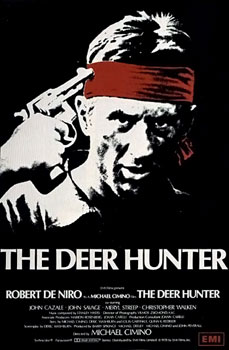
The Deer Hunter (1978)


When The Deer Hunter opened in 1978, it won five Oscars, including Best Picture and Best Director, and was nominated in many other categories. In 1996, it was chosen for preservation by the Library of Congress as being "culturally, historically, or aesthetically significant." In 1997 and again in 2007, it ranked on the AFI's list of the top 100 American films. Indeed, The Deer Hunter is so firmly established as a masterpiece that to watch it is revelatory. The film I saw was a turgid, predictable, arguably racist film that is only somewhat redeemed by strong performances and a few memorable scenes.

Director Michael Cimino's three-hour Vietnam epic is essentially divided into three acts. The first act introduces us to a group of Pennsylvanian steel workers - Steve (John Savage), Nick (Christopher Walken), and the natural leader of the group, Michael (Robert DeNiro). The three friends celebrate a wedding and go deer hunting before they are eventually sent to Vietnam, which begins the second act. Michael, Nick, and a delirious Steve are prisoners of war, and are forced to play a game of Russian roulette. They eventually escape, but along the way Nick gets left behind. The third act of the film deals with Michael and Steve's attempt to readjust to life in America, while Nick is stuck back in Vietnam.

Each act of the film has its problems, and the first act's problem is a basic one - overlength. There is nothing particularly offensive here, but the setup is tedious, and it seems to go on for ever. The wedding scene - which reeks of an imitation of The Godfather - is a particularly good example. But we also get scenes of the friends at work, at a bar, going hunting, etc. Cimino could probably have established the friendship dynamic in half the time he uses. It is also painfully obvious where the movie is heading in the first act. When Michael promises to Nick that he will never leave him behind in Vietnam, it's obvious that that is exactly what he will do. When Michael shares a dance with Nick's girlfriend Linda (Meryl Streep), we know that they will eventually fall in love. There is very little surprise in The Deer Hunter.

The second act of The Deer Hunter, with the three friends caught in a prison camp and forced to play Russian roulette, has a reputation for being particularly harrowing and disturbing. It is not harrowing - again, it is quite clear who will or will not die during the lethal game, and the scene is curiously devoid of tension. It is disturbing, however, but for all the wrong reasons - not for the violence it depicts, but because of its depiction of the North Vietnamese. All of the Asian characters are sadistic caricatures who gleefully laugh at violence. They are stereotypes, with no sense of humanity. One can easily see why the film was deemed racist upon release, although that word may be putting too fine a point on it. Still, Cimino lacks any sense of racial sensitivity, and the film's one-dimensionality is striking. All the Americans are heroes, and all the North Vietnamese are villains. It doesn't get much deeper than that.

Admittedly, the third act of The Deer Hunter is much stronger than the first two, with many memorable scenes. There is a quietly melancholic scene where Michael returns but can't bring himself to go to his coming-home party. In another scene, Michael explodes with startling anger at his friend Stan (John Cazale), who has been joking around with a pistol. The skilled cast is most responsible for making this material work, depicting the lives of ordinary Americans who are forever shaken after the war. This is best expressed in the film's final scene, which takes place at a dimly lit dinner table after a funeral. After a long, awkward silence, one character begins to hum "God Bless America." Soon all the cast joins in, quietly singing a patriotic tune that takes on a whole new meaning. It is a powerful, darkly ironic scene.

Still, I find The Deer Hunter to be a wildly overrated film. In almost every frame, you can see Cimino straining to make a Great American Epic, but his ambition succeeds his reach. There is nothing innovative or exciting here. It's a rather simplistic film, stretched to three hours and given a reputation that it simply does not deserve.

Verdict: C+

Tuesday, February 17, 2009

Apocalypse Now Redux (2001)


Rarely have I been left so utterly speechless at the end of a film than after I finished watching Apocalypse Now Redux. After sitting through Francis Ford Coppola's 3 1/2 hour recut of his 1979 Vietnam epic, I was shocked, terrified, moved, entertained, intellectually stimulated, and speechless. I knew that I had witnessed something extraordinary, but I did not quite know what to make of it. Of course, it is easy to appreciate the technical mastery of the early scenes, with their splendidly choreographed helicopter fights, luscious cinematography, and startling use of sound; the sheer size of the production is incredible. But what to make of the final scenes, in which the protagonist Capt. Willard finally comes face-to-face with the apparently insane Col. Kurtz, who is worshipped like a god in the middle of the Cambodian jungle? This portion of the film is heady and strange, yet there was something undeniably fascinating about it. At the film's end, though not fully understanding the ending, I nonetheless remained convinced that Apocalypse Now was a staggering work of art by one of America's greatest directors.

Apocalypse Now Redux opens with a powerful montage in which Capt. Willard (Martin Sheen) lies in a drunken stupor in his Saigon hotel room, waiting for a new mission. Soon enough, Willard is ordered to sail up the Nung River to Cambodia to find Colonel Walter E. Kurtz (Marlon Brando), a once-promising soldier who has allegedly gone insane and betrayed the army. Willard's task is to terminate the Colonel's command - "with extreme prejudice." Willard is joined by four other men, and the film tracks their journey upriver to find Kurtz's compound.

Ambitious does not begin to describe Apocalypse Now. The production woes of the film are legendary - Sheen had a heart attack, Brando showed up unprepared and overweight, extreme weather destroyed sets, and principal production ended up taking 238 days to complete. To watch the film is to marvel that Coppola managed to pull it off. The air strike sequence, in which the maniacal Col. Kilgore (Robert Duvall) attacks a Vietnamese village to the tune of “Ride of the Valkyries,” is simply extraordinary. We see the point of view of the helicopters, as they swoop through schoolyards and blow up buildings with missiles, while the villagers scatter. The sheer logistics of directing such a scene, especially in the pre-digital age, are mind-boggling. It is simultaneously one of the most thrilling and disturbing battle sequences I have ever seen.

But the long river journey is the heart and center of Apocalypse Now. Willard’s team is filled with young and innocent soldiers, as Willard’s cynical narration tells us – “rock ‘n’ rollers with one foot in their graves.” There is the seventeen year old Clean (a young Lawrence Fishburne) from “some South Bronx shithole,” a Californian surfer named Lance (Sam Bottoms), the tightly wound “Chef” (Frederic Forrest), and the domineering Chief Phillips (Albert Hall). At first the journey seems almost pleasant – the men water ski, chat amicably, drink booze, and surf. But this feeling soon wears off as the journey continues. They are exposed to war atrocities, are attacked by a tiger, and in one tragic scene, accidentally kill a boatload of civilians. Several die along the way. The rest lose whatever faith in civilization they had.

When the survivors finally pull into Kurtz’s compound, they are greeted by a legion of native soldiers and a stoned American reporter (Dennis Hopper) who babbles on about how Kurtz is a “great man.” The camera passes over details like bloody staircases and decapitated heads without providing any explanation, thus leaving us to question who exactly this Kurtz is. The build-up here is effective, and it works on a parallel level, because of Brando’s reputation as a brilliant but difficult actor. When Kurtz finally appears, he is mired in shadow, a bald, cryptic old sage who cynically calls Willard “an errand boy, sent by grocery clerks, to collect the bill.” Brando is a frightening, mysterious, and powerful presence in his few scenes, and it is difficult to imagine any other actor playing the part so successfully.

It is in these final scenes that Apocalypse Now reveals its true ambitions. For all the impressive spectacle of its early scenes, Apocalypse Now remained a somewhat conventional war film. But in this final segment, Coppola dares to show us the darker side of human nature, and to reveal moral complexities. We begin to see Kurtz not as just a raving lunatic but as an ordinary man driven mad by the horrors of war. Yet Coppola offers no easy answers, particularly with an ambiguous ending that plays out like some ancient tribal ritual. This is a film that is meant to challenge, and so Coppola does, with the masterful spell that is Apocalypse Now.

Verdict: A+

Note: I have only seen the 2001 “Redux” version of Apocalypse Now, so all my views here are based on that version.