It is customary for movie critics to finish the year with a list of their 10 favorite movies of the past year. Seeing as I spend much more time watching classics than new releases (I haven't even seen 10 new movies this year), I figured I would present my own variation. These are the Top 10 movies that I saw for the first time in 2009.
I have always been obsessed with movies, but this past year was when my obsession came to fullest fruition. I went through Netflix discs rapid-fire; I went to the library to track down VHS copies of more obscure films; I taped films off of TCM; I got rides to the Brattle and Coolidge Corner Theaters. Unfortunately, I also slacked off when it came to blogging. I was moving through movies so quickly that I thought writing about them would slow me down! So here is an opportunity for me to talk about the movies that made the most impact on me this year - many of which I haven't yet written about.
Limiting this list to 10 proved a challenge, and as a result many great films were excluded. I decided to include a long list of honorable mentions, all of which are just as worthy as the top 10. Without much further ado:
10.
Days of Heaven: Terrence Malick's 1978 film begins as Bill (Richard Gere), a Chicago steelworker, accidentally kills his supervisor and flees to the wheatfields of Texas with his girlfriend and sister. This fairly standard lovers-on-the-run plot suggests little of the film's beauty. The viewers sees the story from a distance, through the eyes of Linda, Bill's sister. Her voiceover narration is astonishing in its detail and insight. Ennio Morricone's score is alternately uplifting and haunting. But what remain most of all are the images. The cinematography, by Nestor Almendros and Haskell Wexler, captures the beauty and harshness of the natural world like no other film I have ever seen.
9.
Woman in the Dunes: Hiroshi Teshigahara's bizarre masterpiece was an arthouse sensation in its day but is now largely forgotten. The script was written by Japanese writer Kobo Abe, from his novel about a bug collector who stays a night at a widow's shack, but is held against his will, forced to shovel out the sands that continually encroach her home. The film is above all an existential allegory, but it is not easily classifiable. It is a variation on the myth of Sisyphus, a psychological study, and a story of obsessive, erotic love. Despite its pretentious trappings, the powerful acting and unsettling mood (symbolized by the ever-sifting sand) make
Woman in the Dunes a consistently fascinating film.
8.
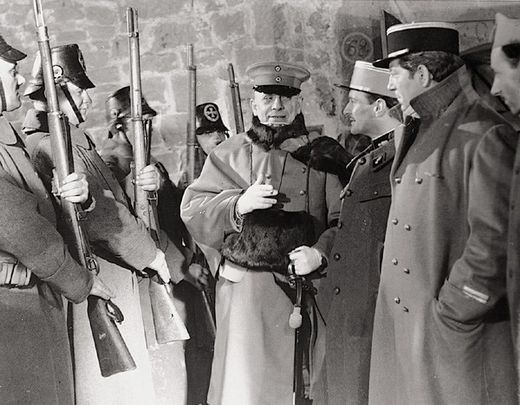
Grand Illusion: Jean Renoir, like his successor François Truffaut, is one of cinema's great humanists. This 1937 film, about a group of French POWs and their German captor, is a detailed and moving character study, as well as a reflection on the European class sysem. It never resorts to melodrama or easy moralizing. It effortlessly moves from romance to cynicism and back again, with grace and style.
7.
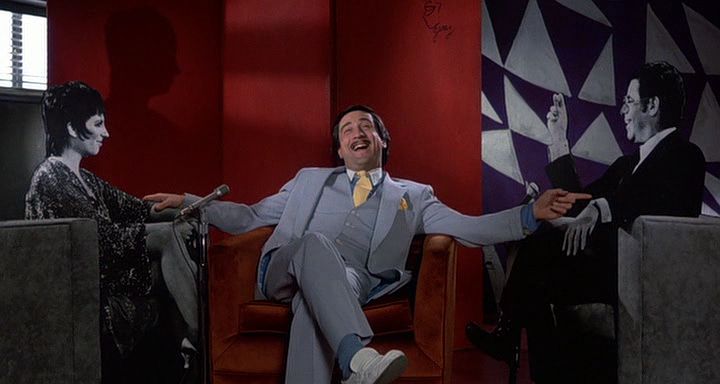
The King of Comedy: Of all the collaborations between Martin Scorsese and Robert De Niro,
The King of Comedy may be the least well known - and arguably the greatest. The film plays like a black comedy version of
Taxi Driver. De Niro is Rupert Pupkin, an aspiring stand up comic who worships late night comedian Jerry Langford (Jerry Lewis). When he fails to break through in the business, Pupkin decides to kidnap Langford in an attempt to get on the show. The film is undoubtedly funny, but it is also unsettling in its depiction of its delusional, celebrity-obsessed characters. The ending seems prophetic in the wake of today's reality TV landscape. It's also perhaps Scorsese's most experimental film; he toys with notions of reality and fantasy without telling us which is which.
6.
Apocalypse Now: When I first saw
Apocalypse Now, I loved it almost unreservedly, though I didn't really "get" the ending. Upon subsequent viewings, I think that may be less my fault and more Coppola's - the ending seems less assured and cohesive than the rest of the film. Still,
Apocalypse Now is pretty stunning. The idea that war is hell is hardly original; but Coppola expresses it visually like no other war film I have seen. And he does not focus merely on the physical realities of battle, but also reveals the inner psyche of the soldier.
Apocalypse Now is far superior to say, the contrived
The Deer Hunter or the simplistic
Saving Private Ryan.

5. The Apu Trilogy: Satyajit Ray has long been acknowledged by respected film critics everywhere as one of the greatest directors of all time. Yet he remains largely unknown, and most of his films are unavailable on DVD. I had to watch The Apu Trilogy, perhaps his most acclaimed work, on three scratchy VHS tapes from the library. The trilogy tells the story of Apu, who is born in a poor Indian village and progresses through life to become a scholar, a priest, and a wanderer. Ray was inspired by the Italian neorealist movement (e.g. The Bicycle Thief), which used nonprofessional actors and real locations to depict the everyday realities of working class people. But The Apu Trilogy is not just a depressing evocation of poverty. It is universal in its scope and its depiction of family relationships. And it contains images of such great beauty that they can only be called visual poetry. This is what "humanistic" filmmaking is all about.
4.
The Apartment: Every time I see Billy Wilder's
The Apartment, I can see its flaws more clearly - it's overlong, Jack Lemmon's acting is a little too hammy, and some of the supporting acting is rather wooden. But Wilder's film is uncommonly affecting, and it strikes a balance between comedy and drama that few films achieve. Jack Lemmon plays C.C. Baxter, an employee in a huge corportation who works his way up by lending out his apartment to his philandering superiors. From this plot Wilder fashions both a cynical satire on the business world and a warm romantic comedy. In addition to the obvious charms of the cast and script, the film earns extra points for its gorgeous, wide-screen, black and white cinematography. Expect more on Wilder - as soon as I see a few more of his films, I'm going to do a retrospective post on the blog.
3.
Three Colors Trilogy: Krzysztof Kieslowski's
Three Colors Trilogy is based on the three colors of the French flag, and their respective values (liberty, equality, and fraternity). But like Kieslowski's similarly masterful
The Decalogue, the films do not get bogged down in abstract theories, but relate with the trials and struggles of real people. The characterizations - by the screewnriters and Kieslowski's cast - are wonderfully nuanced, and Kieslowski's assured direction and perfectly composed images let us known we are in the hands of a master. I recently re-watched these films, about a year after I saw them for the first time, and they still hold up. I even grew to appreciate
White, which I had mixed feelings about the first time around but which I now think is just as good as
Blue and
Red.
2.
Nashville: This film - running 2 hours and 40 minutes, virtually plotless, with a cast of 24 characters - could have so easily degenerated into a rambling mess. But Robert Altman somehow makes it work. It's a satire, a character drama, a musical, and a loopy comedy all rolled into one, and one of the film's strength is that it is so mysterious, so hard to classify. That may not sound very appealing, but make no mistake,
Nashville is
fun, populated with goofy songs and appealing characters. It also, of course, has quite a lot to say about America in the 1970s. I have already seen
Nashville twice, and no doubt will return again and again.
1.
Persona: There's a certain tendency, I think, to see Ingmar Bergman as the King of pretension, obvious symbolism, and arthouse clichés. That does him a great disservice, especially in a masterpiece like
Persona. The film tells the apparently simple story of two women - an actress who has inexplicably decided to stop speaking, and the nurse who is assigned to take care of her. Bergman is at the height of his powers here, and his sheer command of his form is too strong to dismiss the film as pretentious twaddle. The cinematography is so perfect that every shot seems to be a representation of the film's themes. The result is unsettling, dreamlike, and beautiful - "a poem in images," as Bergman called it.
Honorable Mentions (in no particular order):
- Trouble in Paradise
- The Graduate
- Ali: Fear Eats the Soul
- The Decalogue
- In Bruges
- Hiroshima mon Amour
- Network
- Bed and Board
- Sunset Boulevard
- Manhattan
- Swing Time
- Pickpocket
- A Woman Under the Influence
- Ace in the Hole
- Bride of Frankenstein
- Singin' in the Rain
Coming soon to the blog (and I do mean soon!): a review of Masaki Kobayashi's nine and a half hour epic,
The Human Condition!