Showing posts with label war. Show all posts

Thursday, August 27, 2009

Inglourious Basterds (2009)


The opening scene of Quentin Tarantino's Inglourious Basterds is so tense, so disquieting, so rife with real human drama that I almost assumed that Tarantino would try something different with this latest film. In this scene and a handful of others scattered across the film, Tarantino's trademark dialogue sounds more subdued and realistic than usual, and he demonstrates his skill at orchestrating tension followed by sudden releases of violence. But the film soon dissolves into an overlong, self-indulgent, violence-glorifying mess, filled with so many film references that one wonders if there is an original thought in the whole film. In short, Inglourious Basterds is just like every other movie Tarantino has made.

The titular Basterds are led by Lt. Aldo Raine (Brad Pitt, in an amusing turn), a soldier from Tennessee whose squad is intent on "doing one thing, and one thing only - killing Nazis." The Basterds eventually get involved with a plot by the British army to blow up a Parisian cinema during the premiere of Joseph Goebbel's new film, which Hitler and the top-ranking Nazis will be attending. The cinema is run by Shoshanna (Mélanie Laurent), a Jew who escaped death at the hands of SS Colonel Hans Landa (Christoph Waltz). Unbeknowst to the Basterds, Shoshanna has her own plot to kill the Nazis.

Inglourious Basterds is a perfect example of a film that is less than the sum of its parts. The ensemble cast - assembled from America, France, and Germany - is terrific. Christoph Waltz in particular is a standout, delivering an alternately funny and terrifying performance as Landa, "the Jew Hunter." The period production design and costuming is exquisite, and Tarantino's eye for composition is undeniable. I keep returning to one inventive shot late in the film, when a shot of a laughing woman's face projected onto a burning movie screen becomes like a ghostly apparition.

But in the end, Inglourious Basterds falls apart due to Tarantino's excesses. The script is unwieldy, with several scenes dragging on far too long. More importantly, Tarantino never establishes a tone, and the film bizarrely shifts from war drama to farce to action movie to parody. There seems to be no unifying vision behind the film, unless it's another opportunity for Tarantino to throw together a bunch of disparate genres and loosely attach them to a storyline. Francois Truffaut once said that a movie must simultaneously express an idea about cinema and an idea about life. Tarantino's films have never bothered with real life, and indeed his movies can often be reduced to a list of their influences, ranging from Jean-Luc Godard to Sergio Leone.

More than anything, Inglourious Basterds reveals what an immature filmmaker Tarantino is. It seems to me that the film possesses no higher artistic goal than to watch Jews beat up Nazis real good. By the final scenes, in which we are treated to close-ups of Nazis being pelleted in the face with machine guns, I felt sickened and numb. Tarantino's films, I think, are essentially escapist entertainment, but his violence is often so graphic that you feel repulsed rather than entertained.

There may have been a time when Tarantino's combination of violence and humor, and his mishmashing of various genres, seemed original. Now it is tired and stale, the product of a director who refuses to grow up. It remains to be seen whether Tarantino will ever put aside his B movies, stop wallowing in his own cleverness, and make a movie that actually means something.

Verdict: **/****

DVD Recommendation: If you want a refreshing antidote to Tarantino, check out Martin McDonagh's In Bruges. That film is as violent, funny, and profane as anything Tarantino has done, but its characters are real people and not broad caricatures. It features a twisty, unpredictable script and the surprisingly effective comic duo of Brendan Gleeson and Colin Farrell. Also check out my brother Matt's excellent blog post about the movie and the differences between McDonagh and Tarantino.

Sunday, March 15, 2009

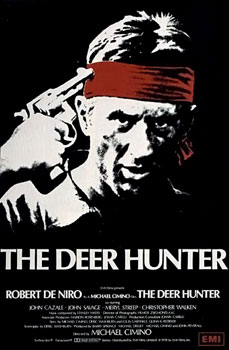
The Deer Hunter (1978)


When The Deer Hunter opened in 1978, it won five Oscars, including Best Picture and Best Director, and was nominated in many other categories. In 1996, it was chosen for preservation by the Library of Congress as being "culturally, historically, or aesthetically significant." In 1997 and again in 2007, it ranked on the AFI's list of the top 100 American films. Indeed, The Deer Hunter is so firmly established as a masterpiece that to watch it is revelatory. The film I saw was a turgid, predictable, arguably racist film that is only somewhat redeemed by strong performances and a few memorable scenes.

Director Michael Cimino's three-hour Vietnam epic is essentially divided into three acts. The first act introduces us to a group of Pennsylvanian steel workers - Steve (John Savage), Nick (Christopher Walken), and the natural leader of the group, Michael (Robert DeNiro). The three friends celebrate a wedding and go deer hunting before they are eventually sent to Vietnam, which begins the second act. Michael, Nick, and a delirious Steve are prisoners of war, and are forced to play a game of Russian roulette. They eventually escape, but along the way Nick gets left behind. The third act of the film deals with Michael and Steve's attempt to readjust to life in America, while Nick is stuck back in Vietnam.

Each act of the film has its problems, and the first act's problem is a basic one - overlength. There is nothing particularly offensive here, but the setup is tedious, and it seems to go on for ever. The wedding scene - which reeks of an imitation of The Godfather - is a particularly good example. But we also get scenes of the friends at work, at a bar, going hunting, etc. Cimino could probably have established the friendship dynamic in half the time he uses. It is also painfully obvious where the movie is heading in the first act. When Michael promises to Nick that he will never leave him behind in Vietnam, it's obvious that that is exactly what he will do. When Michael shares a dance with Nick's girlfriend Linda (Meryl Streep), we know that they will eventually fall in love. There is very little surprise in The Deer Hunter.

The second act of The Deer Hunter, with the three friends caught in a prison camp and forced to play Russian roulette, has a reputation for being particularly harrowing and disturbing. It is not harrowing - again, it is quite clear who will or will not die during the lethal game, and the scene is curiously devoid of tension. It is disturbing, however, but for all the wrong reasons - not for the violence it depicts, but because of its depiction of the North Vietnamese. All of the Asian characters are sadistic caricatures who gleefully laugh at violence. They are stereotypes, with no sense of humanity. One can easily see why the film was deemed racist upon release, although that word may be putting too fine a point on it. Still, Cimino lacks any sense of racial sensitivity, and the film's one-dimensionality is striking. All the Americans are heroes, and all the North Vietnamese are villains. It doesn't get much deeper than that.

Admittedly, the third act of The Deer Hunter is much stronger than the first two, with many memorable scenes. There is a quietly melancholic scene where Michael returns but can't bring himself to go to his coming-home party. In another scene, Michael explodes with startling anger at his friend Stan (John Cazale), who has been joking around with a pistol. The skilled cast is most responsible for making this material work, depicting the lives of ordinary Americans who are forever shaken after the war. This is best expressed in the film's final scene, which takes place at a dimly lit dinner table after a funeral. After a long, awkward silence, one character begins to hum "God Bless America." Soon all the cast joins in, quietly singing a patriotic tune that takes on a whole new meaning. It is a powerful, darkly ironic scene.

Still, I find The Deer Hunter to be a wildly overrated film. In almost every frame, you can see Cimino straining to make a Great American Epic, but his ambition succeeds his reach. There is nothing innovative or exciting here. It's a rather simplistic film, stretched to three hours and given a reputation that it simply does not deserve.

Verdict: C+

Tuesday, February 17, 2009

Apocalypse Now Redux (2001)


Rarely have I been left so utterly speechless at the end of a film than after I finished watching Apocalypse Now Redux. After sitting through Francis Ford Coppola's 3 1/2 hour recut of his 1979 Vietnam epic, I was shocked, terrified, moved, entertained, intellectually stimulated, and speechless. I knew that I had witnessed something extraordinary, but I did not quite know what to make of it. Of course, it is easy to appreciate the technical mastery of the early scenes, with their splendidly choreographed helicopter fights, luscious cinematography, and startling use of sound; the sheer size of the production is incredible. But what to make of the final scenes, in which the protagonist Capt. Willard finally comes face-to-face with the apparently insane Col. Kurtz, who is worshipped like a god in the middle of the Cambodian jungle? This portion of the film is heady and strange, yet there was something undeniably fascinating about it. At the film's end, though not fully understanding the ending, I nonetheless remained convinced that Apocalypse Now was a staggering work of art by one of America's greatest directors.

Apocalypse Now Redux opens with a powerful montage in which Capt. Willard (Martin Sheen) lies in a drunken stupor in his Saigon hotel room, waiting for a new mission. Soon enough, Willard is ordered to sail up the Nung River to Cambodia to find Colonel Walter E. Kurtz (Marlon Brando), a once-promising soldier who has allegedly gone insane and betrayed the army. Willard's task is to terminate the Colonel's command - "with extreme prejudice." Willard is joined by four other men, and the film tracks their journey upriver to find Kurtz's compound.

Ambitious does not begin to describe Apocalypse Now. The production woes of the film are legendary - Sheen had a heart attack, Brando showed up unprepared and overweight, extreme weather destroyed sets, and principal production ended up taking 238 days to complete. To watch the film is to marvel that Coppola managed to pull it off. The air strike sequence, in which the maniacal Col. Kilgore (Robert Duvall) attacks a Vietnamese village to the tune of “Ride of the Valkyries,” is simply extraordinary. We see the point of view of the helicopters, as they swoop through schoolyards and blow up buildings with missiles, while the villagers scatter. The sheer logistics of directing such a scene, especially in the pre-digital age, are mind-boggling. It is simultaneously one of the most thrilling and disturbing battle sequences I have ever seen.

But the long river journey is the heart and center of Apocalypse Now. Willard’s team is filled with young and innocent soldiers, as Willard’s cynical narration tells us – “rock ‘n’ rollers with one foot in their graves.” There is the seventeen year old Clean (a young Lawrence Fishburne) from “some South Bronx shithole,” a Californian surfer named Lance (Sam Bottoms), the tightly wound “Chef” (Frederic Forrest), and the domineering Chief Phillips (Albert Hall). At first the journey seems almost pleasant – the men water ski, chat amicably, drink booze, and surf. But this feeling soon wears off as the journey continues. They are exposed to war atrocities, are attacked by a tiger, and in one tragic scene, accidentally kill a boatload of civilians. Several die along the way. The rest lose whatever faith in civilization they had.

When the survivors finally pull into Kurtz’s compound, they are greeted by a legion of native soldiers and a stoned American reporter (Dennis Hopper) who babbles on about how Kurtz is a “great man.” The camera passes over details like bloody staircases and decapitated heads without providing any explanation, thus leaving us to question who exactly this Kurtz is. The build-up here is effective, and it works on a parallel level, because of Brando’s reputation as a brilliant but difficult actor. When Kurtz finally appears, he is mired in shadow, a bald, cryptic old sage who cynically calls Willard “an errand boy, sent by grocery clerks, to collect the bill.” Brando is a frightening, mysterious, and powerful presence in his few scenes, and it is difficult to imagine any other actor playing the part so successfully.

It is in these final scenes that Apocalypse Now reveals its true ambitions. For all the impressive spectacle of its early scenes, Apocalypse Now remained a somewhat conventional war film. But in this final segment, Coppola dares to show us the darker side of human nature, and to reveal moral complexities. We begin to see Kurtz not as just a raving lunatic but as an ordinary man driven mad by the horrors of war. Yet Coppola offers no easy answers, particularly with an ambiguous ending that plays out like some ancient tribal ritual. This is a film that is meant to challenge, and so Coppola does, with the masterful spell that is Apocalypse Now.

Verdict: A+

Note: I have only seen the 2001 “Redux” version of Apocalypse Now, so all my views here are based on that version.

Wednesday, January 7, 2009

Double Feature: Grand Illusion (1937) / Paths of Glory (1957)


“Patriotism is the last refuge of the scoundrel.”
- Samuel Johnson

That line is quoted early on in Stanley Kubrick’s Paths of Glory, a brilliant World War I film about a risky mission gone wrong. But it might have just as well belonged in Jean Renoir’s Grand Illusion, an influential French film that deals with the relationships between a group of French officers in a German war camp. Although the films were made two decades apart and in different countries, the similarities are striking. Both are black-and-white World War I films about the French army, and both have strong anti-war messages. The two films tackle different realities of war, though – Paths of Glory deplores military corruption, while Grand Illusion laments the way war tears apart human relationships.

Grand Illusion is a war film without the war. There is never a single battle sequence in the film, nor should there be. The story focuses on a group of French officers who are taken as prisoners of war in a German prison camp. Among the captives are Captain de Boeldieu (Pierre Fresnay), a wealthy aristocrat, Lieutenant Maréchal (Jean Gabin), a middle-class soldier, and Rosenthal (Marcel Dalio), a Jewish banker. The men spend every night digging an underground tunnel to escape, but they are deported to another camp before they get the chance. At the new camp, the supposedly inescapable Wintersborn, they meet up with the German Captain von Rauffenstein (Erich von Stroheim), who first shot down Boeldieu’s plane. At Wintersborn, the men eventually pull off a somewhat successful escape, but not without the cost of one man’s life.

I spent much of the first half of Grand Illusion puzzled at its supposedly pacifist message. I suppose I was used to films like Saving Private Ryan, which depicts horrible conditions and sickeningly violent battles to push its message that war is hell. In contrast, the prison camp in Grand Illusion seems downright cheery. The prisoners are treated well, given large quarters, seem fairly happy, and even put on a musical show. But I began to understand that Renoir was not interested in depicting the physical horrors of war. Renoir wrote that the film was “a story about human relationships,” and it is exactly that.

The key relationship in the film is the one between Captain de Boeldieu and Captain von Rauffenstein. Von Rauffenstein is a hospitable captor – after he shoots down the plane, he invites Boeldieu to lunch before he is sent to the camp. The two captains immediately get on, discussing a mutual friend in Berlin. Later, when Boeldieu is reunited with von Rauffenstein at Wintersborg, they seem glad to see each other again, and have a conversation about what will come about after the war. It has been said that World War I was the most literary war; it was led by well-educated aristocrats. That idea runs throughout Grand Illusion, especially in the scenes with the two captains. They discuss how the age of the aristocrat is ending, and von Rauffenstein speaks of having to go on leading a “futile existence” after the war. The scenes between the two men have great poignancy, and the acting is tremendous. Apparently Erich von Stroheim spoke almost no German and struggled through his lines, but he conveys the essence of his character with facial expressions. Von Stroheim was himself a silent movie director, and no doubt realized the power of facial acting.

Another important relationship is introduced near the end of the film. Maréchal and Rosenthal have escaped, and stay with a German widow named Elsa (Dita Parlo) in the countryside. A romance blossoms between Maréchal and Elsa, even though neither can speak the other’s language. But the two soldiers have to leave for Switzerland, and Elsa breaks down crying, telling Maréchal how she has been alone for so long. These two relationships (von Rauffenstein and Boeldieu, Maréchal and Elsa) reveal the essential tragedy of Grand Illusion. Outside of war, these characters would be best friends, but war dictates that they cannot be.

If aristocratic French officers are the heroes of Grand Illusion, they are the villains in Paths of Glory. Kirk Douglas is Colonel Dax, just about the only sympathetic officer in the film. Dax’s corrupt superior officer, General Mireau (George Macready) is ordered by his superior, General George Broulard (Adolphe Menjou) to lead an attack on a well-fortified German hill. Dax insists that it is a suicide mission, but Mireau insists on the attack – mainly for the possibility of promotion. When the attack inevitably fails, Mireau blames it on cowardice, and orders 3 men to be tried under penalty of death. The trial is a sham, and despite Dax’s noblest efforts, the three innocent men are ordered to die.

Paths of Glory is a very cynical film, exposing the inherent corruption in the high ranks of the army. The battle scenes are grim, and probably more harrowing than most films of the time, but the most terrifying scenes occur “behind the scenes,” so to speak – in offices and courts. After the mission inevitably fails, Mireau calls a meeting with Colonel Dax and General Broulard. Mireau, who prides himself on being a principled patriot, initially calls for one hundred men to be killed. Broulard calms him down, eventually working the number down to three, much to Mireau’s disappointment.

The scene is disturbing because it becomes clear how cold and distant these generals are. They feel no guilt in sentencing three innocent men to death and then genially making lunch plans. Dax, meanwhile, is caught in the middle, working his best to defend the innocent men. Douglas may be more of a movie star than a great actor, but his performance in Paths of Glory is very effective. Dax is appalled at the situation, but must contain his anger during the trial. The whole film is a very quiet one. For the most part, there are no impassioned monologues, no tirades against injustice – until the penultimate scene in the film. After the execution, Broulard offers Dax Mireau’s job, implying that Dax has been aiming for promotion all along. Dax, who feels like he has been used, finally explodes, calling Broulard a “degenerate, sadistic old man” and refuses to apologize. The scene is cathartic for both Dax and the audience.

Kubrick adds an interesting tag to the end of the film. The soldiers are gathered in a bar, where a captured German woman is brought onstage to sing a folk song. The men cheer and whistle, but when she starts singing the whole place falls silent. Everyone is clearly affected, and several of the men visibly weep. It’s not clear why - maybe they are thinking of their sweethearts back home, or maybe they are just wondering how this poor woman found herself so far from home. But for a moment, the German woman and the French soldiers, so different superficially, are united in song. It is a very emotional scene, and would not have felt out of place in Grand Illusion. Indeed, I wonder if Kubrick was inspired by Renoir’s film.

Both Grand Illusion and Paths of Glory are incredibly accomplished films. Grand Illusion is by far more influential, and is widely praised as one of the greats of French cinema. But Paths of Glory is a wonderful example of studio filmmaking by a true auteur who would soon transcend it. Grand Illusion shows that a bond can exist between people who should have nothing to do with each other. In the same way, two directors from different backgrounds and countries here made two separate masterworks about the follies of war.

Grand Illusion: A
Paths of Glory: A