Showing posts with label robert de niro. Show all posts

Sunday, March 15, 2009

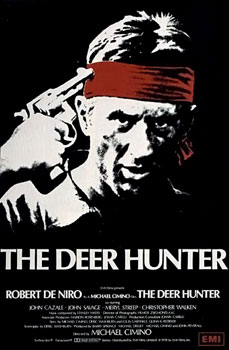
The Deer Hunter (1978)


When The Deer Hunter opened in 1978, it won five Oscars, including Best Picture and Best Director, and was nominated in many other categories. In 1996, it was chosen for preservation by the Library of Congress as being "culturally, historically, or aesthetically significant." In 1997 and again in 2007, it ranked on the AFI's list of the top 100 American films. Indeed, The Deer Hunter is so firmly established as a masterpiece that to watch it is revelatory. The film I saw was a turgid, predictable, arguably racist film that is only somewhat redeemed by strong performances and a few memorable scenes.

Director Michael Cimino's three-hour Vietnam epic is essentially divided into three acts. The first act introduces us to a group of Pennsylvanian steel workers - Steve (John Savage), Nick (Christopher Walken), and the natural leader of the group, Michael (Robert DeNiro). The three friends celebrate a wedding and go deer hunting before they are eventually sent to Vietnam, which begins the second act. Michael, Nick, and a delirious Steve are prisoners of war, and are forced to play a game of Russian roulette. They eventually escape, but along the way Nick gets left behind. The third act of the film deals with Michael and Steve's attempt to readjust to life in America, while Nick is stuck back in Vietnam.

Each act of the film has its problems, and the first act's problem is a basic one - overlength. There is nothing particularly offensive here, but the setup is tedious, and it seems to go on for ever. The wedding scene - which reeks of an imitation of The Godfather - is a particularly good example. But we also get scenes of the friends at work, at a bar, going hunting, etc. Cimino could probably have established the friendship dynamic in half the time he uses. It is also painfully obvious where the movie is heading in the first act. When Michael promises to Nick that he will never leave him behind in Vietnam, it's obvious that that is exactly what he will do. When Michael shares a dance with Nick's girlfriend Linda (Meryl Streep), we know that they will eventually fall in love. There is very little surprise in The Deer Hunter.

The second act of The Deer Hunter, with the three friends caught in a prison camp and forced to play Russian roulette, has a reputation for being particularly harrowing and disturbing. It is not harrowing - again, it is quite clear who will or will not die during the lethal game, and the scene is curiously devoid of tension. It is disturbing, however, but for all the wrong reasons - not for the violence it depicts, but because of its depiction of the North Vietnamese. All of the Asian characters are sadistic caricatures who gleefully laugh at violence. They are stereotypes, with no sense of humanity. One can easily see why the film was deemed racist upon release, although that word may be putting too fine a point on it. Still, Cimino lacks any sense of racial sensitivity, and the film's one-dimensionality is striking. All the Americans are heroes, and all the North Vietnamese are villains. It doesn't get much deeper than that.

Admittedly, the third act of The Deer Hunter is much stronger than the first two, with many memorable scenes. There is a quietly melancholic scene where Michael returns but can't bring himself to go to his coming-home party. In another scene, Michael explodes with startling anger at his friend Stan (John Cazale), who has been joking around with a pistol. The skilled cast is most responsible for making this material work, depicting the lives of ordinary Americans who are forever shaken after the war. This is best expressed in the film's final scene, which takes place at a dimly lit dinner table after a funeral. After a long, awkward silence, one character begins to hum "God Bless America." Soon all the cast joins in, quietly singing a patriotic tune that takes on a whole new meaning. It is a powerful, darkly ironic scene.

Still, I find The Deer Hunter to be a wildly overrated film. In almost every frame, you can see Cimino straining to make a Great American Epic, but his ambition succeeds his reach. There is nothing innovative or exciting here. It's a rather simplistic film, stretched to three hours and given a reputation that it simply does not deserve.

Verdict: C+

Saturday, March 7, 2009

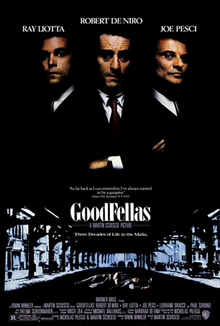
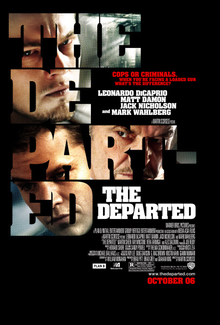
Triple Feature: Taxi Driver (1976) / Goodfellas (1990) / The Departed (2006)


Martin Scorsese is widely hailed as one of the great American directors, yet before I began this blog I had only seen three Scorsese films, and abnormal ones at that – The Last Waltz, No Direction Home, and The Aviator. I have never been particularly attracted by his films’ subject matter, which often tends toward the extremely and unpleasantly violent. But after seeing the astonishing work of filmmaking that is Raging Bull, I decided to catch up with three Scorsese classics. Taxi Driver, which has been called by some the best film of the 70s, is a psychological thriller from the point of view of a mentally unstable cab driver. Goodfellas is Scorsese’s widely praised drama about life in the mob over the course of three decades. And The Departed, the film for which Scorsese finally won an Oscar, is a crime drama about an Irish mob and corruption in the Boston police department.

Taxi Driver is the oldest of the three films, and certainly the most daring. Goodfellas and The Departed, for all their merits, are basically genre films, but Taxi Driver is a bold, unconventional portrait of a man losing his grip on reality. Robert DeNiro, in one of his most famous performances, plays Travis Bickle, a war veteran who is now a taxi driver in New York City. Suffering from insomnia, he spends his sleepless nights shuttling people across the city, always repulsed by what he sees. “All the animals come out at night,” Bickle declares, describing the whores, drug dealers, and addicts he sees every night. “Some day a real rain will come and wash all this scum off the streets. “ Bickle sees a glimpse of hope in his miserable life when he meets a beautiful young campaign worker (Cybil Shepherd), but their relationship soon backfires. He also gets involved in the life of a 12 year-old prostitute (Jodie Foster), whom he tries to save before it is too late. In the end, alienated by society, Bickle resorts to shocking violence.

When I sat down to watch Taxi Driver, I expected to see a violent revenge movie more than anything else. But the film is deeper than that. It is a contemplative, brooding film about loneliness and alienation. Everything is seen from Bickle’s perspective, and the driving scenes perfectly emphasize his isolation from the rest of society – separated by that little plastic window, mired in shadow, and ignored by his customers, we begin to understand Bickle’s frustration – although the film wisely never tries to explain Bickle’s actions. Rather, it relies on the strength of DeNiro’s performance, who makes the whole thing seem believable.

Yet for all its strengths, I cannot pretend that I walked away from Taxi Driver with any lasting impression, or real insight. There is nothing particularly wrong with the film – DeNiro’s performance is excellent, Bernard Herrmann’s eerie score is memorable, and the cinematography is remarkable. But for all of its efforts to delve into Bickle’s psyche, I never became invested in the character – I always remained emotionally aloof, like Bickle himself.

I was less impressed with Goodfellas, one of Scorsese’s most popular and critically acclaimed films. The film, as its tagline declares, depicts three decades of life in the Mafia. Henry Hill (Ray Liotta) grows up in the 50s in Brookyln, and as a teenager becomes attracted to the allure of Mafia life – the cars, the money, the privileges. Much to the concern of his parents, Henry begins working for the local family, led by Paulie Cicero (Paul Sorvino), and the notoriously violent Tommy DeVito (Joe Pesci) and Jimmy Conway (Robert DeNiro). Soon, Henry quits school and becomes part of the mob full time. Despite initial happiness, Henry’s lifestyle eventually leads him to a drug addiction, jail time, and an unhappy marriage, before he winds up in FBI Witness Protection limbo, where he still longs to return to the life of a “Goodfella.”

Goodfellas has often been compared to The Godfather, but for me there is no comparison. I will concede that Goodfellas is no doubt the more realistic mob movie – for all of its artistry, The Godfather is somewhat romanticized, the violence buried under slick montages and swelling music. Scorsese doesn’t fall for that – the violence is frequent, graphic, sudden, and often quite shocking. His movie is certainly an accurate portrait of the Mafia in America, and the performances all ring true. The dialogue always seems realistic and spontaneous, never rehearsed. Scorsese also does a suitable job of depicting the allure of Mafia life. The early scenes are at times playful and fun, reflecting Henry’s naïve perspective on the Mafia. “We were treated like movie stars with muscle,” Henry’s narration tells us, “we had it all just for the asking.” This at first glorious life is depicted with great flair in a long tracking shot where Henry and a date skip the line at an expensive restaurant, make their way through the kitchen, and find their seats while everyone else is standing outside in the cold. Of course, Henry’s lifestyle soon backfires into a hopelessly violent and amoral one.

But after a while, it seems like that is all Goodfellas has to offer – a series of violent, unpleasant incidents. The film lacks any basic sense of humanity, like The Godfather had. None of the characters are relatable. None of the characters are remorseful. And the film lacks any sense of elegance or grace. That may seem an odd complaint for a Mafia movie, but compare it to Taxi Driver. Both films deal with violent, disturbing material, but Taxi Driver uses violence sparingly, and does have a certain elegance about it. Goodfellas is just coarse, and in the end Scorsese relies too heavily on gratuitous violence to make his point – and there doesn’t seem to be much of a point anyway.

I will probably sound like a hypocrite for praising The Departed, because it suffers from many of the same flaws as Goodfellas – overlength, excessive violence, an over-reliance on four-letter words. But I found The Departed totally gripping from its first frame. The film begins with a narration by Irish mob boss Frank Costello (Jack Nicholson), who declares, “I don’t want to be a product of my environment. I want my environment to be a product of me.” In an opening prologue set to the Rolling Stones’ “Gimme Shelter,” Scorsese masterfully sets the scene, depicting Costello’s game – bribing kids off the streets of Boston, pulling them away from the Church and indoctrinating them into his mob. Flash forward many years later, and one such mobster, Colin Sullivan (Matt Damon) has become a mole in the Special Investigations Unit of the Massachusetts State Police. At the same time, the SIU sends its own mole, Billy Costigan (Leonardo DiCaprio) into Costello’s gang. Of course, both sides soon become aware of an intruder, and a bloody cat-and-mouse game ensues.

As I mentioned earlier, The Departed is essentially a genre film, a basic crime story– Scorsese isn’t really experimenting here, he’s playing it safe with familiar material. But what a crime movie it is! The whole film crackles along at a galloping pace, propelled by strong performances. Part of the joy of watching The Departed is to see the giants of 70s cinema – actors like Jack Nicholson and Martin Sheen – matched with some of the most talented actors of today, like DiCaprio, Damon, and Mark Wahlberg. The cast is uniformly solid, particularly Nicholson, who is a genuinely frightening presence. The film also has a tremendous sense of location, making full use of its Boston setting. I was skeptical about The Departed – despite its Best Picture win, I had heard criticisms that it was excessively violent, warmed-over Scorsese. Yet all of these criticisms were trampled by the film’s narrative drive, and the sheer talent of all the players involved.

Taxi Driver: B+
GoodFellas: B
The Departed: A-

Sunday, December 21, 2008

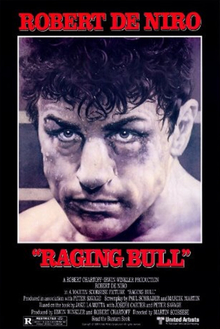
Raging Bull (1980)


We all know the classic underdog story - a young, up-and-coming athlete with a troubled past upsets a formidable opponent to be crowned the new champion. Martin Scorsese's Raging Bull turns this formula on its head, depicting a talented boxer who wins the championship but alienates his friends and family, eventually becoming a fat drunkard who performs terrible nightclub acts. Raging Bull is a biopic, telling the true story of Jake LaMotta, but it is so much more than a simple memoir. It is a story about failure to communicate, and about sexism, and about family. It is also a textbook example of acting, editing, and cinematography - all in service of a deeply human story.

After a brief scene in 1964, in which LaMotta (Robert De Niro) rehearses his nightclub routine, the film cuts to a fight in 1941 between LaMotta and Jimmy Reeves. Immediately we can see that Scorsese is not interested in toning down the violence. The fights in the film are brutal - blood flies, sweat drips, smoke drifts, and lightbulbs flash. At times, unconventional sound effects like swooping birds are used as LaMotta closes in on his prey. Slow-motion is used to great effect, and the sheer violence is striking - not only for the combatants, but for the fight's audience as well. After a controversial decision in the first fight, a brawl erupts in the audience that culminates in several women being trampled by men. In another fight, LaMotta throws a punch that sends blood splattering into several spectators' faces. But even in their brutality, many of the images in the fight scenes have a certain beauty to them. In one slo-mo shot, water is poured over LaMotta and it gently cascades downward. In another shot, the rope boundaries of the ring literally drip with blood. These masterful, unrelenting sequences lose little of their effectiveness today, even though they have been aped countless times in other films.

Soon after the first fight, Jake's brother and manager Joey (Joe Pesci) introduces him to Vickie (Cathy Moriarty), a beautiful 15 year-old whom Jake becomes infatuated with, despite having a wife at home. Jake's relationship with his wife is abusive - he screams at her for overcooking his steak, throws tables around the house, and threatens her. His relationship with Vickie is downright gentle compared to his abusive relationship with his wife. It is only when he actually marries Vickie that his attitude changes. Jake expects Vickie to obey him blindly - to fetch him coffee and be a nice little housewife with no social life of her own. When his brother Joey asks Jake to apologize to Vickie, Jake can't do it. He doesn't understand that Vickie feels like a prisoner, and instead of apologizing he just starts making out with her. To Jake Vickie is just an object, a disposable pleasure rather than a serious partner. Needless to say, the marriage turns to distrust, abuse, and eventually separation by the end of the movie.

Another pivotal relationship in the film is the one between Jake and his brother Joey. On the surface, the two are very similar, with hot tempers and loud mouths. But Joey is fundamentally different from his brother. He cares more deeply about his family and is far more reasonable than Jake. At one point, though, Joey's temper gets the better of him, and he gets into a huge bar brawl with a man he suspects of sleeping with Vickie. It is abundantly clear that Joey deeply loves his brother, but it seems that the only way he can express this love is through blind rage. The same is true of Jake. In one scene, Jake has the preposterous idea that Joey slept with Vickie, and he barges into his house to fight him. When Vickie later urges Jake to apologize for this misunderstanding, Jake can't do it - even over the phone. There is a real inability to communicate between these two characters, and by the end of the film Jake has completely alienated Joey.

De Niro is fascinating to watch in the scenes that depict Jake's later years. It is well-known cinematic lore that De Niro put on a significant amount of weight to play this role, but the performance goes beyond physical transformation. De Niro perfectly expresses a sort of phoned-in happiness that masks a layer of sorrow. In his later years, Jake fools himself into believing that he is happy, when it is clear to everyone else that he is not. We first see the older Jake in 1956 Miami being photographed for a newspaper. He sits by a pool, explaining why he is happiest in retirement - how he doesn't have to worry about weight and can spend more time with his family. Minutes later, of course, we see a drunken Jake telling unfunny jokes at his nightclub, we see Vickie finally announce that she will leave him, and we see Jake thrown into a jail cell, where he smashes his head against the wall, screaming "Why? Why? Why?" And in the final scene, before he goes on stage, he addresses himself in the mirror: "Go get 'em, champ." He still thinks he's a champion, even when no one else does.

I notice that I have spent a lot of time describing the characters and relationships of Raging Bull without critiquing it very much. But there is really not a whole lot to criticize about the movie. My only gripe, perhaps is that the film feels disjointed at times. The storyline skips years at a time without seeming like any time has passed at all. This is particularly problematic for Cathy Moriarty, who plays the crucial role of Vickie. The actress, who was 19 at the time of shooting, seems far older than 15 in the early scenes and far younger than 30 or so in the later scenes. Still, her performance itself cannot be faulted.

Raging Bull is truly a film where all of the elements come together. De Niro is rightly praised for his performance, but the film's success belongs equally to Scorsese, to the other cast members, to the screenwriters, to the editor, and to the cinematographer. It is rightly revered as a masterpiece, and 28 years later it regularly tops lists of the greatest films of all time. Funny, then, to think that Raging Bull nearly never got made. Scorsese repeatedly turned it down, and fell far behind schedule during production. But he prevailed, and delivered a true masterpiece.

Verdict: A