Showing posts with label 1960s. Show all posts

Wednesday, August 25, 2010

7 Women (1966)

Few directors loom larger in American cinema than John Ford, and few directors are so commonly oversimplified. I make no pretensions of being a Ford scholar, but as I have explored his films over the past few months, I have not been satisfied with any of the generalizations typically applied to him. It has been said that he is primarily a director of Westerns. True, Ford's Westerns are the best-remembered of his films, but his filmography extends far beyond that genre. It has been said that he was a workmanlike director, who saw directing as a job rather than an art. That is certainly the impression that Ford conveyed in his interviews, yet his films are graced with an undeniable artistry, in his painterly compositions and the themes that repeatedly express themselves in his work. It has been said that he was a stoutly conservative man, who could even be backwards in his depictions of race, yet socially conscious films like The Grapes of Wrath (1939) and later Westerns like Sergeant Rutledge (1960) and Cheyenne Autumn (1964) contradict this theory. In short, Ford remains something of an enigma to me. Although he is quickly becoming one of my favorite directors, I can never quite pin him down.

Case in point: 7 Women (1966). Ford's final film was derided upon its release, as was much of his later work, as being the work of a man past his prime. A few film critics and Ford scholars have challenged that consensus, but the film still doesn't hold much of a reputation - meaning, inevitably, that it is unavailable on DVD and remains something of an obscurity. That is a shame, because 7 Women is one of Ford's most fascinating films: imperfect, yes, but distinguished by subtleties of character, a claustrophobic visual style, and a harsh cynicism that masks a kind of humanism.

In its broadest outlines, 7 Women could almost pass for a Western: in the middle of the wilderness, a group of bandits descends on an isolated outpost of civilization. However, the setting is 1935 China, the bandits are Mongolian warriors, and the outpost isn't a stagecoach or a frontier town but a Christian mission. The mission is run by Agatha Andrews (Margaret Leighton), a rigidly pious woman who betrays almost no warmth, except to Emma (Sue Lyon), a teenage girl whom she has taken under her wing. The other missionaries include a pregnant middle-aged woman, her husband, and several refugees from other missions who seek shelter after theirs is destroyed by the bandits.

This uneasy mixture is thrown into further distress upon the arrival of Dr. Cartwright (Anne Bancroft), a cynical and atheistic doctor who outspokenly challenges the beliefs and values of the missionaries. Much of the early drama of the film is psychological, as Cartwright wins the admiration of Emma and brings forth the repressed emotions of the women. Later, the drama becomes more pronounced, as a cholera epidemic rages through the mission and the bandits arrive.

It is curious that Ford, whose films are so populated with strong masculine characters, should choose as his last film a movie with an almost entirely female cast. What is more curious about 7 Women is its tone. Even in Ford's more "serious" films, like The Searchers and The Man Who Shot Liberty Valance, there is quite a bit of comic relief, usually in the form of Andy Devine or John Qualen. But in 7 Women, the mood is consistently somber and ominous. There is a line early on that sets the mood for the rest of the film, as the frenzied Florrie Pethers shrieks out, "This is the last place on Earth!"

That kind of apocalyptic foreboding is well matched with Ford's visual style. Like The Man Who Shot Liberty Valance, 7 Women was shot largely on studio sets rather than on location. Gone are the panoramic vistas of The Searchers and Ford's other Westerns. Instead, the movie has a decidedly artificial feel. The characters hardly ever leave the confines of the missionary; when they do, they merely stand outside the gates and muse about an outside world over which they have no control. As such, there is a palpable sense of confinement. Ford's use of color, too, is quite atypical. In contrast to the bright hues of, say, The Quiet Man, 7 Women is dark. Muddy browns, dirty greys, and dark purples are ever present.


With all of these anomalies, it can be difficult to look at 7 Women from an auteurist perspective. It doesn't really feel like a John Ford film. With the pronounced and dramatic use of interior space and the lesbian undertones of one relationship, it could almost pass for a Nicholas Ray movie.* Yet upon closer examination, the movie betrays several of Ford's recurring themes. One is the idea of community and tradition. In movies like The Quiet Man (set in rural Ireland) and The Sun Shines Bright (set in the American South), Ford explores the dynamics of fixed communities and their responses to change. His point of view is usually mixed: a combination of affection towards their traditions and criticism regarding their somewhat backwards ways. 7 Women illustrates this principle. Many of the missionaries - the self-described "soldiers in the army of the Lord" - are admirable characters that elicit our sympathies. But Miss Andrews is depicted in a rather unflattering light, as an unthinkingly stubborn adherent to an outdated form of Christianity. In the end, she is doomed to irrelevance, as all of the other missionaries come to reject and ignore her.

The real hero of 7 Women is Cartwright, the atheist. It seems odd that Ford, a devout Catholic, would celebrate her, but then again Cartwright is in many ways the embodiment of the Fordian hero - an outsider, tough, outspoken, brave, and yet compassionate. In the final scenes of the film, Cartwright must sacrifice herself to save the other women. This decision is not revealed with any teary speeches, but simply as the resolve of a woman who knows what she must do. The final moments of the movie are all the more moving because they seem so distanced and cold. There is no sentimentality, and the way Ford chooses to end the movie is brilliant - jarring, disturbing, and not easy to forget.

What, then, can explain the movie's negative reception, and its current obscurity? For one, several of the performances - particularly the supporting ones - are quite simply bad. Sue Lyon is wooden and bland; Betty Field is shrill and irritating. The script showcases some truly bizarre dialogue. And the portrayal of the bandits as a bunch of greasy, brawny musclemen randomly given to fits of uncontrollable laughter is more unintentionally funny than frightening.

Still, these are ultimately minor shortcomings in one of Ford's richest and strangest movies. It is telling that he himself considered it one of his best, and was deeply disappointed by the public's lack of interest. After 7 Women, plans for at least one more film fell through, and Ford retired from filmmaking. But it is a fitting capstone to his career, and the final scene takes on greater significance in this context. "So long, ya bastard!" Cartwright exclaims in a final act of defiance, and we are reminded of that gruff Irishman whose film this was, uncompromising to the end.

*About Ray - I initially planned to make the next post about him. But I saw "7 Women" and felt compelled to write about it. The next entry will be about three Nicholas Ray films, though - "Bigger than Life," "Johnny Guitar," and "Wind Across the Everglades."

Wednesday, April 21, 2010

The Human Condition (1959-1961)


Masaki Kobayashi's The Human Condition is exactly what it sounds like - a long, sprawling, grandiose epic about war and heroism and patriotism and humanity and a whole variety of other things. Unsurprisingly, it is overlong and overambitious. More surprisingly, it is often a bore. The first film in the trilogy is at least engaging as a conventional war story and character study, but the second and third parts become so prolonged and predictable that when the trilogy finally stopped in its tracks, nine and a half hours after it started, I had lost interest. There is a lot of money thrown at the screen, and a lot of speechifying, and many pretty widescreen vistas. But none of that can hide the film's lack of a meaningful insight into any of the themes it considers.

The Human Condition
was originally released as three films, each about three hours long. In Part 1, we are introduced to the protagonist, Kaji (Tatsuya Nakadai), a young management trainee who gets appointed to the position of a labor camp supervisor in Manchuria during World War Two. There, he tries to implement his socialist ideals in the treatment of the workers, but is opposed by an immoral and rigidly bureaucratic military system. In Part Two, Kaji becomes a soldier in the Imperial Army and is sent to the front lines. In Part Three, a disillusioned Kaji deserts in order to return to his wife Michiko (Michiyo Aratama).

If that plots sounds awfully tidy, it's because it is. From very early on, we know where this is heading. The film follows a linear decline: as time progresses, Kaji's circumstances become more dire, he becomes increasingly cynical, and the film's mood becomes all the more somber, its tone all the more self-serious. Even with nine and a half hours to spare, Kobayashi finds little time to develop his characters in any but the most basic ways. Kaji does change over the course of the trilogy, but his development seems perfunctory, always at the service of the plot and Kobayashi's grand thematic aspirations. The films were based on a six-part novel, and apparently Kobayashi was so enamored of it that he cut almost nothing from the book. But his slavish devotion to the arc of the novel doesn't give the film any room to breathe.

On a technical level, The Human Condition is somehow less than the sum of its parts. Kobayashi hired a new cinematographer, Yoshio Miyajima, specifically for the film. He also employed a then-innovative widescreen film format called Grandscope. Kobayashi's direction is clean and clear, but also rather dull. The camera seems to merely record the action. There are many wide shots of landscapes, but one gets the impression that Kobayashi and Miyajima are merely straining for grandeur; the shots lack depth and meaning. In terms of music, Kobayashi lays it on pretty thick, employing loud, bombastic swells to call our attention to anything particularly dramatic.

For a while, The Human Condition gets by on the strength of its cast. As Kaji, Nakadai is eminently likable, and convincing in his descent from sincere idealist to disillusioned cynic. Aratama, playing his wife, is equally good in what could have been a thankless supporting role. These two actors keep the audeience interested, even as the plot follows its all-too-predictable course.

The Human Condition is perhaps most interesting as a social and political document. Released 15 years after the end of World War two, the film - which depicts the entire Japanese army as a corrupt and outdated institution - was enormously popular in Japan. That says a lot about the nation's postwar attitude. The film's existential concerns also clarify why it was so popular; such themes were the staple of 60's "arthouse" cinema.

Still, the fact that the film's social and political context is its most interesting aspect suggests a larger truth - that over time, The Human Condition has become dated and esoteric rather than universal. Kobayashi's literal-minded and heavy-handed apporach to the film renders it curiously unaffecting. It seems to me the Japanese equivalent of a particularly overwrought Hollywood epic, or maybe a Japanese imitation of a David Lean film. Perhaps the only reason why this film is so revered, why the critic David Shipman called it "unquestionably the greatest film ever made," is that it comes dressed up in subtitles and a long running time, making it seem worth more than it really is.

Sunday, September 20, 2009

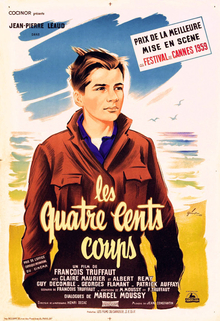
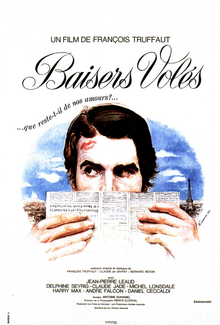
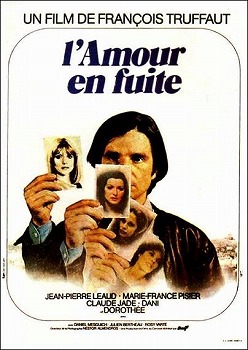
The Adventures of Antoine Doinel - The 400 Blows / Antoine and Colette / Stolen Kisses / Bed and Board / Love on the Run


In September 1958, an advertisement appeared in the French newspaper France-soir for a thirteen year-old boy to play the lead role in an upcoming feature film, The 400 Blows. The director was known in some circles for his controversial film criticism, but had never before directed a feature. The actor eventually chosen was also an amateur, and was initially deemed too old for the part. Yet these two men, Francois Truffaut and Jean-Pierre Léaud, forged a creative partnership and friendship that would last for decades. Incidentally, they also made one of the cornerstones of cinema, a film that kickstarted the French New Wave and ushered in a new era of personal filmmaking.

Looking back today, it hardly seems possible for it to have happened any other way. Rarely has there been such a perfect harmony between actor and director, with each man's personality equally informing the character of Antoine Doinel, who evolved in four sequels. The 400 Blows, rightly, is the most admired, but none of the later Doinel films is without value, and they all play off of motifs established in the first film.

In The 400 Blows, Antoine is a 13 year-old living in Paris with a stressed-out mother and distant stepfather. Neglected at home and vilified by his teacher at school, Antoine spends much of his time wandering through Paris with his friend René - going to movies, carnival rides and parks. Due to a series of poor decisions and misunderstandings at home and school, Antoine resorts to petty crime, and is sent to a seaside camp for juvenile delinquents.

Truffaut said his goal was "not to depict adolescene from the usual viewpoint of sentimental nostalgia, but....to show it as the painful experience it is." His visual style fits the mood - the films is shot in gritty black-and-white, set in cramped apartments, crowded prisons and dirty playgrounds. But the film also captures the excitement of living in the city, the simple pleasures of going to the movies and exploring the city with friends. In one sequence, Antoine goes on a centrifugal carnival ride, and ends up suspended in midair, back against the machine as it spins around. Adults watch from a distance, but Antoine can hardly make them out. It is a striking scene, and one that emphasizes Antoine's uncertain place in the world - stuck between childhood and the world of adults who don't seem to understand him.

Then there is the final scene, one of the most famous in cinema. It shows Antoine as he escapes from his juvenile holding camp. For a few minutes, Truffaut just shows us Antoine running, as he seems to do so often in the series. Then, an exhausted Antoine sees the sea for the first time, wades into the water, and turns to face the audience. The film ends with a zoomed-in freeze frame of Antoine's face. This shot, in some ways, is a miniature of the entire film - an honest, unflinching look at adolescence, freed from all sentimentality and false artifice.

Of all the sequels, Antoine and Colette looks most like The 400 Blows, but announces a departure in terms of tone and mood. This time, Antoine is not an angsty, misunderstood adolescent but a plucky 19 year-old working at a record store in Paris. Antoine is also a regular conertgoer, and it is at one such conert that he meets Colette (Marie-France Pisier), who soon becomes the object of his affections. Antoine tries to woo her, but only manages to charm her parents.

Antoine and Colette (a 30-minute short originally made for the omnibus Love at Twenty) seems downright lightweight compared to The 400 Blows. It maintains the previous film's black-and-white photography and Parisian settings, but the tone is more comic and romantic. That does not mean it is a bad film, for it is certainly an acute and bittersweet portrayal of young love. But it is an intermediary film more than anything, and perhaps too short to fully establish itself.

The romanticism of Antoine and Colette is taken even further in the next installment, Stolen Kisses. This time around, Antoine has been dishonorably discharged from the army, and finds himself on the streets of Paris looking for a job. He eventually finds one in a private detective agency. He also finds love, in the form of an older married woman (Delphine Seyrig) and a charming girl his own age, Christine (Claude Jade).

Stolen Kisses is light, funny, somewhat episodic and mostly irresistible. The success of the movie lies not so much in Truffaut's mise-en-scène but in the charms of the characters and script. It is also the film where Léaud, so arresting as the troubled boy of The 400 Blows, emerges as a full-fledged comedic actor. By this point in the series, you can see how the character evolved from a distillation of Truffaut's troubled childhood to a combination of Truffaut and Léaud's sensibilities. At its most basic level, though, Stolen Kisses is a skillful romantic comedy- whimsical, sentimental, slightly forgettable, but hard not to enjoy.

Bed and Board is my sentimental favorite of the Doinel series, though my perceptions of it are no dobut colored by the circumstances in which I first saw it. I saw both Bed and Board and Love on the Run as a double feature at the Brattle Theatre in Cambridge. As someone largely raised on VHS and DVD, seeing a real film print of a cinema classic is truly a thrill that cannot be replicated at home. In any case, though, there is something more about Bed and Board that makes it rise above the other Doinel sequels. The first half of the film is a domestic comedy that resembles Stolen Kisses in its episodic nature and comedic tone. Much of the film is set in a courtyard where Antoine works selling flowers; his wife Christine works as a violin tutor in their apartment a few floors above. Through a series of vigenttes, Truffaut establishes the supporting characters - a moocher who is constantly asking Antoine for money, a woman who is always hitting on him, a silent, shifty-eyed man deemed "The Strangler" by the apartment residents.

But about halfway into the movie, the tone changes as Antoine begins an affair with a Japanese woman. Up until this point in the series, the movies have relied on the natural likability of the main character. Now the empathy switches to Christine, and Truffaut portrays Antoine as a boy who refuses to grow up. In the centerpiece of the film, a separated Antoine and Christine have a passionate discussion which rapidly changes from a heated argument to a declaration of love. At one point, Christine lashes out against Antoine's desire to have everything his way. On the subject of Antoine's autobiographical novel, she says that "if you use art to settle accounts, it's no longer art." You can almost hear Truffaut's doubts in that statement; he seems to be questioning the artistic value of the entire series. At the very least, he seems fed up with playing the story for laughs, and Bed and Board briefly regains the melancholy tone that made The 400 Blows so powerful.

Consider the end of the scene. A cab arrives to take Christine into the city for a night of shopping. Before she leaves, she senses that Antoine is lonely and asks if he wants to go to a movie. After a few minutes of joking around, Christine gets in the cab and asks Antoine to kiss her, although they have already established that they will not be seeing each other. He does, and in typically melodramatic fashion declares, "You're my little sister, my daughter, my mother." Christine responds with an understated "I'd have liked to be your wife too."

This scene alone reveals what a terrific writer Truffaut was; it is an emotional rollercoaster ride in which the confused emotions of the main characters keep bubbling to the surface, threatening to obscure their best intentions to stay away from each other. It may be true, as it is frequently claimed, that by this point in his career Truffaut had abandoned the experimental, avant-garde nature of his early work for a more traditional style. But he never gave up the humanism that made his work so moving and so accessible to so many people. There are no flashy camera tricks or showy editing techniques in Bed and Board. It is purely minimalist, and extremely effective at that. All that needs to be said about Antoine's regret is shown in the shot where Christine's cab pulls away and Antoine walks down a lonely street into a brothel.

Bed and Board was originally intended to be the final Antoine Doinel film, and in retrospect it probably should have been. At times, Love on the Run seems like a clipshow; it features numerous flashbacks to all the previous films, which only makes it seems slight in comparison. It also seems altogether too tidy, with every aspect of Antoine's life coming together to create a happy ending. Finally, Love on the Run is a retreat from the serious reflection of Bed and Board, reverting back to the comedic situational comedy of Stolen Kisses.

The film is helped a great deal by the return of Colette's character; the actress Marie-France Pisier infuses the film with much-needed warmth. The style of the film is also noteworthy - the editing is quick and forceful, featuring swift cutaways and fast zooms. But the story is ultimately where the film falls apart. Antoine's love interest, Sabine, hardly establishes a personality of her own, and there is a genuine lack of new, interesting material.

Despite the final film's shortcomings, the Antoine Doinel series really is a remarkable piece of work. It is too easy to dismiss the sequels to The 400 Blows as sentimental fluff, but this is simply not the case. Watching the entire series, you can trace the evolution of Antoine Doinel not only in terms of plot, but in the sensibilities of his creators. You can also see the whole series as an examination of the fine line between adolescence and adulthood. Or you can simply get caught up in the story, in the acute feelings that Truffaut's films so effortlessly exude. No matter how you look at it, The Adventures of Antoine Doinel is a success.

Ratings (out of 4 stars)
The 400 Blows: ****
Antoine and Colette: ***
Stolen Kisses: ***
Bed and Board: ****
Love on the Run: **1/2

Tuesday, June 9, 2009

Persona (1966)


If there were ever a definitive answer to what Persona all meant, I would not want to hear it. Countless theories have tried to make sense of its enigmatic characters, of its surreal, seemingly random images, and of just what Ingmar Bergman was trying to say. Wisely, Bergman never commented on the film's meaning, preferring to let the film speak for itself. And so it does, 43 years after the fact. Persona is more disturbing than most horror films, more emotionally devastating than most dramas, and altogether more satisfying than almost any film I have seen.

The setup for this complex film is deceptively simple. Alma (Bibi Andersson) is a young nurse assigned to take care of Elisabet Vogler (Liv Ullmann), an actress who one day stopped talking after a performance. As Alma's superior informs her, there is nothing physically or mentally wrong with Elisabet - she just refuses to speak. Alma is ordered to look after Elisabet at an isolated seaside home for the summer. Alma at first enjoys their time together, but as she spills more and more of her private life, Alma begins to break down.

"The human face is the great subject of the cinema. Everything is there." Bergman himself said that, and Persona is perhaps the greatest expression of this belief. The startling cinematography, by Sven Nykvist, often lingers on the actresses' faces in long, revealing close-ups. At other times, he frames shots so that the two actresses seem to be mirror images of each other, on opposite sides of the frame. Nykvist and Bergamn also constantly experiment with light and shadow, background and foreground. As a result, every shot looks gorgeous - and not just superficially, either, for this is a film in which every shot reflects, on an aesthetic level, the film's themes. The most dramatic example comes at the film's climax, when Bergman fuses the two women's faces together in an expression of how the characters' personalities have merged.

None of this would matter, of course, if it weren't for the actresses, who play off each other in consistently fascinating ways. Ullman is a tranquil, ethereal presence as the silent Elisabet. Andersson is equally brilliant as Alma, who initially comes off as composed and controlled, but is in fact full of doubts and insecurities. In one of the film's most famous scenes, Alma tells Elisabet about a sexual encounter she had with two strange boys at a beach. Bergman pulls no punches with describing the graphic details, and Andersson is compelling as her character confronts her guilt over aborting the child that resulted. Indeed, the film is full of such darkly compelling monologues. One, spoken by Alma near the end of the film, is actually spoken twice - once, with the camera focused on Elisabeth, and once with the camera focused on Alma. This seems tedious at first, but it serves the useful purpose of showing how inseparable these two women's experiences are.

This may all sound like pretentious, pseudo-psychological nonsense, but I assure you that Persona is nothing of the sort. Bergman's film may be ambiguous, but it is not esoteric. Persona is a true joy to watch, enveloping us in its spell. From the very first frame, I was utterly captivated by the film - so much so that I watched it again two days later with the same fascination. I also recently watched Michelangelo Antonioni's Blowup, and was struck by how dated and stuffy it seemed in comparison - more of an intellecutal exercise than a fully formed film. Persona never lets its ideas stifle its emotions, and it is without a doubt one of the most beautiful films I have ever seen. Indeed, on every single front, Persona is that rare film that reminds you of everything that cinema can be.

Verdict: A+

Saturday, May 16, 2009

The Graduate (1967)


"Hello darkness my old friend. I've come to speak with you again."

Those lines, from Simon & Garfunkel's "The Sound of Silence", open and close The Graduate and they speak for much of the film's tone. Mike Nichol's film is, in some sense, a sex comedy. It also, in some sense, reflects the spirit of optimism and rebellion that characterized the 60s. Yet the pervading tone is sadness; this is above all a film about alienation and loneliness. The ending of the film is fondly remembered - the film's hero runs off with the girl of his dreams, getting on a bus as they begin their new life together. But the most telling shot comes when the couple sit down, and look at each other. They have nothing to say, nothing to share. There is a distance there that is unsettling. And then the sad chords of "The Sound of Silence" begin as the bus rolls off into an uncertain future.

I have spoiled the ending of the film, but The Graduate is so firmly ingrained in popular culture that I feel little guilt in doing so. Even those who are not familiar with The Graduate can feel its influence today. Of course, it launched the careers of such talented people as Dustin Hoffman and Mike Nichols, but its reach extends further. Released a year before the Summer of Love, The Graduate's frank depictions of sexual activity broke barriers in Hollywood. And it began the trend of popular music being incorporated into movie soundtracks. Yet despite all the imitators, The Graduate remains fresh today.

Benjamin Braddock (Dustin Hoffman) is the quintessential overachiever - track star, award winner, bright young scholar. But he returns home after college with no idea of what to do with his life. Soon enough, he becomes seduced by one of his parent's friends, the attractive Mrs. Robinson (Anne Bancroft). But soon after the affair breaks off, Benjamin falls in love with Mrs. Robinson's daughter Elaine (Katharine Ross).

This kind of material could be the stuff of soap opera, but not here. The film's director, Mike Nichols, initially looked for a typical Californian type - tall, blond, muscular - to play Benjamin. But Hoffman's nervous mannerisms won Nichols over, and the film is the better for it. Benjamin feels like an authentic person, as does Anne Bancroft's Mrs. Robinson, who hides a history of alcoholism and unhappiness behind her sexy sophistication. The two are also gifted comic actors, and the early seduction scenes are hilarious, and rightfully famous.
The Graduate is not a film that lives and dies by its acting, however. Director Nichols demonstrates an evident visual flair. At the very beginning of the film, I was struck by the simple image of a sad-looking Benjamin, in profile, gliding across a moving walkway at the airport. Throughout the film, Nichols create similar compositions that suggest Benjamin's utter loneliness. In one, he sits in a water suit at the bottom of an abandoned pool. In another, he stands in the middle of Elaine's college campus, dwarfed by his surroundings. These carefully composed images greatly enhance the film's mood.

I wish I could say that the film's second half was as good as its first. But Bancroft gets slighted in favor of Katharine Ross, playing her daughter Elaine. Although a great beauty, Elaine is also the dullest character in the film, with no discernible personality. Quite simply, nothing in the second half of the film matches the comedic heights or emotional depths of the first. Another problem throughout the film is the adult supporting actors, who all seem to be playing caricatures of superficial materialists. With the possible exception of Mrs. Robinson, there is not a single likable adult character, and this hamfisted generalization is tedious.

So yes, The Graduate does have its share of problems. But it casts such a captivating, almost effortless spell that its shortcomings are easy to forgive. The film is a snapshot of the 60s, to be sure, but to this day it has lost none of its emotional power. So here's to you, Mrs. Robinson.

Verdict: A-

Saturday, January 31, 2009

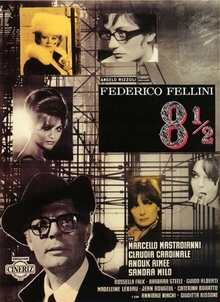
Double Feature: Day for Night (1973) / 8 1/2 (1963)


“I demand that a film express either the joy of making cinema or the agony of making cinema. I am not at all interested in anything in between; I am not interested in all those films that do not pulse.”

So said François Truffaut, the renowned French director of such films as The 400 Blows and Jules and Jim. In addition to being one of cinema’s greatest artists, he was also one of its greatest patrons. Truffaut began his career as a film critic, and according to those who knew him, he had an encyclopedic knowledge of films and an unadulterated love for the filmmaking process. That love comes across in his 1973 film Day for Night, which examines the family dynamic that forms between the cast and crew of a lightweight studio film named Meet Pamela. An interesting counterpoint is Federico Fellini’s 8 ½, about a director whose long-in-development film leaves his personal life in ruin. Upon first glance, it would appear that the two films are polar opposites, but both films “pulse” with a creative energy and the joy of cinema that Truffaut was so adamant about.

Every frame of Day for Night is bursting with love for the movie-making process. Truffaut plays Ferrand, the director of the studio comedy Meet Pamela. Jean-Pierre Leaud is Alphonse, the temperamental young star. Jacqueline Bisset plays Julie, a slightly unstable actress who has the title role in Meet Pamela. Truffaut fills out his film with other movie types – the aging supporting actress, the script girl, and various crew members.

Day for Night takes the form of a series of vignettes rather than a developed narrative, giving us a fly-on-the-wall look at life on a movie set. We observe the crew film a busy crowd scene, a car chase stunt, a simple dining room scene, and all the while we pick up on various film-making techniques. We share in the frustrations of the crew, as a cat refuses to lap up milk on cue, or as the aging actress Severine stumbles over her lines. Off set, we witness the relationships that develop among the cast and crew – friendships, romances, flings. All the while, the cast and crew are seen as a family, who share good times and console each other during bad ones.

The center of the film, though, is Ferrand, played by Truffaut as a version of himself. Truffaut once said that when he first saw Citizen Kane, he realized that he had never loved anyone as much as that film. The same would certainly be true of Ferrand, who remains doggedly fixated on making his movie above all else. To be sure, Ferrand develops friendships with his actors, and is never emotionally distant. Yet when Ferrand tries to console Alphonse after a romance gone wrong, his advice is to focus on learning his lines, because “people like you and me are only happy in our work.” That is one of the film’s strongest scenes, and it exemplifies what is so compelling about Day for Night. Not only is Truffaut’s adoration of cinema infectious, but the movie is filled with truthful human relationships.

Federico Fellini’s 8 ½ is also ostensibly about the making of a movie, but it is not really a film about film in the way that Day for Night is. The protagonist of 8 ½ is Guido (Marcello Mastroianni), a celebrated director whose film and life are crumbling around him. On vacation at a resort spa along with his producers, writer, and potential stars, Guido is hounded from all sides by people who are telling him how to make his film. The truth is, Guido doesn’t know what film he wants to make, and he finds solace in drifting into his childhood memories and his fantasies, embodied by a luminous Claudia Cardinale as the woman of his dreams. At the same time, Guido has to compete with the real women in his life – his mistress Carla (Sandra Milo) and jealous wife Luisa (Anouk Aimee).

8 ½ is remarkable on many levels. Fellini’s film weaves seamlessly between reality and fantasy, past and present without seeming at all heavy-handed. Unlike Guido, Fellini is in full command of his craft, and each segment builds upon the last to create a fuller portrait of Guido. That is not to say that every single shot or symbol makes sense. In one bizarre outdoors scene, Fellini pans past a group of characters who smile directly into the camera, and move in perfect synchronization as if they are in a sort of dance. There is no apparent reason for this, except that Fellini, ever the visual stylist, thought it looked interesting. That is not a criticism, but rather an example of how Fellini refused to follow conventions, constantly experimenting with structure and movement and composition. The film was originally titled The Beautiful Confusion, and that is exactly what it is. Even when we don’t fully understand Fellini’s intentions, his masterful direction and Gianni de Venanzo lush black-and-white photography keep the audience fully involved.

I have probably made 8 ½ sound far too esoteric, but it is really quite an entertaining movie. Fellini kept a note attached to his camera that read “Remember, this is a comedy.” Indeed, it is a rather broad comedy at times. One of the film’s most memorable sequences is a dream envisioned by Guido, who imagines a harem filled with all of the women in his life. They dote upon him, giving him baths, washing his home and preparing dinner. In another scene, Guido remembers as a schoolboy visiting the severely overweight Saraghina (Eddra Gale), a prostitute who does a grotesque and hilarious dance on the beach.

Despite these comic scenes, though, I would not generally characterize 8 ½ as a comedy. Guido spends most of the film in an unhappy state, only taking comfort in his dreams and fantasies. Only in the end does Guido find happiness, as he abandons his movie and decides to pick up the scattered pieces of his life. “Life is a celebration,” Guido tells his wife Luisa, “let’s live it together!” Fellini, unlike Truffaut, seems to be concluding that life is more important than film. And yet Day for Night and 8 ½ are not at all incompatible; both emphasize the joy of making cinema in their own way. Truffaut points out the simple pleasures of movie-making, the day-to-day gratifications of being on a set. And Fellini, through the creation of 8 ½, shows us that he is an artist of the first order, using the tools of his trade to examine the pieces of a man’s life – a beautiful confusion indeed.

Day for Night: A
8 ½: A+

Friday, December 26, 2008

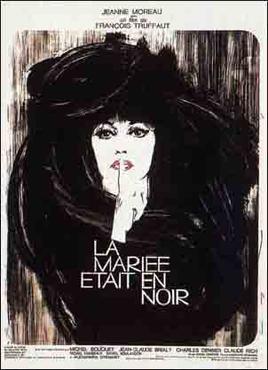
The Bride Wore Black (1968)


What happens when one acclaimed director deliberately styles his film after another? That is one question answered by The Bride Wore Black, François Truffaut's tribute to Alfred Hitchcock. Although the two directors worked in very different genres and styles (not to mention countries), they had great admiration for each other's work - Truffaut even published a book of his interviews with Hitchcock. But imitation is the sincerest form of flattery, and Truffaut decided to film a deliberately Hitchcockian thriller. The resulting film is not as inventive or influential as some of Truffaut's other films, like The 400 Blows or Shoot the Piano Player, nor does it rise to the heights of Hitchcock's greatest films. But it is a perfectly effective and clever little film about a woman set on revenge at any cost.

We are first introduced to the titular bride, Julie Kohler (Jeanne Moreau), when her mother foils her clumsy suicide attempt. Soon after, she leaves on a revenge mission to kill the five men who accidentally shot her husband. This motive is not revealed immediately - Truffaut makes an effective use of flashbacks at different stages in the story to slowly reveal the connections between the men, and to display the awful truth behind what happened that wedding day.

Hitchcock's influence is readily apparent throughout The Bride Wore Black. The plot itself is pure Hitchcock, and Jeanne Moreau's icy protagonist (or antagonist, depending on how you see it) would be perfectly at home in any of his films. The movie is also stylistically similar to much of Hitchcock's work, using bright colors and employing a Bernard Herrmann score (Herrmann was Hitchcock's main composer). Individual scenes, as well, struck me as possible homages. The first victim's death (by plunging from a high building) is rather clumsily filmed, but no doubt inspired by Vertigo. And a scene at a classical concert struck me as a possible nod to the climax of The Man Who Knew Too Much. But beyond any superficial homages, The Bride Wore Black is most closely related to Hitchcock in the way it finds the terrifying in the ordinary. Like Hitchcock, Truffaut establishes his characters very slowly. A scene at the beginning, where two friends are conversing about women and love, reminded me of The Birds, which is basically a romance story before the bird attacks ravage the town. Similarly, Truffaut establishes a seemingly banal setting and then startles us by introducing violence.

The Bride Wore Black may be effective as an homage, but it is not as effective as a thriller unto itself. At times the film limps on rather slowly without much of a point. There is one scene that achieves a high level of suspense, but there are few genuinely frightening moments. Perhaps I am wrong, though, in even classifying the film as a thriller. One could easily argue that the movie is a black comedy. Many scenes have an ironic or even comic overtone, particularly the brilliant final scene.

The Bride Wore Black is a modest little film. It was not career-defining for Truffaut, nor will it be life-changing for anybody. It was, perhaps, more of an experiment for Truffaut than anything. But the film has its fair share of merits. It is an entertaining revenge film, anchored by a strong lead performance, capped off with a nice dose of black humor.

Verdict: B

Monday, December 22, 2008

L'avventura (1960)


L'avventura (English title: The Adventure) is a strange title for any film. It is certainly a nondescript title, and it implies a sort of light-hearted escapism. But Michelangelo Antonioni's 1960 film offers nothing of the sort. It is a film where the "adventure" - namely the disappearance of a wealthy socialite on an island - plays second fiddle to the characters and their relationships. This deception initially led to a vitriolic public reaction, and the film was booed by the audience when it premiered at the Cannes Film Festival in 1960. But two years later it was voted by Sight & Sound as the second greatest film of all time, and it is regarded as a milestone in foreign cinema today.

The story begins with two wealthy friends, Anna (Lea Massari) and Claudia (Monica Vitti) leaving to go on a yacht trip. Anna brings her boyfriend Sandro (Gabriele Ferzetti), whom she feels frustrated with and distant from. The three depart, along with two other couples, for their excursion. After making a stop at an island, the company soon discovers that Anna is missing. They search the island and call in the police, but to no avail. After a few days worrying, everyone goes on with their lives - including Sandro and Claudia, who are beginning to fall in love.

L'avventura never resolves the mystery of what happened to Anna. It doesn't need to, because that is not what the film is about. Anna's disappearance only sets the stage to illuminate the shallowness of the main characters' lives. Days after his girlfriend's disappearance, Sandro and Claudia share a kiss, and proclaim their love for one another. In the same period of time, Giulia (Dominique Blanchar), another friend of Anna's, begins to crack jokes about her disappearance. She has also begun dating a 17 year-old painter, seemingly bored with her previous squeeze, an older man named Corrado. Immediately we begin to understand one of the points of L'avventura - friendships mean nothing to these people. They lead perfectly comfortable yet incredibly empty lives. Pauline Kael put it better than I ever could: "Too shallow to be truly lonely, they are people trying to escape their boredom by reaching out to one another and finding only boredom once again.'' In this way, the themes of L'avventura are very similar to those in La Dolce Vita, another Italian film released the same year.

L'avventura is also notable for its beautiful cinematography. In fact, the film won a special jury prize at Cannes in part for "the beauty of its images." Yet the cinematography did not inspire me in the way that films like Lawrence of Arabia do. It is perfectly adequate, even above average, but I think almost anyone can make shots of Italian islands and crashing waves look appealing. Few images stayed with me, with the exception of the last scene. It is an exquisite, silent scene that relies on the power of images rather than dialogue to bring the film full circle. That is the second reason why the film won the jury prize - it was cited for the creation of a "new cinematic language." The film did not rely on plot gimmicks, narration, or even much dialogue to tell its story, preferring instead to focus on the images.

L'avventura is a very accomplished and influential film, but it did not resonate with me the way that La Dolce Vita did. I found La Dolce Vita a more profound film, with deeper themes. Yet a comparison between the two may be unfair, and I have found that many foreign films require at least two viewings before full appreciation sets in. On its own terms, L'avventura is a fascinating and intelligent film as well as an important landmark of cinema.

Verdict: B+

Saturday, December 20, 2008

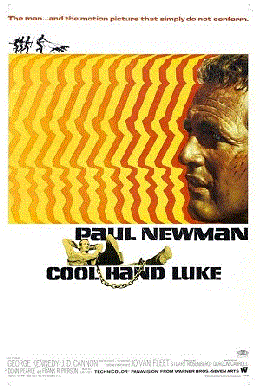
Cool Hand Luke (1967)


Cool Hand Luke is about a young war veteran who is forced into a chain gang for a petty crime. There, he is tormented and abused by the tyrants who run the place. By this description alone, one could safely assume that Cool Hand Luke is a tragic, gritty drama. Yet I found the film strangely optimistic, a stirring affirmation of the human spirit in the face of adversity. And who better to embody such a spirit than Paul Newman, who exudes both a tough manliness and tender humanity in the role of Luke. It is perhaps his most fondly remembered role, and not without reason. Newman is Luke, and to imagine anyone else in the role is nearly impossible.

Lucas Jackson is first arrested at the beginning of the film for cutting off the heads of parking meters (as he explains later, "Small town, not much to do in the evenin'"). For this petty crime, Luke is forced to join a chain gang for two years. His fellow convicts, particularly a character named Dragline (George Kennedy) are at first put off by his status as a war vet and his outspoken attitude. But they begin to admire him for his bravery and free spirit at the same time that the prison wardens begin to punish him for it. "What we have here is...failure to communicate," Strother Martin's Captain famously tells Luke. But what they really have is a clash of wills, a clash of ideals, a clash of attitudes that eventually leads to untold suffering for Luke.

Cool Hand Luke has a strongly anti-authoritarian message. The prison guards are, for the most part, portrayed as sadistic tyrants who are obsessed with rules. One intimidating character, referred to as the "Man with No Eyes," wears reflective sunglasses and carries a shotgun everywhere he goes. He is the symbol of authority in the film. Yet the movie never bashes you over the head with its message, and there is some moral ambiguity. When one guard is forced to put Luke in the dreaded "box" for the night, he confesses that he doesn't want to do it, but is just doing his job. This line shows that the guards may simply be acting on orders, rather than actively trying to make the convicts' lives miserable.

Cool Hand Luke also functions as a Christ metaphor. Subtlety is not the key word here, however. After the egg-eating contest, Luke lies sprawled on a table in the crucified position. Luke refers to God as "Old Man." And like Jesus, Luke is a good person who endures suffering at the hands of those who misunderstand him.

There I go again, making Cool Hand Luke sound far more depressing than it really is. It is true that the story has many tragic elements, and great critics like Roger Ebert have argued that it is a deeply pessimistic movie. But I think they are missing the point. Even the sad, poignant scenes have a strong dose of humor and warmth.

Take, for example, the scene where Luke's mother Arletta (Jo Van Pleet) comes to visit. There are, of course, the moments of regret and sorrow, like when Arletta confesses to Luke how she always wanted to see him have grandchildren. But even though Arletta is close to death, her spirit is fully intact. This is no frail old woman. She sits in the back of a truck, cracking jokes, swearing, and puffing on a cigarette. She never once scolds Luke, but rather tries to enjoy the little remaining time she has with her son. Even on the tender subject of Luke's father, who apparently left years ago, Arletta finds the humor. "Your old man, Luke. He wasn't much good for sticking around, but dammit he made me laugh!"

That sort of optimism pervades the film from the start. When Luke is first arrested, he flashes a drunken grin at the officers. When he is beaten to a bloody pulp by Dragline, he determinedly keeps fighting. When he takes on the sickening challenge of eating 50 eggs in an hour, he fulfills the task with bravado. And even after he has been captured by the prison wardens for the second time, when it seems like his spirit has been broken, he flashes a weak smile. Newman has a sort of quiet strength that carries these scenes. After all that he has suffered, both physically and emotionally, Luke's spirit is intact to the end. It's all summed up perfectly by Dragline at the end of the film - "That old Luke smile. Oh, Luke. He was some boy. Cool Hand Luke. Hell, he's a natural-born world-shaker."

Verdict: A -

Monday, November 24, 2008

La Dolce Vita (1960)


Federico Fellini's La Dolce Vita is perhaps most remembered for the image of beautiful blonde actress Anita Ekberg standing in a fountain in Rome. It is an iconic image; recognizable even to those who have not seen the film. Ekberg plays an American actress named Sylvia, but she is only a minor character in the film, just one of many characters who pass through the story. In fact, La Dolce Vita is a very episodic film with few recurring characters. The one thread that ties it all together is the character of Marcello (Marcello Mastroianni), a photojournalist who lives the "sweet life" in Rome - driving expensive cars, eating at cafes and cavorting with movie stars. The movie exposes the shallowness of such a life, and is particularly relevant in this age of Paris Hiltons and Lindsday Lohans. But to look at La Dolce Vita as merely a message movie is to ignore the most compelling reason to see it - it is a fascinating character study, featuring beautiful cinematography and directed by a top-class filmmaker at the height of his power. 

It is difficult to summarize the "plot" of La Dolce Vita because it is by no means a traditionally structured narrative. The film is mainly a string of disconnected sequences, each representing one night in Marcello's life. There are a few recurring characters, though - Emma (Yvonne Furneaux) is Marcello's estranged and suicidal girlfriend. Steiner (Alain Cuny) is one of Marcello's idols, a seemingly happy intellectual with a wife and kids. Maddalena is a rich heiress who Marcello encounters at the beginning and end of the film. 

The film's structure is at times frustrating. Upon first viewing, some sequences seem overlong, and the film lacks a cohesive flow. Yet that is part of what La Dolce Vita so brilliant. Its disjointed structure illustrates the empty life of Marcello. He spends his nights at sumptuous parties, drinking with beautiful women, but never finds a stable relationship or any real meaning in his life. The same holds true for the people Marcello surrounds himself with. 

In one telling sequence, Marcello's father comes to Rome and visits his son. Marcello expresses a clear desire to connect with his father, but at dinner his father is distracted by an alluring chorus girl. They go home together, but at dawn his father becomes sick and eventually must leave on an early train. The scene is revealing because it shows how Marcello's character flaws go back to his father, but also that Marcello is looking for a real relationship with his father. Mastroianni perfectly exudes a lonely yearning in that scene. 

Another central figure in the story is Steiner, who in many ways represents what Marcello would like to be. Steiner is a serious writer, a family man, and fancies himself an intellectual. But he is not as happy as it would appear, which is made tragically clear later in the film. The character of Steiner, and indeed all of the supporting characters, are wonderfully sketched by Fellini, the screenwriters, and a gifted cast. 

Another one of the the film's assets is its gorgeous black-and-white cinematography. Many of the images in the film are extremely memorable.  The fountain scene is the most obvious example, but there are others. A Christ statue being towed over Rome by a helicopter. The deserted streets of Rome at night. Marcello's father, blankly staring out of an apartment window. And the perfect final few shots of the film, which I will not reveal here.  

La Dolce Vita is also fascinating for its depiction of the paparazzi. In fact, the word "paparazzi" comes from the film's character of Paparazzo, who is one of the many photojournalists who swarm around the lives of the main characters. The paparazzi are ever-present in the movie, and they have no sense of decency. When Marcello gets into a fight with Sylvia's boyfriend, they do not rush to help their friend but rather rotate around the fight to get the best shot. When a woman is informed of a family tragedy, dozens of them crowd around her to capture her reaction. The film is almost scarily accurate in this depiction, especially since it holds true today. 

La Dolce Vita is a long and at times frustrating film - its unconventional structure may try the patience of some viewers. But that is really the only criticism I can give it. The film is positively overflowing with ideas, and its influence on cinema is remarkable. Yet aside from any historical importance, La Dolce Vita is a wonderful film in its own right. The story is heartbreaking, the cast impeccable, and the cinematography beautiful. For adventurous filmgoers, La Dolce Vita will provide food for thought for years to come. 

Verdict: A


Saturday, November 1, 2008

The Birds (1963)


Alfred Hitchcock promoted his film The Birds by saying "It could be the most terrifying motion picture I have ever made!" Interesting, then, to note that the movie takes about 45 minutes before anything remotely terrifying happens.

The Birds begins with young socialite Melanie Daniels (Tippi Hedren) meeting lawyer Mitch Brenner (Rod Taylor) at a bird store. She is charmed and after he leaves, she purchases a pair of lovebirds that he was interested in for his younger sister. Daniels tracks down Brenner at his Bodega Bay home, and delivers the birds. She is soon persuaded to stay for the weekend, staying with schoolteacher (and Brenner's ex-flame) Annie Hayworth (Suzanne Pleshette). Soon after her arrival, huge groups of birds begin to inexplicably attack the residents of Bodega Bay.

Hitchcock certainly takes his time in setting up the characters and plot. Maybe a little too much time. The actors all do a fine job, but much of the setup seems tedious. The beginning scenes where Daniels tracks down Brenner, drives down to Bodega Bay, finds out the name of his sister, etc. is a prime example. There is nothing wrong with character development, but I think that the first hour or so of The Birds could have been tightened up considerably. To be sure, Hitchcock rarely rushes into the action at the beginning of a movie. But in films like Psycho, Hitchcock uses the extra time to build up the suspense and mood of the film. A lot of the setup in The Birds just feels unnecessary.

Hitchcock is at his best when the birds finally attack. It starts off innocently enough, with one gull swooping down at Melanie on a boat. Then a flock attacks several children during Cathy Brenner's birthday party. Each attack gets progressively bigger and more threatening. Interestingly, Hitchcock almost never uses music, at least not noticeably like he did in Psycho. I suppose he didn't really need it; there is something rather unsettling about the birds' attacks as they are. But even more unsettling are the shots where the birds are just sitting there calmly, staring. One of the most suspenseful Hitchcock sequences I've seen comes at the end of the film, when Brenner goes outside at dawn and sees hundreds of birds perched all around his house. He quietly walks over to the garage, slowly backs out with the car, and opens the front door to bring his family and Melanie to the car. The suspense, obviously, comes from the fact that the birds could attack at any minute. But they don't, they just stare, and the result is a very creepy scene.

The Birds does have some other flaws besides the tedious set-up. There is a scene in a diner that is altogether too convenient. Melanie is calling home trying to explain to her father about the bird attacks, when she just happens to run into a bird expert who lectures her about the difference between crows and blackbirds and why different kinds of birds would never fly together. The whole scene comes off as phony and unnatural, as well as overlong. It also seemed that Hitchcock really didn't know how to end the movie. The ending is abrupt and there is no resolution for the characters he has so labored to develop.

The Birds certainly is an imperfect movie, with its tedious setup and abrupt ending. But Hitchcock succeeds hugely with the actual bird attacks, which, let's face it, is the main reason to watch The Birds. Hitchcock also wisely never gives an explanation for why the birds attacked. My 1,001 Movies You Must See Before You Die book suggests that Hitchcock might have intended it to be a "misogynistic sexual allegory," but I don't buy it. No, I think he was just trying to scare us out of our wits. Mission accomplished, Hitch.

Verdict: B