Saturday, May 16, 2009

The Graduate (1967)


"Hello darkness my old friend. I've come to speak with you again."

Those lines, from Simon & Garfunkel's "The Sound of Silence", open and close The Graduate and they speak for much of the film's tone. Mike Nichol's film is, in some sense, a sex comedy. It also, in some sense, reflects the spirit of optimism and rebellion that characterized the 60s. Yet the pervading tone is sadness; this is above all a film about alienation and loneliness. The ending of the film is fondly remembered - the film's hero runs off with the girl of his dreams, getting on a bus as they begin their new life together. But the most telling shot comes when the couple sit down, and look at each other. They have nothing to say, nothing to share. There is a distance there that is unsettling. And then the sad chords of "The Sound of Silence" begin as the bus rolls off into an uncertain future.

I have spoiled the ending of the film, but The Graduate is so firmly ingrained in popular culture that I feel little guilt in doing so. Even those who are not familiar with The Graduate can feel its influence today. Of course, it launched the careers of such talented people as Dustin Hoffman and Mike Nichols, but its reach extends further. Released a year before the Summer of Love, The Graduate's frank depictions of sexual activity broke barriers in Hollywood. And it began the trend of popular music being incorporated into movie soundtracks. Yet despite all the imitators, The Graduate remains fresh today.

Benjamin Braddock (Dustin Hoffman) is the quintessential overachiever - track star, award winner, bright young scholar. But he returns home after college with no idea of what to do with his life. Soon enough, he becomes seduced by one of his parent's friends, the attractive Mrs. Robinson (Anne Bancroft). But soon after the affair breaks off, Benjamin falls in love with Mrs. Robinson's daughter Elaine (Katharine Ross).

This kind of material could be the stuff of soap opera, but not here. The film's director, Mike Nichols, initially looked for a typical Californian type - tall, blond, muscular - to play Benjamin. But Hoffman's nervous mannerisms won Nichols over, and the film is the better for it. Benjamin feels like an authentic person, as does Anne Bancroft's Mrs. Robinson, who hides a history of alcoholism and unhappiness behind her sexy sophistication. The two are also gifted comic actors, and the early seduction scenes are hilarious, and rightfully famous.
The Graduate is not a film that lives and dies by its acting, however. Director Nichols demonstrates an evident visual flair. At the very beginning of the film, I was struck by the simple image of a sad-looking Benjamin, in profile, gliding across a moving walkway at the airport. Throughout the film, Nichols create similar compositions that suggest Benjamin's utter loneliness. In one, he sits in a water suit at the bottom of an abandoned pool. In another, he stands in the middle of Elaine's college campus, dwarfed by his surroundings. These carefully composed images greatly enhance the film's mood.

I wish I could say that the film's second half was as good as its first. But Bancroft gets slighted in favor of Katharine Ross, playing her daughter Elaine. Although a great beauty, Elaine is also the dullest character in the film, with no discernible personality. Quite simply, nothing in the second half of the film matches the comedic heights or emotional depths of the first. Another problem throughout the film is the adult supporting actors, who all seem to be playing caricatures of superficial materialists. With the possible exception of Mrs. Robinson, there is not a single likable adult character, and this hamfisted generalization is tedious.

So yes, The Graduate does have its share of problems. But it casts such a captivating, almost effortless spell that its shortcomings are easy to forgive. The film is a snapshot of the 60s, to be sure, but to this day it has lost none of its emotional power. So here's to you, Mrs. Robinson.

Verdict: A-

Sunday, March 15, 2009

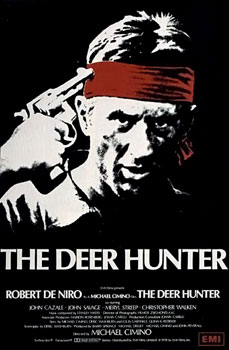
The Deer Hunter (1978)


When The Deer Hunter opened in 1978, it won five Oscars, including Best Picture and Best Director, and was nominated in many other categories. In 1996, it was chosen for preservation by the Library of Congress as being "culturally, historically, or aesthetically significant." In 1997 and again in 2007, it ranked on the AFI's list of the top 100 American films. Indeed, The Deer Hunter is so firmly established as a masterpiece that to watch it is revelatory. The film I saw was a turgid, predictable, arguably racist film that is only somewhat redeemed by strong performances and a few memorable scenes.

Director Michael Cimino's three-hour Vietnam epic is essentially divided into three acts. The first act introduces us to a group of Pennsylvanian steel workers - Steve (John Savage), Nick (Christopher Walken), and the natural leader of the group, Michael (Robert DeNiro). The three friends celebrate a wedding and go deer hunting before they are eventually sent to Vietnam, which begins the second act. Michael, Nick, and a delirious Steve are prisoners of war, and are forced to play a game of Russian roulette. They eventually escape, but along the way Nick gets left behind. The third act of the film deals with Michael and Steve's attempt to readjust to life in America, while Nick is stuck back in Vietnam.

Each act of the film has its problems, and the first act's problem is a basic one - overlength. There is nothing particularly offensive here, but the setup is tedious, and it seems to go on for ever. The wedding scene - which reeks of an imitation of The Godfather - is a particularly good example. But we also get scenes of the friends at work, at a bar, going hunting, etc. Cimino could probably have established the friendship dynamic in half the time he uses. It is also painfully obvious where the movie is heading in the first act. When Michael promises to Nick that he will never leave him behind in Vietnam, it's obvious that that is exactly what he will do. When Michael shares a dance with Nick's girlfriend Linda (Meryl Streep), we know that they will eventually fall in love. There is very little surprise in The Deer Hunter.

The second act of The Deer Hunter, with the three friends caught in a prison camp and forced to play Russian roulette, has a reputation for being particularly harrowing and disturbing. It is not harrowing - again, it is quite clear who will or will not die during the lethal game, and the scene is curiously devoid of tension. It is disturbing, however, but for all the wrong reasons - not for the violence it depicts, but because of its depiction of the North Vietnamese. All of the Asian characters are sadistic caricatures who gleefully laugh at violence. They are stereotypes, with no sense of humanity. One can easily see why the film was deemed racist upon release, although that word may be putting too fine a point on it. Still, Cimino lacks any sense of racial sensitivity, and the film's one-dimensionality is striking. All the Americans are heroes, and all the North Vietnamese are villains. It doesn't get much deeper than that.

Admittedly, the third act of The Deer Hunter is much stronger than the first two, with many memorable scenes. There is a quietly melancholic scene where Michael returns but can't bring himself to go to his coming-home party. In another scene, Michael explodes with startling anger at his friend Stan (John Cazale), who has been joking around with a pistol. The skilled cast is most responsible for making this material work, depicting the lives of ordinary Americans who are forever shaken after the war. This is best expressed in the film's final scene, which takes place at a dimly lit dinner table after a funeral. After a long, awkward silence, one character begins to hum "God Bless America." Soon all the cast joins in, quietly singing a patriotic tune that takes on a whole new meaning. It is a powerful, darkly ironic scene.

Still, I find The Deer Hunter to be a wildly overrated film. In almost every frame, you can see Cimino straining to make a Great American Epic, but his ambition succeeds his reach. There is nothing innovative or exciting here. It's a rather simplistic film, stretched to three hours and given a reputation that it simply does not deserve.

Verdict: C+

Saturday, March 7, 2009

Triple Feature: Taxi Driver (1976) / Goodfellas (1990) / The Departed (2006)


Martin Scorsese is widely hailed as one of the great American directors, yet before I began this blog I had only seen three Scorsese films, and abnormal ones at that – The Last Waltz, No Direction Home, and The Aviator. I have never been particularly attracted by his films’ subject matter, which often tends toward the extremely and unpleasantly violent. But after seeing the astonishing work of filmmaking that is Raging Bull, I decided to catch up with three Scorsese classics. Taxi Driver, which has been called by some the best film of the 70s, is a psychological thriller from the point of view of a mentally unstable cab driver. Goodfellas is Scorsese’s widely praised drama about life in the mob over the course of three decades. And The Departed, the film for which Scorsese finally won an Oscar, is a crime drama about an Irish mob and corruption in the Boston police department.

Taxi Driver is the oldest of the three films, and certainly the most daring. Goodfellas and The Departed, for all their merits, are basically genre films, but Taxi Driver is a bold, unconventional portrait of a man losing his grip on reality. Robert DeNiro, in one of his most famous performances, plays Travis Bickle, a war veteran who is now a taxi driver in New York City. Suffering from insomnia, he spends his sleepless nights shuttling people across the city, always repulsed by what he sees. “All the animals come out at night,” Bickle declares, describing the whores, drug dealers, and addicts he sees every night. “Some day a real rain will come and wash all this scum off the streets. “ Bickle sees a glimpse of hope in his miserable life when he meets a beautiful young campaign worker (Cybil Shepherd), but their relationship soon backfires. He also gets involved in the life of a 12 year-old prostitute (Jodie Foster), whom he tries to save before it is too late. In the end, alienated by society, Bickle resorts to shocking violence.

When I sat down to watch Taxi Driver, I expected to see a violent revenge movie more than anything else. But the film is deeper than that. It is a contemplative, brooding film about loneliness and alienation. Everything is seen from Bickle’s perspective, and the driving scenes perfectly emphasize his isolation from the rest of society – separated by that little plastic window, mired in shadow, and ignored by his customers, we begin to understand Bickle’s frustration – although the film wisely never tries to explain Bickle’s actions. Rather, it relies on the strength of DeNiro’s performance, who makes the whole thing seem believable.

Yet for all its strengths, I cannot pretend that I walked away from Taxi Driver with any lasting impression, or real insight. There is nothing particularly wrong with the film – DeNiro’s performance is excellent, Bernard Herrmann’s eerie score is memorable, and the cinematography is remarkable. But for all of its efforts to delve into Bickle’s psyche, I never became invested in the character – I always remained emotionally aloof, like Bickle himself.

I was less impressed with Goodfellas, one of Scorsese’s most popular and critically acclaimed films. The film, as its tagline declares, depicts three decades of life in the Mafia. Henry Hill (Ray Liotta) grows up in the 50s in Brookyln, and as a teenager becomes attracted to the allure of Mafia life – the cars, the money, the privileges. Much to the concern of his parents, Henry begins working for the local family, led by Paulie Cicero (Paul Sorvino), and the notoriously violent Tommy DeVito (Joe Pesci) and Jimmy Conway (Robert DeNiro). Soon, Henry quits school and becomes part of the mob full time. Despite initial happiness, Henry’s lifestyle eventually leads him to a drug addiction, jail time, and an unhappy marriage, before he winds up in FBI Witness Protection limbo, where he still longs to return to the life of a “Goodfella.”
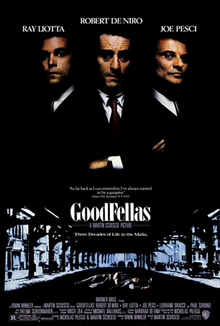
Goodfellas has often been compared to The Godfather, but for me there is no comparison. I will concede that Goodfellas is no doubt the more realistic mob movie – for all of its artistry, The Godfather is somewhat romanticized, the violence buried under slick montages and swelling music. Scorsese doesn’t fall for that – the violence is frequent, graphic, sudden, and often quite shocking. His movie is certainly an accurate portrait of the Mafia in America, and the performances all ring true. The dialogue always seems realistic and spontaneous, never rehearsed. Scorsese also does a suitable job of depicting the allure of Mafia life. The early scenes are at times playful and fun, reflecting Henry’s naïve perspective on the Mafia. “We were treated like movie stars with muscle,” Henry’s narration tells us, “we had it all just for the asking.” This at first glorious life is depicted with great flair in a long tracking shot where Henry and a date skip the line at an expensive restaurant, make their way through the kitchen, and find their seats while everyone else is standing outside in the cold. Of course, Henry’s lifestyle soon backfires into a hopelessly violent and amoral one.

But after a while, it seems like that is all Goodfellas has to offer – a series of violent, unpleasant incidents. The film lacks any basic sense of humanity, like The Godfather had. None of the characters are relatable. None of the characters are remorseful. And the film lacks any sense of elegance or grace. That may seem an odd complaint for a Mafia movie, but compare it to Taxi Driver. Both films deal with violent, disturbing material, but Taxi Driver uses violence sparingly, and does have a certain elegance about it. Goodfellas is just coarse, and in the end Scorsese relies too heavily on gratuitous violence to make his point – and there doesn’t seem to be much of a point anyway.
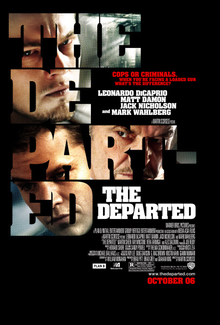
I will probably sound like a hypocrite for praising The Departed, because it suffers from many of the same flaws as Goodfellas – overlength, excessive violence, an over-reliance on four-letter words. But I found The Departed totally gripping from its first frame. The film begins with a narration by Irish mob boss Frank Costello (Jack Nicholson), who declares, “I don’t want to be a product of my environment. I want my environment to be a product of me.” In an opening prologue set to the Rolling Stones’ “Gimme Shelter,” Scorsese masterfully sets the scene, depicting Costello’s game – bribing kids off the streets of Boston, pulling them away from the Church and indoctrinating them into his mob. Flash forward many years later, and one such mobster, Colin Sullivan (Matt Damon) has become a mole in the Special Investigations Unit of the Massachusetts State Police. At the same time, the SIU sends its own mole, Billy Costigan (Leonardo DiCaprio) into Costello’s gang. Of course, both sides soon become aware of an intruder, and a bloody cat-and-mouse game ensues.

As I mentioned earlier, The Departed is essentially a genre film, a basic crime story– Scorsese isn’t really experimenting here, he’s playing it safe with familiar material. But what a crime movie it is! The whole film crackles along at a galloping pace, propelled by strong performances. Part of the joy of watching The Departed is to see the giants of 70s cinema – actors like Jack Nicholson and Martin Sheen – matched with some of the most talented actors of today, like DiCaprio, Damon, and Mark Wahlberg. The cast is uniformly solid, particularly Nicholson, who is a genuinely frightening presence. The film also has a tremendous sense of location, making full use of its Boston setting. I was skeptical about The Departed – despite its Best Picture win, I had heard criticisms that it was excessively violent, warmed-over Scorsese. Yet all of these criticisms were trampled by the film’s narrative drive, and the sheer talent of all the players involved.

Taxi Driver: B+
GoodFellas: B
The Departed: A-

Tuesday, February 17, 2009

Apocalypse Now Redux (2001)


Rarely have I been left so utterly speechless at the end of a film than after I finished watching Apocalypse Now Redux. After sitting through Francis Ford Coppola's 3 1/2 hour recut of his 1979 Vietnam epic, I was shocked, terrified, moved, entertained, intellectually stimulated, and speechless. I knew that I had witnessed something extraordinary, but I did not quite know what to make of it. Of course, it is easy to appreciate the technical mastery of the early scenes, with their splendidly choreographed helicopter fights, luscious cinematography, and startling use of sound; the sheer size of the production is incredible. But what to make of the final scenes, in which the protagonist Capt. Willard finally comes face-to-face with the apparently insane Col. Kurtz, who is worshipped like a god in the middle of the Cambodian jungle? This portion of the film is heady and strange, yet there was something undeniably fascinating about it. At the film's end, though not fully understanding the ending, I nonetheless remained convinced that Apocalypse Now was a staggering work of art by one of America's greatest directors.

Apocalypse Now Redux opens with a powerful montage in which Capt. Willard (Martin Sheen) lies in a drunken stupor in his Saigon hotel room, waiting for a new mission. Soon enough, Willard is ordered to sail up the Nung River to Cambodia to find Colonel Walter E. Kurtz (Marlon Brando), a once-promising soldier who has allegedly gone insane and betrayed the army. Willard's task is to terminate the Colonel's command - "with extreme prejudice." Willard is joined by four other men, and the film tracks their journey upriver to find Kurtz's compound.

Ambitious does not begin to describe Apocalypse Now. The production woes of the film are legendary - Sheen had a heart attack, Brando showed up unprepared and overweight, extreme weather destroyed sets, and principal production ended up taking 238 days to complete. To watch the film is to marvel that Coppola managed to pull it off. The air strike sequence, in which the maniacal Col. Kilgore (Robert Duvall) attacks a Vietnamese village to the tune of “Ride of the Valkyries,” is simply extraordinary. We see the point of view of the helicopters, as they swoop through schoolyards and blow up buildings with missiles, while the villagers scatter. The sheer logistics of directing such a scene, especially in the pre-digital age, are mind-boggling. It is simultaneously one of the most thrilling and disturbing battle sequences I have ever seen.

But the long river journey is the heart and center of Apocalypse Now. Willard’s team is filled with young and innocent soldiers, as Willard’s cynical narration tells us – “rock ‘n’ rollers with one foot in their graves.” There is the seventeen year old Clean (a young Lawrence Fishburne) from “some South Bronx shithole,” a Californian surfer named Lance (Sam Bottoms), the tightly wound “Chef” (Frederic Forrest), and the domineering Chief Phillips (Albert Hall). At first the journey seems almost pleasant – the men water ski, chat amicably, drink booze, and surf. But this feeling soon wears off as the journey continues. They are exposed to war atrocities, are attacked by a tiger, and in one tragic scene, accidentally kill a boatload of civilians. Several die along the way. The rest lose whatever faith in civilization they had.

When the survivors finally pull into Kurtz’s compound, they are greeted by a legion of native soldiers and a stoned American reporter (Dennis Hopper) who babbles on about how Kurtz is a “great man.” The camera passes over details like bloody staircases and decapitated heads without providing any explanation, thus leaving us to question who exactly this Kurtz is. The build-up here is effective, and it works on a parallel level, because of Brando’s reputation as a brilliant but difficult actor. When Kurtz finally appears, he is mired in shadow, a bald, cryptic old sage who cynically calls Willard “an errand boy, sent by grocery clerks, to collect the bill.” Brando is a frightening, mysterious, and powerful presence in his few scenes, and it is difficult to imagine any other actor playing the part so successfully.

It is in these final scenes that Apocalypse Now reveals its true ambitions. For all the impressive spectacle of its early scenes, Apocalypse Now remained a somewhat conventional war film. But in this final segment, Coppola dares to show us the darker side of human nature, and to reveal moral complexities. We begin to see Kurtz not as just a raving lunatic but as an ordinary man driven mad by the horrors of war. Yet Coppola offers no easy answers, particularly with an ambiguous ending that plays out like some ancient tribal ritual. This is a film that is meant to challenge, and so Coppola does, with the masterful spell that is Apocalypse Now.

Verdict: A+

Note: I have only seen the 2001 “Redux” version of Apocalypse Now, so all my views here are based on that version.

Saturday, January 31, 2009

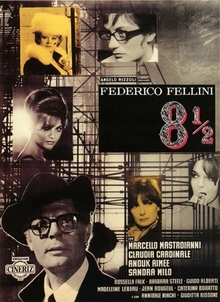
Double Feature: Day for Night (1973) / 8 1/2 (1963)


“I demand that a film express either the joy of making cinema or the agony of making cinema. I am not at all interested in anything in between; I am not interested in all those films that do not pulse.”

So said François Truffaut, the renowned French director of such films as The 400 Blows and Jules and Jim. In addition to being one of cinema’s greatest artists, he was also one of its greatest patrons. Truffaut began his career as a film critic, and according to those who knew him, he had an encyclopedic knowledge of films and an unadulterated love for the filmmaking process. That love comes across in his 1973 film Day for Night, which examines the family dynamic that forms between the cast and crew of a lightweight studio film named Meet Pamela. An interesting counterpoint is Federico Fellini’s 8 ½, about a director whose long-in-development film leaves his personal life in ruin. Upon first glance, it would appear that the two films are polar opposites, but both films “pulse” with a creative energy and the joy of cinema that Truffaut was so adamant about.

Every frame of Day for Night is bursting with love for the movie-making process. Truffaut plays Ferrand, the director of the studio comedy Meet Pamela. Jean-Pierre Leaud is Alphonse, the temperamental young star. Jacqueline Bisset plays Julie, a slightly unstable actress who has the title role in Meet Pamela. Truffaut fills out his film with other movie types – the aging supporting actress, the script girl, and various crew members.

Day for Night takes the form of a series of vignettes rather than a developed narrative, giving us a fly-on-the-wall look at life on a movie set. We observe the crew film a busy crowd scene, a car chase stunt, a simple dining room scene, and all the while we pick up on various film-making techniques. We share in the frustrations of the crew, as a cat refuses to lap up milk on cue, or as the aging actress Severine stumbles over her lines. Off set, we witness the relationships that develop among the cast and crew – friendships, romances, flings. All the while, the cast and crew are seen as a family, who share good times and console each other during bad ones.

The center of the film, though, is Ferrand, played by Truffaut as a version of himself. Truffaut once said that when he first saw Citizen Kane, he realized that he had never loved anyone as much as that film. The same would certainly be true of Ferrand, who remains doggedly fixated on making his movie above all else. To be sure, Ferrand develops friendships with his actors, and is never emotionally distant. Yet when Ferrand tries to console Alphonse after a romance gone wrong, his advice is to focus on learning his lines, because “people like you and me are only happy in our work.” That is one of the film’s strongest scenes, and it exemplifies what is so compelling about Day for Night. Not only is Truffaut’s adoration of cinema infectious, but the movie is filled with truthful human relationships.

Federico Fellini’s 8 ½ is also ostensibly about the making of a movie, but it is not really a film about film in the way that Day for Night is. The protagonist of 8 ½ is Guido (Marcello Mastroianni), a celebrated director whose film and life are crumbling around him. On vacation at a resort spa along with his producers, writer, and potential stars, Guido is hounded from all sides by people who are telling him how to make his film. The truth is, Guido doesn’t know what film he wants to make, and he finds solace in drifting into his childhood memories and his fantasies, embodied by a luminous Claudia Cardinale as the woman of his dreams. At the same time, Guido has to compete with the real women in his life – his mistress Carla (Sandra Milo) and jealous wife Luisa (Anouk Aimee).

8 ½ is remarkable on many levels. Fellini’s film weaves seamlessly between reality and fantasy, past and present without seeming at all heavy-handed. Unlike Guido, Fellini is in full command of his craft, and each segment builds upon the last to create a fuller portrait of Guido. That is not to say that every single shot or symbol makes sense. In one bizarre outdoors scene, Fellini pans past a group of characters who smile directly into the camera, and move in perfect synchronization as if they are in a sort of dance. There is no apparent reason for this, except that Fellini, ever the visual stylist, thought it looked interesting. That is not a criticism, but rather an example of how Fellini refused to follow conventions, constantly experimenting with structure and movement and composition. The film was originally titled The Beautiful Confusion, and that is exactly what it is. Even when we don’t fully understand Fellini’s intentions, his masterful direction and Gianni de Venanzo lush black-and-white photography keep the audience fully involved.

I have probably made 8 ½ sound far too esoteric, but it is really quite an entertaining movie. Fellini kept a note attached to his camera that read “Remember, this is a comedy.” Indeed, it is a rather broad comedy at times. One of the film’s most memorable sequences is a dream envisioned by Guido, who imagines a harem filled with all of the women in his life. They dote upon him, giving him baths, washing his home and preparing dinner. In another scene, Guido remembers as a schoolboy visiting the severely overweight Saraghina (Eddra Gale), a prostitute who does a grotesque and hilarious dance on the beach.

Despite these comic scenes, though, I would not generally characterize 8 ½ as a comedy. Guido spends most of the film in an unhappy state, only taking comfort in his dreams and fantasies. Only in the end does Guido find happiness, as he abandons his movie and decides to pick up the scattered pieces of his life. “Life is a celebration,” Guido tells his wife Luisa, “let’s live it together!” Fellini, unlike Truffaut, seems to be concluding that life is more important than film. And yet Day for Night and 8 ½ are not at all incompatible; both emphasize the joy of making cinema in their own way. Truffaut points out the simple pleasures of movie-making, the day-to-day gratifications of being on a set. And Fellini, through the creation of 8 ½, shows us that he is an artist of the first order, using the tools of his trade to examine the pieces of a man’s life – a beautiful confusion indeed.

Day for Night: A
8 ½: A+

Monday, January 19, 2009

Three Colors Trilogy: Blue/White/Red (1993-1994)


The three colors in Krzysztof Kieslowski's Three Colors trilogy are said to represent the colors of the French flag, and the values they stand for - blue (liberty), white (equality), and red (fraternity). But the trilogy is about as apolitical a work as one can imagine. The three values are examined from an emotional, not a political standpoint. Like Kieslowski’s The Decalogue, a series of ten hour-long films examining each of the Ten Commandments, the Three Colors trilogy explores the meaning of a traditional set of values in the modern world. Seen on their own, the films stand up as rich and fascinating character studies. But the trilogy is greater than the sum of its parts, and ultimately emerges as a beautiful and haunting work – despite some missteps.

Blue tells the story of Julie (Juliette Binoche), whose husband (a famous composer) and daughter are killed in a car crash at the beginning of the film. Julie decides to break off any connection to her past life, abandoning her home and moving to a Paris apartment. In White, a Polish man named Karol Karol (Zbigniew Zamachowski) is divorced and abandoned by his French wife of six months, Dominique (Julie Delpy). He eventually returns to post-communist Poland, rebuilds his life, and becomes determined on seeking revenge. Red closes out the trilogy with the story of an unlikely friendship that forms between a kindhearted young model (Irène Jacob) and a cynical old judge (Jean-Louis Trintignant).

Blue begins the trilogy with a bang - a purely figurative one, though, since Blue is a very quiet, subtle, and somber film. There is no “plot” to speak of, other than the set up in which Julie loses her family in a car crash. Rather, Kieslowski gives us an almost first-person look into Julie’s life, without providing any exposition. She is an intriguing character from the start precisely because we do not understand her. Why can she not carry on with her suicide attempt? Why does she sleep with her husband’s colleague only days after her release from the hospital? Why does she decide to toss away her husband’s last great work, a piece of music he was writing for a prestigious European concert? These kinds of questions propel Blue, and Binoche’s ambiguous performance is fascinating.

The film is also wonderful to look at. Kieslowski uses the color blue to great effect – a blue haze dominates some scenes, blue beads dangle from Julie’s apartment, and Julie takes late night swims in a lonely blue pool. The film also makes great use of classical music, particularly the consistently replayed “Song for the Unification of Europe” composed by Julie’s late husband. Blue closes with an incredibly artful montage that shows the various characters in Julie’s new life. It is a perfect blending of image and music, and a fitting end to this masterful work of art.

White is considerably less brilliant. It is the only comedy in the trilogy, and as a result seems rather disconnected from the two other films. It is the most narratively busy movie in the trilogy, with its story arc of a Polish man who gets divorced by his wife, winds up a beggar in Paris, returns to Poland, starts a successful business, and eventually hatches a revenge scheme to get even with his wife. Yet for all this plotting, the characters themselves simply are not very interesting. The relationship between Karol and his wife Dominique, which the entire film hinges upon, is never fully developed. For the most part, the film fails to connect on an emotional level.

White is not without its strengths, however. As with the other films in the Three Colors Trilogy, it features exceptionally strong acting from its leads, particularly Zbigniew Zamachowski as Karol. His performance is not as nuanced as the female leads in Blue and Red, but he is a perfectly likable and funny hero. The supporting cast is equally strong, with the standout being Janusz Gajos as Mikolaj, the Polish man who befriends Karol and helps him to get his life back. Mikolaj is not without his own demons, however, and the friendship between Karol and Mikolaj is one of the most compelling features of White. Kieslowski also again makes great use of the color white in telling his story. White is not a bad film, necessarily. It just feels somewhat lightweight in the company of Blue and Red.

Red brings the trilogy full circle with a fascinating study of chance and friendship. Irène Jacob stars as Valentine, a lonely young model who by chance meets a retired judge named Joseph Kern when she runs over his dog. Valentine is initially turned off by Joseph’s cynicism and habit of spying on his neighbors. Yet a friendship quickly develops between these two unlikely friends. Running parallel to this story is the story of Auguste (Jean-Pierre Lorit), a young judge struggling with love. Auguste lives next door to Valentine, yet they somehow never meet.

Red works on a number of different levels. There are character parallels between the young and old judge, there is the sheer artistry of the cinematography and editing, and there are the motifs that echo themes from the previous two films. But the most memorable scenes in Red are those of Valentine and Joseph just talking. I have consistently praised the acting of the trilogy, but Jean-Louis Trintignant as Joseph really outdoes himself here. Like Valentine, we at first dislike Joseph and take him for a nasty old man, but Trintignant slowly shows us the many layers that make up this man, and the tragedy that he is hiding. Above all, Red is an intelligent film about human connections.

Krzysztof Kieslowski’s Three Colors trilogy is a work greater than the sum of its parts. Although I did not greatly appreciate White, I have come to admire it as a piece of the whole, along with the masterful Blue and Red. The whole trilogy could be dissected endlessly, in an examination of its themes, and its use of color, cinematography, music, and editing. Yet what stood out to me upon first viewing were the quiet moments of pure human emotion - Julie’s conversation with a stripper in Blue, Mikolaj’s life-altering decision in White, and Valentine and Joseph’s final conversation in Red. This is the real triumph of the Three Colors trilogy – besides being a technical triumph, it understands what it is to be human.

Blue: A
White: B –
Red: A

Trilogy: A -

Wednesday, January 7, 2009

Double Feature: Grand Illusion (1937) / Paths of Glory (1957)


“Patriotism is the last refuge of the scoundrel.”
- Samuel Johnson

That line is quoted early on in Stanley Kubrick’s Paths of Glory, a brilliant World War I film about a risky mission gone wrong. But it might have just as well belonged in Jean Renoir’s Grand Illusion, an influential French film that deals with the relationships between a group of French officers in a German war camp. Although the films were made two decades apart and in different countries, the similarities are striking. Both are black-and-white World War I films about the French army, and both have strong anti-war messages. The two films tackle different realities of war, though – Paths of Glory deplores military corruption, while Grand Illusion laments the way war tears apart human relationships.

Grand Illusion is a war film without the war. There is never a single battle sequence in the film, nor should there be. The story focuses on a group of French officers who are taken as prisoners of war in a German prison camp. Among the captives are Captain de Boeldieu (Pierre Fresnay), a wealthy aristocrat, Lieutenant Maréchal (Jean Gabin), a middle-class soldier, and Rosenthal (Marcel Dalio), a Jewish banker. The men spend every night digging an underground tunnel to escape, but they are deported to another camp before they get the chance. At the new camp, the supposedly inescapable Wintersborn, they meet up with the German Captain von Rauffenstein (Erich von Stroheim), who first shot down Boeldieu’s plane. At Wintersborn, the men eventually pull off a somewhat successful escape, but not without the cost of one man’s life.

I spent much of the first half of Grand Illusion puzzled at its supposedly pacifist message. I suppose I was used to films like Saving Private Ryan, which depicts horrible conditions and sickeningly violent battles to push its message that war is hell. In contrast, the prison camp in Grand Illusion seems downright cheery. The prisoners are treated well, given large quarters, seem fairly happy, and even put on a musical show. But I began to understand that Renoir was not interested in depicting the physical horrors of war. Renoir wrote that the film was “a story about human relationships,” and it is exactly that.

The key relationship in the film is the one between Captain de Boeldieu and Captain von Rauffenstein. Von Rauffenstein is a hospitable captor – after he shoots down the plane, he invites Boeldieu to lunch before he is sent to the camp. The two captains immediately get on, discussing a mutual friend in Berlin. Later, when Boeldieu is reunited with von Rauffenstein at Wintersborg, they seem glad to see each other again, and have a conversation about what will come about after the war. It has been said that World War I was the most literary war; it was led by well-educated aristocrats. That idea runs throughout Grand Illusion, especially in the scenes with the two captains. They discuss how the age of the aristocrat is ending, and von Rauffenstein speaks of having to go on leading a “futile existence” after the war. The scenes between the two men have great poignancy, and the acting is tremendous. Apparently Erich von Stroheim spoke almost no German and struggled through his lines, but he conveys the essence of his character with facial expressions. Von Stroheim was himself a silent movie director, and no doubt realized the power of facial acting.

Another important relationship is introduced near the end of the film. Maréchal and Rosenthal have escaped, and stay with a German widow named Elsa (Dita Parlo) in the countryside. A romance blossoms between Maréchal and Elsa, even though neither can speak the other’s language. But the two soldiers have to leave for Switzerland, and Elsa breaks down crying, telling Maréchal how she has been alone for so long. These two relationships (von Rauffenstein and Boeldieu, Maréchal and Elsa) reveal the essential tragedy of Grand Illusion. Outside of war, these characters would be best friends, but war dictates that they cannot be.

If aristocratic French officers are the heroes of Grand Illusion, they are the villains in Paths of Glory. Kirk Douglas is Colonel Dax, just about the only sympathetic officer in the film. Dax’s corrupt superior officer, General Mireau (George Macready) is ordered by his superior, General George Broulard (Adolphe Menjou) to lead an attack on a well-fortified German hill. Dax insists that it is a suicide mission, but Mireau insists on the attack – mainly for the possibility of promotion. When the attack inevitably fails, Mireau blames it on cowardice, and orders 3 men to be tried under penalty of death. The trial is a sham, and despite Dax’s noblest efforts, the three innocent men are ordered to die.

Paths of Glory is a very cynical film, exposing the inherent corruption in the high ranks of the army. The battle scenes are grim, and probably more harrowing than most films of the time, but the most terrifying scenes occur “behind the scenes,” so to speak – in offices and courts. After the mission inevitably fails, Mireau calls a meeting with Colonel Dax and General Broulard. Mireau, who prides himself on being a principled patriot, initially calls for one hundred men to be killed. Broulard calms him down, eventually working the number down to three, much to Mireau’s disappointment.

The scene is disturbing because it becomes clear how cold and distant these generals are. They feel no guilt in sentencing three innocent men to death and then genially making lunch plans. Dax, meanwhile, is caught in the middle, working his best to defend the innocent men. Douglas may be more of a movie star than a great actor, but his performance in Paths of Glory is very effective. Dax is appalled at the situation, but must contain his anger during the trial. The whole film is a very quiet one. For the most part, there are no impassioned monologues, no tirades against injustice – until the penultimate scene in the film. After the execution, Broulard offers Dax Mireau’s job, implying that Dax has been aiming for promotion all along. Dax, who feels like he has been used, finally explodes, calling Broulard a “degenerate, sadistic old man” and refuses to apologize. The scene is cathartic for both Dax and the audience.

Kubrick adds an interesting tag to the end of the film. The soldiers are gathered in a bar, where a captured German woman is brought onstage to sing a folk song. The men cheer and whistle, but when she starts singing the whole place falls silent. Everyone is clearly affected, and several of the men visibly weep. It’s not clear why - maybe they are thinking of their sweethearts back home, or maybe they are just wondering how this poor woman found herself so far from home. But for a moment, the German woman and the French soldiers, so different superficially, are united in song. It is a very emotional scene, and would not have felt out of place in Grand Illusion. Indeed, I wonder if Kubrick was inspired by Renoir’s film.

Both Grand Illusion and Paths of Glory are incredibly accomplished films. Grand Illusion is by far more influential, and is widely praised as one of the greats of French cinema. But Paths of Glory is a wonderful example of studio filmmaking by a true auteur who would soon transcend it. Grand Illusion shows that a bond can exist between people who should have nothing to do with each other. In the same way, two directors from different backgrounds and countries here made two separate masterworks about the follies of war.

Grand Illusion: A
Paths of Glory: A