Showing posts with label italian. Show all posts

Saturday, January 31, 2009

Double Feature: Day for Night (1973) / 8 1/2 (1963)


“I demand that a film express either the joy of making cinema or the agony of making cinema. I am not at all interested in anything in between; I am not interested in all those films that do not pulse.”

So said François Truffaut, the renowned French director of such films as The 400 Blows and Jules and Jim. In addition to being one of cinema’s greatest artists, he was also one of its greatest patrons. Truffaut began his career as a film critic, and according to those who knew him, he had an encyclopedic knowledge of films and an unadulterated love for the filmmaking process. That love comes across in his 1973 film Day for Night, which examines the family dynamic that forms between the cast and crew of a lightweight studio film named Meet Pamela. An interesting counterpoint is Federico Fellini’s 8 ½, about a director whose long-in-development film leaves his personal life in ruin. Upon first glance, it would appear that the two films are polar opposites, but both films “pulse” with a creative energy and the joy of cinema that Truffaut was so adamant about.

Every frame of Day for Night is bursting with love for the movie-making process. Truffaut plays Ferrand, the director of the studio comedy Meet Pamela. Jean-Pierre Leaud is Alphonse, the temperamental young star. Jacqueline Bisset plays Julie, a slightly unstable actress who has the title role in Meet Pamela. Truffaut fills out his film with other movie types – the aging supporting actress, the script girl, and various crew members.

Day for Night takes the form of a series of vignettes rather than a developed narrative, giving us a fly-on-the-wall look at life on a movie set. We observe the crew film a busy crowd scene, a car chase stunt, a simple dining room scene, and all the while we pick up on various film-making techniques. We share in the frustrations of the crew, as a cat refuses to lap up milk on cue, or as the aging actress Severine stumbles over her lines. Off set, we witness the relationships that develop among the cast and crew – friendships, romances, flings. All the while, the cast and crew are seen as a family, who share good times and console each other during bad ones.

The center of the film, though, is Ferrand, played by Truffaut as a version of himself. Truffaut once said that when he first saw Citizen Kane, he realized that he had never loved anyone as much as that film. The same would certainly be true of Ferrand, who remains doggedly fixated on making his movie above all else. To be sure, Ferrand develops friendships with his actors, and is never emotionally distant. Yet when Ferrand tries to console Alphonse after a romance gone wrong, his advice is to focus on learning his lines, because “people like you and me are only happy in our work.” That is one of the film’s strongest scenes, and it exemplifies what is so compelling about Day for Night. Not only is Truffaut’s adoration of cinema infectious, but the movie is filled with truthful human relationships.

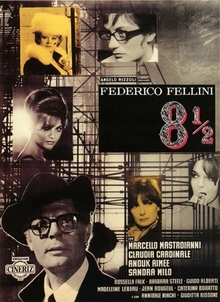
Federico Fellini’s 8 ½ is also ostensibly about the making of a movie, but it is not really a film about film in the way that Day for Night is. The protagonist of 8 ½ is Guido (Marcello Mastroianni), a celebrated director whose film and life are crumbling around him. On vacation at a resort spa along with his producers, writer, and potential stars, Guido is hounded from all sides by people who are telling him how to make his film. The truth is, Guido doesn’t know what film he wants to make, and he finds solace in drifting into his childhood memories and his fantasies, embodied by a luminous Claudia Cardinale as the woman of his dreams. At the same time, Guido has to compete with the real women in his life – his mistress Carla (Sandra Milo) and jealous wife Luisa (Anouk Aimee).

8 ½ is remarkable on many levels. Fellini’s film weaves seamlessly between reality and fantasy, past and present without seeming at all heavy-handed. Unlike Guido, Fellini is in full command of his craft, and each segment builds upon the last to create a fuller portrait of Guido. That is not to say that every single shot or symbol makes sense. In one bizarre outdoors scene, Fellini pans past a group of characters who smile directly into the camera, and move in perfect synchronization as if they are in a sort of dance. There is no apparent reason for this, except that Fellini, ever the visual stylist, thought it looked interesting. That is not a criticism, but rather an example of how Fellini refused to follow conventions, constantly experimenting with structure and movement and composition. The film was originally titled The Beautiful Confusion, and that is exactly what it is. Even when we don’t fully understand Fellini’s intentions, his masterful direction and Gianni de Venanzo lush black-and-white photography keep the audience fully involved.

I have probably made 8 ½ sound far too esoteric, but it is really quite an entertaining movie. Fellini kept a note attached to his camera that read “Remember, this is a comedy.” Indeed, it is a rather broad comedy at times. One of the film’s most memorable sequences is a dream envisioned by Guido, who imagines a harem filled with all of the women in his life. They dote upon him, giving him baths, washing his home and preparing dinner. In another scene, Guido remembers as a schoolboy visiting the severely overweight Saraghina (Eddra Gale), a prostitute who does a grotesque and hilarious dance on the beach.

Despite these comic scenes, though, I would not generally characterize 8 ½ as a comedy. Guido spends most of the film in an unhappy state, only taking comfort in his dreams and fantasies. Only in the end does Guido find happiness, as he abandons his movie and decides to pick up the scattered pieces of his life. “Life is a celebration,” Guido tells his wife Luisa, “let’s live it together!” Fellini, unlike Truffaut, seems to be concluding that life is more important than film. And yet Day for Night and 8 ½ are not at all incompatible; both emphasize the joy of making cinema in their own way. Truffaut points out the simple pleasures of movie-making, the day-to-day gratifications of being on a set. And Fellini, through the creation of 8 ½, shows us that he is an artist of the first order, using the tools of his trade to examine the pieces of a man’s life – a beautiful confusion indeed.

Day for Night: A
8 ½: A+

Monday, December 22, 2008

L'avventura (1960)


L'avventura (English title: The Adventure) is a strange title for any film. It is certainly a nondescript title, and it implies a sort of light-hearted escapism. But Michelangelo Antonioni's 1960 film offers nothing of the sort. It is a film where the "adventure" - namely the disappearance of a wealthy socialite on an island - plays second fiddle to the characters and their relationships. This deception initially led to a vitriolic public reaction, and the film was booed by the audience when it premiered at the Cannes Film Festival in 1960. But two years later it was voted by Sight & Sound as the second greatest film of all time, and it is regarded as a milestone in foreign cinema today.

The story begins with two wealthy friends, Anna (Lea Massari) and Claudia (Monica Vitti) leaving to go on a yacht trip. Anna brings her boyfriend Sandro (Gabriele Ferzetti), whom she feels frustrated with and distant from. The three depart, along with two other couples, for their excursion. After making a stop at an island, the company soon discovers that Anna is missing. They search the island and call in the police, but to no avail. After a few days worrying, everyone goes on with their lives - including Sandro and Claudia, who are beginning to fall in love.

L'avventura never resolves the mystery of what happened to Anna. It doesn't need to, because that is not what the film is about. Anna's disappearance only sets the stage to illuminate the shallowness of the main characters' lives. Days after his girlfriend's disappearance, Sandro and Claudia share a kiss, and proclaim their love for one another. In the same period of time, Giulia (Dominique Blanchar), another friend of Anna's, begins to crack jokes about her disappearance. She has also begun dating a 17 year-old painter, seemingly bored with her previous squeeze, an older man named Corrado. Immediately we begin to understand one of the points of L'avventura - friendships mean nothing to these people. They lead perfectly comfortable yet incredibly empty lives. Pauline Kael put it better than I ever could: "Too shallow to be truly lonely, they are people trying to escape their boredom by reaching out to one another and finding only boredom once again.'' In this way, the themes of L'avventura are very similar to those in La Dolce Vita, another Italian film released the same year.

L'avventura is also notable for its beautiful cinematography. In fact, the film won a special jury prize at Cannes in part for "the beauty of its images." Yet the cinematography did not inspire me in the way that films like Lawrence of Arabia do. It is perfectly adequate, even above average, but I think almost anyone can make shots of Italian islands and crashing waves look appealing. Few images stayed with me, with the exception of the last scene. It is an exquisite, silent scene that relies on the power of images rather than dialogue to bring the film full circle. That is the second reason why the film won the jury prize - it was cited for the creation of a "new cinematic language." The film did not rely on plot gimmicks, narration, or even much dialogue to tell its story, preferring instead to focus on the images.

L'avventura is a very accomplished and influential film, but it did not resonate with me the way that La Dolce Vita did. I found La Dolce Vita a more profound film, with deeper themes. Yet a comparison between the two may be unfair, and I have found that many foreign films require at least two viewings before full appreciation sets in. On its own terms, L'avventura is a fascinating and intelligent film as well as an important landmark of cinema.

Verdict: B+

Monday, November 24, 2008

La Dolce Vita (1960)


Federico Fellini's La Dolce Vita is perhaps most remembered for the image of beautiful blonde actress Anita Ekberg standing in a fountain in Rome. It is an iconic image; recognizable even to those who have not seen the film. Ekberg plays an American actress named Sylvia, but she is only a minor character in the film, just one of many characters who pass through the story. In fact, La Dolce Vita is a very episodic film with few recurring characters. The one thread that ties it all together is the character of Marcello (Marcello Mastroianni), a photojournalist who lives the "sweet life" in Rome - driving expensive cars, eating at cafes and cavorting with movie stars. The movie exposes the shallowness of such a life, and is particularly relevant in this age of Paris Hiltons and Lindsday Lohans. But to look at La Dolce Vita as merely a message movie is to ignore the most compelling reason to see it - it is a fascinating character study, featuring beautiful cinematography and directed by a top-class filmmaker at the height of his power. 

It is difficult to summarize the "plot" of La Dolce Vita because it is by no means a traditionally structured narrative. The film is mainly a string of disconnected sequences, each representing one night in Marcello's life. There are a few recurring characters, though - Emma (Yvonne Furneaux) is Marcello's estranged and suicidal girlfriend. Steiner (Alain Cuny) is one of Marcello's idols, a seemingly happy intellectual with a wife and kids. Maddalena is a rich heiress who Marcello encounters at the beginning and end of the film. 

The film's structure is at times frustrating. Upon first viewing, some sequences seem overlong, and the film lacks a cohesive flow. Yet that is part of what La Dolce Vita so brilliant. Its disjointed structure illustrates the empty life of Marcello. He spends his nights at sumptuous parties, drinking with beautiful women, but never finds a stable relationship or any real meaning in his life. The same holds true for the people Marcello surrounds himself with. 

In one telling sequence, Marcello's father comes to Rome and visits his son. Marcello expresses a clear desire to connect with his father, but at dinner his father is distracted by an alluring chorus girl. They go home together, but at dawn his father becomes sick and eventually must leave on an early train. The scene is revealing because it shows how Marcello's character flaws go back to his father, but also that Marcello is looking for a real relationship with his father. Mastroianni perfectly exudes a lonely yearning in that scene. 

Another central figure in the story is Steiner, who in many ways represents what Marcello would like to be. Steiner is a serious writer, a family man, and fancies himself an intellectual. But he is not as happy as it would appear, which is made tragically clear later in the film. The character of Steiner, and indeed all of the supporting characters, are wonderfully sketched by Fellini, the screenwriters, and a gifted cast. 

Another one of the the film's assets is its gorgeous black-and-white cinematography. Many of the images in the film are extremely memorable.  The fountain scene is the most obvious example, but there are others. A Christ statue being towed over Rome by a helicopter. The deserted streets of Rome at night. Marcello's father, blankly staring out of an apartment window. And the perfect final few shots of the film, which I will not reveal here.  

La Dolce Vita is also fascinating for its depiction of the paparazzi. In fact, the word "paparazzi" comes from the film's character of Paparazzo, who is one of the many photojournalists who swarm around the lives of the main characters. The paparazzi are ever-present in the movie, and they have no sense of decency. When Marcello gets into a fight with Sylvia's boyfriend, they do not rush to help their friend but rather rotate around the fight to get the best shot. When a woman is informed of a family tragedy, dozens of them crowd around her to capture her reaction. The film is almost scarily accurate in this depiction, especially since it holds true today. 

La Dolce Vita is a long and at times frustrating film - its unconventional structure may try the patience of some viewers. But that is really the only criticism I can give it. The film is positively overflowing with ideas, and its influence on cinema is remarkable. Yet aside from any historical importance, La Dolce Vita is a wonderful film in its own right. The story is heartbreaking, the cast impeccable, and the cinematography beautiful. For adventurous filmgoers, La Dolce Vita will provide food for thought for years to come. 

Verdict: A