Showing posts with label 1950s. Show all posts

Friday, December 24, 2010

Nicholas Ray Triple Feature: Bigger than Life (1956) / Johnny Guitar (1954) / Wind Across the Everglades (1958)

Nicholas Ray never won an Oscar or a lifetime achievement award, worked in Hollywood for little more than a decade, and directed only a few canonized classics. His most famous film, Rebel Without A Cause, is remembered for James Dean's iconic performance rather than Ray's direction. Surprising, then, that this was the man whose career launched the auteur theory. François Truffaut, Claude Chabrol, and Jean-Luc Godard sang his praises in the pages of Cahiers du Cinéma, seeing in his work the possibilities of a newly personal cinema, in which the director was the true author of the movie. When these same critics became filmmakers themselves, and the leaders of the French New Wave, they continually cited Ray as a formative influence. Godard even dedicated his film Made in U.S.A. to Ray, and once declared, in typically hyperbolic fashion, "The cinema is Nicholas Ray!" All this while Ray was ignored in his native land.

What, exactly, makes Nicholas Ray an "auteur?" Upon first glance, he might seem merely a workmanlike, efficient Hollywood director. Unlike his French admirers, Ray was never really an independent filmmaker, rather working under the confines of the studio system. Neither did he specialize in a particular genre, but rather dabbled in film noir, Westerns, Biblical epics, socially conscious dramas, adventure films, and more. But Ray's triumph was to make deeply personal films with popular appeal. Each of his films, no matter the genre, is graced with the same qualities: a dynamic and expressionistic visual style, and a thematic concern for the lonely and isolated. Ray's films also address societal issues like suburbanization, the Communist witch hunts, and environmentalism - themes that were overlooked at the time but which only make his movies more fascinating as time goes by.

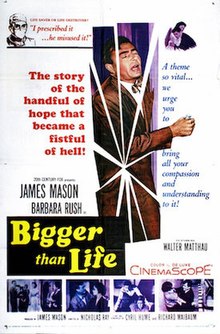
Bigger than Life (1956) is perhaps Ray's masterpiece. The story could almost be an after school special: a suburban father begins taking an experimental drug, which dramatically transforms his personality and nearly destroys his family. In the end, though, he recovers, repents, and the happy family is reconciled. Under another director, Bigger than Life could have been an insufferable message movie. Instead, though, Ray uses this plot to launch a freewheeling critique of American society in the 50s. We begin to understand that Ed Avery, the main character played by James Mason, is not fundamentally changed by the drug - it merely unleashes his suppressed feelings about his life, his family, and his culture. The failings of American education, the obsession of consumerism, the banality of suburban life, the superficial distinctions of class, the realities of a loveless marriage - all are targeted in Bigger than Life.

Part of what makes Ray a great director is his ability to dramatize his themes visually, and Bigger than Life is perhaps the best example. The film is shot in the aspect ratio of 2.55:1, an extremely wide format that allows Ray to fill the frame with revealing details. Consider the way Ray films Avery's house. The house is a typical specimen of suburbia, and would not be out of place in Leave it to Beaver or Father Knows Best. As the film progresses, though, the house becomes a visual representation of Avery's character, an extension of his psyche. The walls of the house are plastered with posters of European cities that Avery will never visit. A deflated football on the mantelpiece is a sad reminder of his fading college football days. The spacious interiors and separation of rooms suggest the estrangement that Avery feels from his family.

Ray, who made some of the great film noirs, is certainly no stranger to shadows. In Bigger than Life, they are everywhere. Initially, most of the interiors are shot with muted colors and low light, but Ray ups the contrast later in the film, setting bright colors against dark shadows. Consider the shot below, in which Avery looms over his son, pressuring him to finish a math problem. So many themes of the movie are present in that one shot: the impossible expectations Avery sets for his son, the God complex that the use of cortisone has given him, the ugly demons that overtake his personality. And perhaps above all, Richie, the son, isolated in the foreground, overwhelmed and silently crying.
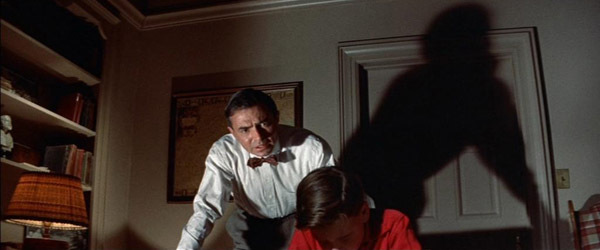
Richie, in fact, may be the key to the film. Upon a second viewing, it struck me that the viewer's sympathies - and certainly Ray's - lie almost entirely with this little boy. Richie is the wisest character in the film - the first to notice the effect of the drug on his father, the first to question his father's newfound obsession with spending money, and ultimately the one to call the doctor and make his father stop taking the pills. But Richie's mother dismisses his concerns, and his father considers him a failure. "Childhood is a congenital disease, and the purpose of education is to cure it," Avery says at one point. In the end, Avery gives up on even this cynical mantra, deciding to sacrifice his son in an imitation of Abraham slaughtering Isaac. Until a deus ex machina appears, of course, saving Richie and delivering a happy Hollywood ending.

Despite this obvious compromise, Bigger than Life remains perhaps Ray's greatest film: a social satire posing as a domestic melodrama that becomes something of a horror film. It is a movie of ideas, but these ideas never overtake the film's emotional center - Richie. He stands for his entire generation, I think, and he shares some affinities with the hero of Ray's previous film - James Dean's Jimmy Stark. It is easy to see how Richie, too, could become a rebel without a cause.

How to describe Johnny Guitar (1954)? François Truffaut put it this way: "It is dreamed, a fairy tale, a hallucinatory Western...Johnny Guitar is the Beauty and the Beast of Westerns, a Western dream. The cowboys vanish and die with the grace of ballerinas." That oft-quoted description comes close to capturing the film's wonderful strangeness, its bizarre remove from its own genre. Here is a Western where the gunslinger is a mopey, laid-back guitar player who hardly influences the action at all. The real drama, and indeed the final shootout, is between two women: Joan Crawford's Vienna, a saloon owner who is being run out of town, and Mercedes McCambridge's Emma, a Puritanical cattle rancher who wants her gone. The ostensible cause of the women's enmity is the love of a man, but the film is rife with barely concealed lesbian tension. "I never met a woman that was more man," a bartender says of Vienna, and Emma seems oblivious of all men in her quest to bring down Vienna.

The plot is patently ridiculous, the colors are outlandish, and the film has few of the traditional pleasures of the Western. It's easy to see, then, how Johnny Guitar has become something of a cult classic; it's also easy to see how it could be dismissed as little more than an eccentric example of genre revisionism. But the movie is better than that. Despite all of its ludicrous trappings, the true story of Johnny Guitar is a sincere, affecting one. It reiterates Ray's perpetual themes of loners and outsiders. Vienna is a woman hardened by life and unrequited love, who builds her saloon as a kind of haven. Johnny is a wanderer who returns to his ex-lover, Vienna, for a few days of happiness before Emma's posse descends on the saloon and ruins their paradise.

Johnny Guitar is also an unapologetic commentary on McCarthyism and the Hollywood blacklist. About halfway through the film, Sheriff McIvers (Ward Bond) is desperate to frame someone for the robbery of a stagecoach, and his gang try to make townspeople testify against each other - a clear parallel to the House Un-American Activities Committee and their attempts to root out suspected Communists. The issue would certainly have had personal significance to Ray. His political views leaned towards the left, and many of his closest collaborators - among them Johnny Guitar's screenwriter Ben Maddow, and Humphrey Bogart - had been targeted by HUAC. Ray dresses the sheriff's gang in matching black, and arranges them in diagonal formations that suggest their gang mentality.

What emerges from Johnny Guitar most clearly, though, apart from these political overtones, is a sense of doomed romanticism. Ray's vivid use of color and space, the melancholic score, and the script's surprisingly moving romantic exchanges do indeed create a dreamlike quality, as suggested by Truffaut. This is not a hard-hitting Western, but a sensitive, passionate one, in which the characters all seem to be wounded and yearning for love.

Wind Across the Everglades (1958) is obscure even by Ray's standards. It was never released on VHS, let alone DVD, and its two main stars were hardly A-listers: Burl Ives and Christopher Plummer. What's more, it has to be asked if it is a Nicholas Ray film at all. The movie was the brainchild of screenwriter Budd Schulberg, and was produced by his brother Stuart; when they were unhappy with Ray's style, they fired him and Budd directed the rest of the film. The critic Jonathan Rosenbaum has described it as "a kind of litmus test for auteurists," and from that perspective it is a fascinating case study.

Unfortunately, and perhaps inevitably, the movie itself is somewhat choppy. Schulberg so resented Ray that he threw away much of his footage, and the narrative is not easy to follow. The story is set in early 19th century Florida, and concerns a game warden (Christopher Plummer) who comes to enforce conservation laws and goes up against a violent bird poacher (Burl Ives). There is also a romantic subplot that goes nowhere.

Wind Across the Everglades
plays like a rough draft of a film that, if polished, could have become something much greater. Nonetheless, the movie is not without interest. For a 1958 film, it is curiously modern in its depiction of the environment. The opening scene depicts, in a documentarylike fashion, how the whims of women's fashion nearly decimated the population of birds in Florida. The main character, moreover, is a strident conservationist who pits himself against a ruthless hunter. The relationship between these two men is the core of the film. Both men are, in their own way, outcasts from society. Despite their professional differences, the two men unite over a drinking game, in an extended scene that seems spontaneous and improvised. Alas, such improvisational techniques are what got Ray fired from the film.

Wind Across the Everglades is less than the sum of its parts, but in some scenes Ray's brilliance is clearly evident. Ray's visual gifts are on full display, though this time he largely trains his camera on beautiful wildife exteriors, as opposed to the interiors of Bigger than Life and Johnny Guitar. A subplot involving a Native American is a classic example of Ray's outsider theme, and the performances he coaxes from the actors are uniformly strong. One only wishes that Ray had been allowed to see his vision through from beginning to end.

What makes a great director? For the famous critic Andrew Sarris, it was the presence of a theme. For Orson Welles and the New Wave critics, it was the extent to which the work represented the man who made it. Others might point to style, or influence. Whatever the criteria, Nicholas Ray seems to have it all.

Apologies for the delay with this post! When I saw these films in July at the Harvard Film Archive, I never expected that it would take 5 months to write the blog post on them. Hopefully, with my college apps almost done, I will have more time for blogging in the future.

Wednesday, April 21, 2010

The Human Condition (1959-1961)


Masaki Kobayashi's The Human Condition is exactly what it sounds like - a long, sprawling, grandiose epic about war and heroism and patriotism and humanity and a whole variety of other things. Unsurprisingly, it is overlong and overambitious. More surprisingly, it is often a bore. The first film in the trilogy is at least engaging as a conventional war story and character study, but the second and third parts become so prolonged and predictable that when the trilogy finally stopped in its tracks, nine and a half hours after it started, I had lost interest. There is a lot of money thrown at the screen, and a lot of speechifying, and many pretty widescreen vistas. But none of that can hide the film's lack of a meaningful insight into any of the themes it considers.

The Human Condition
was originally released as three films, each about three hours long. In Part 1, we are introduced to the protagonist, Kaji (Tatsuya Nakadai), a young management trainee who gets appointed to the position of a labor camp supervisor in Manchuria during World War Two. There, he tries to implement his socialist ideals in the treatment of the workers, but is opposed by an immoral and rigidly bureaucratic military system. In Part Two, Kaji becomes a soldier in the Imperial Army and is sent to the front lines. In Part Three, a disillusioned Kaji deserts in order to return to his wife Michiko (Michiyo Aratama).

If that plots sounds awfully tidy, it's because it is. From very early on, we know where this is heading. The film follows a linear decline: as time progresses, Kaji's circumstances become more dire, he becomes increasingly cynical, and the film's mood becomes all the more somber, its tone all the more self-serious. Even with nine and a half hours to spare, Kobayashi finds little time to develop his characters in any but the most basic ways. Kaji does change over the course of the trilogy, but his development seems perfunctory, always at the service of the plot and Kobayashi's grand thematic aspirations. The films were based on a six-part novel, and apparently Kobayashi was so enamored of it that he cut almost nothing from the book. But his slavish devotion to the arc of the novel doesn't give the film any room to breathe.

On a technical level, The Human Condition is somehow less than the sum of its parts. Kobayashi hired a new cinematographer, Yoshio Miyajima, specifically for the film. He also employed a then-innovative widescreen film format called Grandscope. Kobayashi's direction is clean and clear, but also rather dull. The camera seems to merely record the action. There are many wide shots of landscapes, but one gets the impression that Kobayashi and Miyajima are merely straining for grandeur; the shots lack depth and meaning. In terms of music, Kobayashi lays it on pretty thick, employing loud, bombastic swells to call our attention to anything particularly dramatic.

For a while, The Human Condition gets by on the strength of its cast. As Kaji, Nakadai is eminently likable, and convincing in his descent from sincere idealist to disillusioned cynic. Aratama, playing his wife, is equally good in what could have been a thankless supporting role. These two actors keep the audeience interested, even as the plot follows its all-too-predictable course.

The Human Condition is perhaps most interesting as a social and political document. Released 15 years after the end of World War two, the film - which depicts the entire Japanese army as a corrupt and outdated institution - was enormously popular in Japan. That says a lot about the nation's postwar attitude. The film's existential concerns also clarify why it was so popular; such themes were the staple of 60's "arthouse" cinema.

Still, the fact that the film's social and political context is its most interesting aspect suggests a larger truth - that over time, The Human Condition has become dated and esoteric rather than universal. Kobayashi's literal-minded and heavy-handed apporach to the film renders it curiously unaffecting. It seems to me the Japanese equivalent of a particularly overwrought Hollywood epic, or maybe a Japanese imitation of a David Lean film. Perhaps the only reason why this film is so revered, why the critic David Shipman called it "unquestionably the greatest film ever made," is that it comes dressed up in subtitles and a long running time, making it seem worth more than it really is.

Sunday, September 20, 2009

The Adventures of Antoine Doinel - The 400 Blows / Antoine and Colette / Stolen Kisses / Bed and Board / Love on the Run


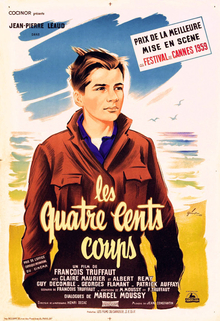
In September 1958, an advertisement appeared in the French newspaper France-soir for a thirteen year-old boy to play the lead role in an upcoming feature film, The 400 Blows. The director was known in some circles for his controversial film criticism, but had never before directed a feature. The actor eventually chosen was also an amateur, and was initially deemed too old for the part. Yet these two men, Francois Truffaut and Jean-Pierre Léaud, forged a creative partnership and friendship that would last for decades. Incidentally, they also made one of the cornerstones of cinema, a film that kickstarted the French New Wave and ushered in a new era of personal filmmaking.

Looking back today, it hardly seems possible for it to have happened any other way. Rarely has there been such a perfect harmony between actor and director, with each man's personality equally informing the character of Antoine Doinel, who evolved in four sequels. The 400 Blows, rightly, is the most admired, but none of the later Doinel films is without value, and they all play off of motifs established in the first film.

In The 400 Blows, Antoine is a 13 year-old living in Paris with a stressed-out mother and distant stepfather. Neglected at home and vilified by his teacher at school, Antoine spends much of his time wandering through Paris with his friend René - going to movies, carnival rides and parks. Due to a series of poor decisions and misunderstandings at home and school, Antoine resorts to petty crime, and is sent to a seaside camp for juvenile delinquents.

Truffaut said his goal was "not to depict adolescene from the usual viewpoint of sentimental nostalgia, but....to show it as the painful experience it is." His visual style fits the mood - the films is shot in gritty black-and-white, set in cramped apartments, crowded prisons and dirty playgrounds. But the film also captures the excitement of living in the city, the simple pleasures of going to the movies and exploring the city with friends. In one sequence, Antoine goes on a centrifugal carnival ride, and ends up suspended in midair, back against the machine as it spins around. Adults watch from a distance, but Antoine can hardly make them out. It is a striking scene, and one that emphasizes Antoine's uncertain place in the world - stuck between childhood and the world of adults who don't seem to understand him.

Then there is the final scene, one of the most famous in cinema. It shows Antoine as he escapes from his juvenile holding camp. For a few minutes, Truffaut just shows us Antoine running, as he seems to do so often in the series. Then, an exhausted Antoine sees the sea for the first time, wades into the water, and turns to face the audience. The film ends with a zoomed-in freeze frame of Antoine's face. This shot, in some ways, is a miniature of the entire film - an honest, unflinching look at adolescence, freed from all sentimentality and false artifice.

Of all the sequels, Antoine and Colette looks most like The 400 Blows, but announces a departure in terms of tone and mood. This time, Antoine is not an angsty, misunderstood adolescent but a plucky 19 year-old working at a record store in Paris. Antoine is also a regular conertgoer, and it is at one such conert that he meets Colette (Marie-France Pisier), who soon becomes the object of his affections. Antoine tries to woo her, but only manages to charm her parents.

Antoine and Colette (a 30-minute short originally made for the omnibus Love at Twenty) seems downright lightweight compared to The 400 Blows. It maintains the previous film's black-and-white photography and Parisian settings, but the tone is more comic and romantic. That does not mean it is a bad film, for it is certainly an acute and bittersweet portrayal of young love. But it is an intermediary film more than anything, and perhaps too short to fully establish itself.

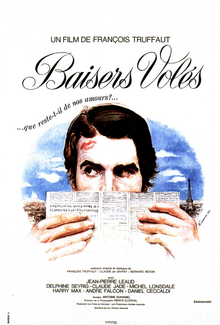
The romanticism of Antoine and Colette is taken even further in the next installment, Stolen Kisses. This time around, Antoine has been dishonorably discharged from the army, and finds himself on the streets of Paris looking for a job. He eventually finds one in a private detective agency. He also finds love, in the form of an older married woman (Delphine Seyrig) and a charming girl his own age, Christine (Claude Jade).

Stolen Kisses is light, funny, somewhat episodic and mostly irresistible. The success of the movie lies not so much in Truffaut's mise-en-scène but in the charms of the characters and script. It is also the film where Léaud, so arresting as the troubled boy of The 400 Blows, emerges as a full-fledged comedic actor. By this point in the series, you can see how the character evolved from a distillation of Truffaut's troubled childhood to a combination of Truffaut and Léaud's sensibilities. At its most basic level, though, Stolen Kisses is a skillful romantic comedy- whimsical, sentimental, slightly forgettable, but hard not to enjoy.

Bed and Board is my sentimental favorite of the Doinel series, though my perceptions of it are no dobut colored by the circumstances in which I first saw it. I saw both Bed and Board and Love on the Run as a double feature at the Brattle Theatre in Cambridge. As someone largely raised on VHS and DVD, seeing a real film print of a cinema classic is truly a thrill that cannot be replicated at home. In any case, though, there is something more about Bed and Board that makes it rise above the other Doinel sequels. The first half of the film is a domestic comedy that resembles Stolen Kisses in its episodic nature and comedic tone. Much of the film is set in a courtyard where Antoine works selling flowers; his wife Christine works as a violin tutor in their apartment a few floors above. Through a series of vigenttes, Truffaut establishes the supporting characters - a moocher who is constantly asking Antoine for money, a woman who is always hitting on him, a silent, shifty-eyed man deemed "The Strangler" by the apartment residents.

But about halfway into the movie, the tone changes as Antoine begins an affair with a Japanese woman. Up until this point in the series, the movies have relied on the natural likability of the main character. Now the empathy switches to Christine, and Truffaut portrays Antoine as a boy who refuses to grow up. In the centerpiece of the film, a separated Antoine and Christine have a passionate discussion which rapidly changes from a heated argument to a declaration of love. At one point, Christine lashes out against Antoine's desire to have everything his way. On the subject of Antoine's autobiographical novel, she says that "if you use art to settle accounts, it's no longer art." You can almost hear Truffaut's doubts in that statement; he seems to be questioning the artistic value of the entire series. At the very least, he seems fed up with playing the story for laughs, and Bed and Board briefly regains the melancholy tone that made The 400 Blows so powerful.

Consider the end of the scene. A cab arrives to take Christine into the city for a night of shopping. Before she leaves, she senses that Antoine is lonely and asks if he wants to go to a movie. After a few minutes of joking around, Christine gets in the cab and asks Antoine to kiss her, although they have already established that they will not be seeing each other. He does, and in typically melodramatic fashion declares, "You're my little sister, my daughter, my mother." Christine responds with an understated "I'd have liked to be your wife too."

This scene alone reveals what a terrific writer Truffaut was; it is an emotional rollercoaster ride in which the confused emotions of the main characters keep bubbling to the surface, threatening to obscure their best intentions to stay away from each other. It may be true, as it is frequently claimed, that by this point in his career Truffaut had abandoned the experimental, avant-garde nature of his early work for a more traditional style. But he never gave up the humanism that made his work so moving and so accessible to so many people. There are no flashy camera tricks or showy editing techniques in Bed and Board. It is purely minimalist, and extremely effective at that. All that needs to be said about Antoine's regret is shown in the shot where Christine's cab pulls away and Antoine walks down a lonely street into a brothel.

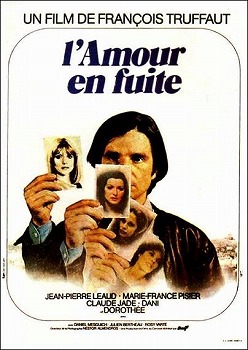
Bed and Board was originally intended to be the final Antoine Doinel film, and in retrospect it probably should have been. At times, Love on the Run seems like a clipshow; it features numerous flashbacks to all the previous films, which only makes it seems slight in comparison. It also seems altogether too tidy, with every aspect of Antoine's life coming together to create a happy ending. Finally, Love on the Run is a retreat from the serious reflection of Bed and Board, reverting back to the comedic situational comedy of Stolen Kisses.

The film is helped a great deal by the return of Colette's character; the actress Marie-France Pisier infuses the film with much-needed warmth. The style of the film is also noteworthy - the editing is quick and forceful, featuring swift cutaways and fast zooms. But the story is ultimately where the film falls apart. Antoine's love interest, Sabine, hardly establishes a personality of her own, and there is a genuine lack of new, interesting material.

Despite the final film's shortcomings, the Antoine Doinel series really is a remarkable piece of work. It is too easy to dismiss the sequels to The 400 Blows as sentimental fluff, but this is simply not the case. Watching the entire series, you can trace the evolution of Antoine Doinel not only in terms of plot, but in the sensibilities of his creators. You can also see the whole series as an examination of the fine line between adolescence and adulthood. Or you can simply get caught up in the story, in the acute feelings that Truffaut's films so effortlessly exude. No matter how you look at it, The Adventures of Antoine Doinel is a success.

Ratings (out of 4 stars)
The 400 Blows: ****
Antoine and Colette: ***
Stolen Kisses: ***
Bed and Board: ****
Love on the Run: **1/2

Monday, July 20, 2009

The Searchers (1956)


Of all the canonical classics of American cinema, few are as highly disputed as The Searchers. It has been called the "Great American Film," and a generation of filmmakers, critics, and moviegoers have imbued it with an almost mythic stature. Yet a new generation of moviegoers have questioned its reputation, focusing on its perceived racism and jarring variations in tone. I find the accusations of racism hard to fathom, though The Searchers is far from politically correct. However, The Searchers is flawed in several important ways, most of them tracing back to the script.

As the film begins, crusty Civil War veteran Ethan Edwards (John Wayne) arrives at his brother Aaron’s ranch in Texas. Shortly afterwards, a Comanche raid leaves all but Aaron’s two daughters killed. Ethan sets off with a search party to rescue the two girls, but soon all have abandoned the quest except for Ethan and Martin Pawley (Jeffrey Hunter), Aaron’s adopted son. As the years go by, the racist Ethan becomes intent upon killing the lone survivor, Debbie, believing that after years of living with Indians she is beyond saving.

This central arc of The Searchers is compelling, but unfortunately screenwriter Frank S. Nugent surrounds it with a meandering romantic subplot. In several scenes, Jeffrey Hunter and Vera Miles play out a contrived romance which only serves to distract from the main story. Nugent’s script is also flawed in its treatment of the supporting characters, most of whom are caricatures being played for laughs. The comedy often sinks quite low – in fact, a big joke is made out of a large Indian woman being kicked down a hill. The script is altogether too comic, a flaw which often undermines the film’s suspense and the film’s tone in general.

What cannot be argued with, though, is John Ford’s superb direction. Monument Valley, no doubt a stunning vista on its own, becomes even more breathtaking when filtered through Ford’s discerning camera. Few films capture so well the beauty and breadth of the natural world, along with the inherent dangers that go with it. Ford also displays his skill for choreographing exciting and suspenseful action sequences. It is no surprise to see how often the film’s shots are quoted, in films ranging from Star Wars to Lawrence of Arabia to Kill Bill.

Yet Ford’s skill does not lie only in the cinematography. He takes a rather conventional Western script and draws out universal themes like obsession and the nature of heroism. This is done completely without pretension, and Ford never seems to stretch to lofty artistic ambitions. The Searchers reveals what a master Ford is, as he simultaneously delivers an entertaining Western movie and elevates it to something far more lyrical.

Still, I cannot pretend that The Searchers is the masterpiece that so many claim. I think the film's supporters tend to ignore the buffoonery of the supporting characters and the many imperfections of the script. It is one of the landmark Westerns, no doubt (though I prefer both My Darling Clementine and The Man Who Shot Liberty Valance). But one of the greatest films ever made? That'll be the day.

Verdict: B

Wednesday, January 7, 2009

Double Feature: Grand Illusion (1937) / Paths of Glory (1957)


“Patriotism is the last refuge of the scoundrel.”
- Samuel Johnson

That line is quoted early on in Stanley Kubrick’s Paths of Glory, a brilliant World War I film about a risky mission gone wrong. But it might have just as well belonged in Jean Renoir’s Grand Illusion, an influential French film that deals with the relationships between a group of French officers in a German war camp. Although the films were made two decades apart and in different countries, the similarities are striking. Both are black-and-white World War I films about the French army, and both have strong anti-war messages. The two films tackle different realities of war, though – Paths of Glory deplores military corruption, while Grand Illusion laments the way war tears apart human relationships.

Grand Illusion is a war film without the war. There is never a single battle sequence in the film, nor should there be. The story focuses on a group of French officers who are taken as prisoners of war in a German prison camp. Among the captives are Captain de Boeldieu (Pierre Fresnay), a wealthy aristocrat, Lieutenant Maréchal (Jean Gabin), a middle-class soldier, and Rosenthal (Marcel Dalio), a Jewish banker. The men spend every night digging an underground tunnel to escape, but they are deported to another camp before they get the chance. At the new camp, the supposedly inescapable Wintersborn, they meet up with the German Captain von Rauffenstein (Erich von Stroheim), who first shot down Boeldieu’s plane. At Wintersborn, the men eventually pull off a somewhat successful escape, but not without the cost of one man’s life.

I spent much of the first half of Grand Illusion puzzled at its supposedly pacifist message. I suppose I was used to films like Saving Private Ryan, which depicts horrible conditions and sickeningly violent battles to push its message that war is hell. In contrast, the prison camp in Grand Illusion seems downright cheery. The prisoners are treated well, given large quarters, seem fairly happy, and even put on a musical show. But I began to understand that Renoir was not interested in depicting the physical horrors of war. Renoir wrote that the film was “a story about human relationships,” and it is exactly that.

The key relationship in the film is the one between Captain de Boeldieu and Captain von Rauffenstein. Von Rauffenstein is a hospitable captor – after he shoots down the plane, he invites Boeldieu to lunch before he is sent to the camp. The two captains immediately get on, discussing a mutual friend in Berlin. Later, when Boeldieu is reunited with von Rauffenstein at Wintersborg, they seem glad to see each other again, and have a conversation about what will come about after the war. It has been said that World War I was the most literary war; it was led by well-educated aristocrats. That idea runs throughout Grand Illusion, especially in the scenes with the two captains. They discuss how the age of the aristocrat is ending, and von Rauffenstein speaks of having to go on leading a “futile existence” after the war. The scenes between the two men have great poignancy, and the acting is tremendous. Apparently Erich von Stroheim spoke almost no German and struggled through his lines, but he conveys the essence of his character with facial expressions. Von Stroheim was himself a silent movie director, and no doubt realized the power of facial acting.

Another important relationship is introduced near the end of the film. Maréchal and Rosenthal have escaped, and stay with a German widow named Elsa (Dita Parlo) in the countryside. A romance blossoms between Maréchal and Elsa, even though neither can speak the other’s language. But the two soldiers have to leave for Switzerland, and Elsa breaks down crying, telling Maréchal how she has been alone for so long. These two relationships (von Rauffenstein and Boeldieu, Maréchal and Elsa) reveal the essential tragedy of Grand Illusion. Outside of war, these characters would be best friends, but war dictates that they cannot be.

If aristocratic French officers are the heroes of Grand Illusion, they are the villains in Paths of Glory. Kirk Douglas is Colonel Dax, just about the only sympathetic officer in the film. Dax’s corrupt superior officer, General Mireau (George Macready) is ordered by his superior, General George Broulard (Adolphe Menjou) to lead an attack on a well-fortified German hill. Dax insists that it is a suicide mission, but Mireau insists on the attack – mainly for the possibility of promotion. When the attack inevitably fails, Mireau blames it on cowardice, and orders 3 men to be tried under penalty of death. The trial is a sham, and despite Dax’s noblest efforts, the three innocent men are ordered to die.

Paths of Glory is a very cynical film, exposing the inherent corruption in the high ranks of the army. The battle scenes are grim, and probably more harrowing than most films of the time, but the most terrifying scenes occur “behind the scenes,” so to speak – in offices and courts. After the mission inevitably fails, Mireau calls a meeting with Colonel Dax and General Broulard. Mireau, who prides himself on being a principled patriot, initially calls for one hundred men to be killed. Broulard calms him down, eventually working the number down to three, much to Mireau’s disappointment.

The scene is disturbing because it becomes clear how cold and distant these generals are. They feel no guilt in sentencing three innocent men to death and then genially making lunch plans. Dax, meanwhile, is caught in the middle, working his best to defend the innocent men. Douglas may be more of a movie star than a great actor, but his performance in Paths of Glory is very effective. Dax is appalled at the situation, but must contain his anger during the trial. The whole film is a very quiet one. For the most part, there are no impassioned monologues, no tirades against injustice – until the penultimate scene in the film. After the execution, Broulard offers Dax Mireau’s job, implying that Dax has been aiming for promotion all along. Dax, who feels like he has been used, finally explodes, calling Broulard a “degenerate, sadistic old man” and refuses to apologize. The scene is cathartic for both Dax and the audience.

Kubrick adds an interesting tag to the end of the film. The soldiers are gathered in a bar, where a captured German woman is brought onstage to sing a folk song. The men cheer and whistle, but when she starts singing the whole place falls silent. Everyone is clearly affected, and several of the men visibly weep. It’s not clear why - maybe they are thinking of their sweethearts back home, or maybe they are just wondering how this poor woman found herself so far from home. But for a moment, the German woman and the French soldiers, so different superficially, are united in song. It is a very emotional scene, and would not have felt out of place in Grand Illusion. Indeed, I wonder if Kubrick was inspired by Renoir’s film.

Both Grand Illusion and Paths of Glory are incredibly accomplished films. Grand Illusion is by far more influential, and is widely praised as one of the greats of French cinema. But Paths of Glory is a wonderful example of studio filmmaking by a true auteur who would soon transcend it. Grand Illusion shows that a bond can exist between people who should have nothing to do with each other. In the same way, two directors from different backgrounds and countries here made two separate masterworks about the follies of war.

Grand Illusion: A
Paths of Glory: A

Saturday, January 3, 2009

Ikiru (1952)


The title of Akira Kurosawa's 1952 film Ikiru means "To Live" and it is about a man who is dying. If that sounds like a paradox, try this - Ikiru is on the surface a tragic story, but it is an optimistic and deeply life-affirming movie that never once relies on sentimentality or melodrama.

Ikiru
is the story of Kanji Watanabe (Takashi Shimura), a poor wretch of a government official who serves as the Section Chief of Public Affairs at City Hall. His wife died years ago, and although he lives with his son and daughter-in-law, they harbor no great affection for him. His life is lonely and boring, and as the narrator informs us, "This man has been dead for 20 years." One day Watanabe is diagnosed with stomach cancer, and he discovers that he has only six months to live. In an effort to make the most of his remaining life, Watanabe at first spends a night touring Tokyo's nightclubs with a stranger he meets at a bar, but he finds little happiness. Then he forms a friendship with a young co-worker, until she eventually deems him creepy. Eventually, Watanabe becomes determined to make something before he dies, focusing on turning a dirty neighborhood cesspool into a public park.

Akira Kurosawa is best known for his samurai epics, like Seven Samurai, Yojimbo, and The Hidden Fortress. But the story of Ikiru is decidedly more intimate. It proves that Kurosawa's talent extends far beyond depicting violence - he can also deliver meaningful stories about real people. Much of the credit, of course, goes to Takashi Shimura, who is perfect as Watanabe. Shimura was a well-known Japanese movie star, but he never feels like one. The movie never glorifies Watanabe - he is an ordinary, lonely man, and often seems rather pathetic. But Shimura makes him an incredibly endearing and likable character, and I felt great empathy for Watanabe.

One of the film's most moving scenes takes place in a Tokyo nightclub, where Watanabe sits alone while young couples dance happily around him. He requests that the pianist play an old love song called "Life is Brief." As the song begins, Watanabe starts to sing. All action around him stops, as everyone focuses their attention on this sad old man, who tearfully sings
"Life is brief.
Fall in love, maidens
Before the crimson bloom
Fades from your lips
Before the tides of passion
Cool within you,
For those of you
Who know no tomorrow."
Shimura's performance is magnetic in that scene. Towards the end of the song, Kurosawa focuses only on Watanabe's face, and that is all we need to see - the sad, tired old face of a man who has given up - at least for the time being.

But Ikiru is far from melancholy. There is great humor to be found throughout the film. One early scene satirizes the inefficient bureaucracy of Watanabe's workplace, as disinterested workers filter a public concern through at least a dozen different departments, accomplishing nothing. The nightclub scenes also have moments of great comedy, as Watanabe dances awkwardly with young women and looks grotesquely out of place. And there is a darkly funny scene in the doctor's waiting room, where a chatty patient unknowingly gossips with Watanabe about another patient's symptoms - the same symptoms that Watanabe is suffering from - and attributes it to stomach cancer. The film alternates between moments of great sadness and joy, much like life.

Kurosawa makes an interesting structural choice about halfway through Ikiru. As soon as Watanabe decides to build the park, the film jumps forward in time a few months to his wake, and the rest of the story is told in flashback. We see Watanabe's co-workers discuss his remarkable change in attitude, and we see his boss take credit for the construction of the park, even though the villagers insist that it was Watanabe's passion that saw the project through. Kurosawa provides no easy resolution here. Watanabe's son and daughter-in-law are heartbroken to reveal that Watanabe never told them of his sickness. The truth of Watanabe's achievement is distorted after his death. And even the few workers who claim to be inspired by Watanabe's altruism soon forget it, and go back to meaninglessly filing papers at work.

Yet Ikiru is an undeniably optimistic movie, and Watanabe's legacy lives on in his one great achievement. Interestingly, the park is never seen in full until the film's closing shot. When we finally do see it, the park is quite small, and even appears somewhat dirty. But that is part of what makes Ikiru so touching - everything about the film seems starkly realistic, and yet it still has the power to inspire. So many Hollywood endings are contrived and sugar-coated, and to see something like Ikiru is revelatory. I cannot fully explain why - that is waiting for you to discover.

Verdict: A+

Friday, November 14, 2008

12 Angry Men (1957)


With the exception of two brief scenes that bookend the film, Sidney Lumet's 12 Angry Men takes place entirely in a jury room on a sweltering summer day. In other films, such a confined setting might become tedious, or even seem more like a play than a movie. But this is not the case with 12 Angry Men. The film is so finely crafted by the director, and the cast so impeccable that it transcends its humble setting to become a memorable and lasting entertainment. 

The film begins with a quick courtroom scene, in which a bored judge addresses the jury of a murder trial before dismissing them. The case in question involves the murder of a father by his son, a juvenile delinquent who was allegedly seen and heard committing the crime. The vote must be unanimous to pass a decision either way, but it seems obvious that the defendant is guilty. But during the preliminary vote, there is one holdout - Juror No. 8 (Henry Fonda), who votes not guilty and expresses a desire to talk about the case. What follows takes place entirely within the confines of the jury room,  as Fonda presents his argument for reasonable doubt. As the debate progresses, things get heated, and the jurors' prejudices and ulterior motives are revealed.

12 Angry Men marked the directorial debut of Sidney Lumet, who went on to direct such films as Murder on the Orient Express, Network, and Dog Day Afternoon. But even from this first feature, his skill is unquestionable. It is said that as the film progresses, Lumet used different lenses and shifting camera angles to contribute to an increasing feeling of claustrophobia. This technique is fascinating,  but perhaps the most important thing about it is that the viewer hardly notices. Certainly, the tension of the film seems to increase as it goes on, but Lumet never lets any of his techniques upstage the actors. 

And what a cast he assembled! The ensemble here is truly perfect. The standout, at least for me, is Lee J. Cobb as Juror No. 3, an extremely embittered and angry man who has had something of a family tragedy. But every actor delivers solid work. E.G. Marshall as a man of pure reason and Ed Begley as an outspoken racist are just a few examples. Each of these actors gives a distinct personality to their nameless characters, and the way that those personalities collide with the other jurors is consistently fascinating to watch. Ironically enough, Fonda's Juror No. 8, the protagonist of the film, is one of the few jurors who really seems like a stock character. He is honorable and dignified but rather uninteresting, mainly serving to set the story in motion. Still, this is hardly bothersome, and one can hardly blame the screenwriter for not providing a backstory for every single character. 

12 Angry Men is the promising debut of a young director, who is now fully recognized as one of the great American filmmakers. That alone is reason enough to see it. But above all, 12 Angry Men is simply a terrific story brought to life by a brilliant cast. A true classic.

Verdict: A