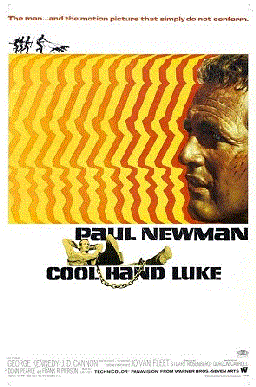
Cool Hand Luke is about a young war veteran who is forced into a chain gang for a petty crime. There, he is tormented and abused by the tyrants who run the place. By this description alone, one could safely assume that Cool Hand Luke is a tragic, gritty drama. Yet I found the film strangely optimistic, a stirring affirmation of the human spirit in the face of adversity. And who better to embody such a spirit than Paul Newman, who exudes both a tough manliness and tender humanity in the role of Luke. It is perhaps his most fondly remembered role, and not without reason. Newman is Luke, and to imagine anyone else in the role is nearly impossible.
Lucas Jackson is first arrested at the beginning of the film for cutting off the heads of parking meters (as he explains later, "Small town, not much to do in the evenin'"). For this petty crime, Luke is forced to join a chain gang for two years. His fellow convicts, particularly a character named Dragline (George Kennedy) are at first put off by his status as a war vet and his outspoken attitude. But they begin to admire him for his bravery and free spirit at the same time that the prison wardens begin to punish him for it. "What we have here is...failure to communicate," Strother Martin's Captain famously tells Luke. But what they really have is a clash of wills, a clash of ideals, a clash of attitudes that eventually leads to untold suffering for Luke.
Cool Hand Luke has a strongly anti-authoritarian message. The prison guards are, for the most part, portrayed as sadistic tyrants who are obsessed with rules. One intimidating character, referred to as the "Man with No Eyes," wears reflective sunglasses and carries a shotgun everywhere he goes. He is the symbol of authority in the film. Yet the movie never bashes you over the head with its message, and there is some moral ambiguity. When one guard is forced to put Luke in the dreaded "box" for the night, he confesses that he doesn't want to do it, but is just doing his job. This line shows that the guards may simply be acting on orders, rather than actively trying to make the convicts' lives miserable.
Cool Hand Luke also functions as a Christ metaphor. Subtlety is not the key word here, however. After the egg-eating contest, Luke lies sprawled on a table in the crucified position. Luke refers to God as "Old Man." And like Jesus, Luke is a good person who endures suffering at the hands of those who misunderstand him.
Cool Hand Luke has a strongly anti-authoritarian message. The prison guards are, for the most part, portrayed as sadistic tyrants who are obsessed with rules. One intimidating character, referred to as the "Man with No Eyes," wears reflective sunglasses and carries a shotgun everywhere he goes. He is the symbol of authority in the film. Yet the movie never bashes you over the head with its message, and there is some moral ambiguity. When one guard is forced to put Luke in the dreaded "box" for the night, he confesses that he doesn't want to do it, but is just doing his job. This line shows that the guards may simply be acting on orders, rather than actively trying to make the convicts' lives miserable.
Cool Hand Luke also functions as a Christ metaphor. Subtlety is not the key word here, however. After the egg-eating contest, Luke lies sprawled on a table in the crucified position. Luke refers to God as "Old Man." And like Jesus, Luke is a good person who endures suffering at the hands of those who misunderstand him.
There I go again, making Cool Hand Luke sound far more depressing than it really is. It is true that the story has many tragic elements, and great critics like Roger Ebert have argued that it is a deeply pessimistic movie. But I think they are missing the point. Even the sad, poignant scenes have a strong dose of humor and warmth.
Take, for example, the scene where Luke's mother Arletta (Jo Van Pleet) comes to visit. There are, of course, the moments of regret and sorrow, like when Arletta confesses to Luke how she always wanted to see him have grandchildren. But even though Arletta is close to death, her spirit is fully intact. This is no frail old woman. She sits in the back of a truck, cracking jokes, swearing, and puffing on a cigarette. She never once scolds Luke, but rather tries to enjoy the little remaining time she has with her son. Even on the tender subject of Luke's father, who apparently left years ago, Arletta finds the humor. "Your old man, Luke. He wasn't much good for sticking around, but dammit he made me laugh!"
That sort of optimism pervades the film from the start. When Luke is first arrested, he flashes a drunken grin at the officers. When he is beaten to a bloody pulp by Dragline, he determinedly keeps fighting. When he takes on the sickening challenge of eating 50 eggs in an hour, he fulfills the task with bravado. And even after he has been captured by the prison wardens for the second time, when it seems like his spirit has been broken, he flashes a weak smile. Newman has a sort of quiet strength that carries these scenes. After all that he has suffered, both physically and emotionally, Luke's spirit is intact to the end. It's all summed up perfectly by Dragline at the end of the film - "That old Luke smile. Oh, Luke. He was some boy. Cool Hand Luke. Hell, he's a natural-born world-shaker."
Verdict: A -

